
How to Get Scuff Marks Off Laminate Flooring for Good
You can usually remove scuff marks from laminate quickly by starting gentle and working up. Wipe loose dirt, try a white eraser or microfiber cloth with a baking-soda paste, then a damp melamine sponge. For stubborn marks use diluted dish soap, a laminate-safe cleaner, or a little isopropyl alcohol on a cloth, testing first. Avoid abrasive pads or heavy solvents to prevent damage. If marks persist or finish looks compromised, keep going for full step-by-step fixes and prevention tips.
Quick Answer Remove Scuff Marks from Laminate Flooring Fast
You can remove scuff marks from laminate flooring quickly with a simple household trick.
For immediate results, try a soft eraser or a microfiber cloth with a little baking soda paste as the top two methods. Both work fast and won’t damage the finish when you use gentle pressure.
One-line solution summary
Quickly erase scuff marks from laminate flooring by gently rubbing the spot with a melamine sponge or a soft cloth and a mild cleaner.
Then buffing dry to restore the finish.
If you’re asking how do you get scuff marks off of laminate flooring, test a small area first, work gently to avoid damage, and repeat as needed until the mark lifts fully.
Best 1“2 methods for immediate results
If the melamine sponge or soft-cloth method from above didn’t fully remove the mark, try these two fastest fixes that usually work immediately: rub a melamine (magic) sponge dampened with water across the scuff using light pressure, or apply a pea-sized drop of non-gel toothpaste on a soft cloth and buff the spot in small circular motions.
- Test first
- Use light pressure
- Wipe residue
- Repeat if needed
- Avoid harsh cleaners
How Scuff Marks Happen and Why They’re Different on Laminate
Scuff marks are usually either material transfer—like rubber or dirt left on the surface—or actual surface abrasion where the finish is worn away.
Laminate reacts differently than hardwood or vinyl because its wear layer is a thin, printed protective coating over fiberboard, so marks often sit on the surface and can be removed without refinishing.
If a scuff won’t lift or you can feel a groove, that’s a sign the wear layer or core is damaged and needs repair or replacement.
What scuff marks are (material transfer vs surface abrasion)
Anyone who lives with laminate floors will eventually notice dark streaks or smudges that don’t come up with a quick sweep; those are scuff marks, and they usually come in two forms: material transfer and surface abrasion.
Material transfer leaves foreign pigment from shoes or rubber on the finish and wipes away.
Surface abrasion actually scrapes or dulls the wear layer, requiring gentle buffing or repair rather than simple cleaning.
Why laminate reacts differently than hardwood or vinyl
Because laminate has a thin, printed decorative layer sealed under a clear wear coat, it reacts differently to scuffs than hardwood or vinyl does.
You’ll notice scuffs often sit on the wear layer rather than penetrating grain or compressing material. That means cleaning and gentle abrasion usually remove marks, but aggressive scraping risks removing the printed layer, causing visible loss of pattern unlike on solid wood or flexible vinyl.
When scuffs indicate deeper damage
When marks won’t come off with a cloth and mild cleaner, they can signal more than surface grime—you may be looking at wear through the clear wear layer or damage to the printed design beneath it.
If scuffs feel rough, show color loss, or reveal fiberboard beneath, stop scrubbing. You’ll need professional repair, replacement of affected planks, or consult warranty coverage to prevent moisture and further delamination.
Safe Preparations Before You Start
Before you start, gather your tools and materials — microfiber cloths, a gentle cleaner, a magic eraser, and a soft brush — so you won’t be scrambling mid-clean.
Take basic safety steps, wear gloves, and always test any cleaner on an inconspicuous spot to make sure it won’t damage the laminate.
If marks won’t budge or the floor’s finish looks compromised, call a professional rather than risking permanent damage.
Tools and materials checklist
Gathering the right tools and materials guarantees you’ll remove scuff marks efficiently and without damaging your laminate.
You’ll need simple, nonabrasive items and cleaners ready before you begin.
- Soft microfiber cloths
- Melamine sponge (like a Magic Eraser)
- Mild dish soap or laminate cleaner
- Isopropyl alcohol (70%) for stubborn marks
- Soft-bristle brush or old toothbrush
Safety precautions and testing on an inconspicuous spot
Because some cleaners and tools can dull or discolor laminate, you should always take basic safety steps and test any product on an inconspicuous spot first.
Wear gloves and eye protection, work in a well-ventilated area, and follow label instructions.
Apply a small amount of cleaner, wait a few minutes, then check for color change or finish damage before proceeding to the visible scuff.
When to call a professional instead
If testing a cleaner raises doubts—like a noticeable color shift or finish softening—or if the scuff covers a large area, deep scratches, or old damage, call a professional instead of continuing on your own.
A pro can assess underlying issues, prevent further harm, match finishes, and recommend repair or replacement.
Don’t risk DIY fixes that could void warranties or worsen the floor.
Step-by-Step Methods to Remove Scuff Marks (Progress from Gentle to Stronger)
Start with the least aggressive options and only move to stronger treatments if scuffs won’t budge.
You’ll try dry methods first, then mild cleaners, DIY remedies, laminate-safe commercial products, and finally solvents—using each one exactly as directed and rinsing or spot-testing as you go.
Follow precautions for harsher options so you don’t damage the finish.
Step 1 Dry, non-abrasive removal (eraser, broom, microfiber)
Begin with the gentlest approach: dry, non-abrasive tools remove most laminate scuffs without risking finish damage.
You’ll start by testing an inconspicuous area, then use targeted, light pressure to lift marks.
Try these tools:
- White eraser (rub gently)
- Microfiber cloth (buff in circles)
- Soft broom or dust mop
- Tennis ball (rubbed lightly)
- Pencil eraser (for small spots)
Step 2 Gentle household cleaners (water + dish soap, vinegar solution) instructions and rinse
After you’ve removed loose marks with a dry cloth or eraser, try a gentle liquid cleaner to lift stains without harming the finish.
Mix a few drops of dish soap in warm water or dilute 1 cup white vinegar in a gallon of water.
Dampen a microfiber mop, wipe scuffs in the grain direction, then rinse with clean water and dry to prevent residue.
Step 3 Common at-home remedies (baking soda paste, magic eraser) how to use safely
Now it’s time to try common at-home remedies that are slightly stronger but still safe when used correctly: a baking soda paste for mild abrasion and a melamine sponge (Magic Eraser) for stubborn marks.
Make a paste (baking soda + water), test in an inconspicuous spot, rub gently, then wipe clean.
For Magic Eraser, dampen, test first, use light pressure and rinse residue promptly.
Step 4 Commercial laminate-safe cleaners and degreasers
If the baking soda paste and melamine sponge didn’t fully remove the scuffs, reach for a commercial laminate-safe cleaner or degreaser next; these products are formulated to break down tougher residues without harming the wear layer.
Test first in an inconspicuous spot, then:
- Choose a labeled laminate-safe product
- Follow dilution instructions
- Apply with a soft cloth
- Rinse residue thoroughly
- Dry promptly to prevent streaks
Step 5 Solvents and stronger options (isopropyl alcohol, acetone) precautions and how-to
When commercial laminate-safe cleaners don’t lift stubborn scuffs, you can move to stronger solvents like isopropyl alcohol or, more cautiously, acetone.
Test an inconspicuous area first. Dampen a soft cloth, rub gently, and rinse with water.
Use gloves, guarantee ventilation, and avoid pools of solvent. Stop if finish dulls; switch to a milder method or consult manufacturer guidance.
Step 6 Polishing and blending finish after cleaning
Step 6 focuses on restoring the floor’s look after cleaning by gently polishing and blending any minor finish changes so the repaired area matches the surrounding laminate.
Use a microfiber pad and a small amount of laminate polish or paste wax, buffing in circular motions.
Feather edges into the surrounding surface, wipe residue, and inspect under natural light.
Repeat lightly until sheen matches.
Comparison of Methods Effectiveness, Safety, and When to Use Each
You’ll find a quick comparison table below that lays out each method, its pros and cons, and which scuff types it handles best.
Use gentler options first to protect the finish, and step up only if marks persist.
The table will help you pick the safest, most effective approach for light surface smudges versus deeper rubber or shoe scuffs.
Quick comparison table of methods, pros/cons, best for types of scuffs
Here’s a quick comparison to help you pick the best method for removing scuff marks from laminate flooring:
| Method | Pros / Cons | Best for |
|---|---|---|
| Eraser | Gentle, cheap / can rub finish | Light pencil scuffs |
| Baking soda paste | Effective, non-toxic / needs rinsing | Sticky or greasy marks |
| Magic eraser | Powerful / may dull finish if overused | Stubborn rubber scuffs |
Common Scuff-Related Problems and Mistakes to Avoid
Don’t grab abrasive pads or steel wool—you’ll scratch the laminate instead of removing scuffs.
Don’t overuse solvents or harsh cleaners, and be careful with rinsing so you don’t leave residue or streaks.
Never try sanding or refinishing laminate yourself, since it’s not designed for that treatment.
Using abrasive tools that scratch the surface
Scrub carefully: reaching for steel wool, metal scrapers, or coarse brushes might seem like a quick fix, but those abrasive tools will leave fine scratches that dull laminate’s protective finish and make future scuffs harder to remove.
Instead, use soft microfiber, a gentle eraser sponge, or a plastic scraper. Test in an inconspicuous spot and work slowly to preserve the surface.
Overusing solvents that damage finish
If abrasive tools can etch the finish, overusing solvents can strip it away altogether — and it’s easy to go too far when you’re trying to remove a stubborn mark.
You should test any cleaner in an inconspicuous spot, dilute harsh products, and limit contact time.
Don’t repeatedly apply solvents; instead use gentle cleaners, a soft cloth, and stop when the scuff lifts to protect the wear layer.
Rinsing mistakes that leave residue or streaks
Anyone can leave streaks or a filmy residue by rinsing the floor poorly after cleaning, so you should pay attention to water temperature, detergent amounts, and drying technique.
Use lukewarm water, dilute cleaners per label, and change rinse water when dirty.
Wring mops well, rinse microfiber pads frequently, and dry with a clean towel or fan to prevent streaks, residue buildup, and attract dust.
Trying to sand or refinish laminate improperly
After rinsing properly, you might be tempted to take more drastic action on stubborn scuffs—but sanding or refinishing laminate is a bad idea.
Laminate has a thin wear layer; sanding ruins the printed surface and voids warranties. Don’t use abrasive pads, grinders, or heavy solvents.
Instead, try targeted cleaners, magic erasers gently, or replace damaged planks to restore appearance without causing irreversible damage.
Prevention and Long-Term Care to Keep Scuffs Away
To keep scuffs from coming back, you’ll want a simple daily care routine and a clear maintenance schedule for seasonal and high-traffic zones.
Use protective products like floor mats, felt pads, and furniture glides to prevent wear before it starts.
With a few quick habits—sweeping daily, spot-cleaning spills, and checking pads monthly—you’ll cut down scuffs long-term.
Best practices for daily care and cleaning routines
A simple daily routine will keep scuffs from building up on your laminate:
- Sweep or vacuum high-traffic areas each day.
- Spot-clean spills immediately with a damp microfiber cloth.
- Use a pH-neutral laminate cleaner once weekly.
- Dry floors thoroughly to prevent swelling or streaks.
- Inspect shoes and debris at entryways daily to remove grit before it scratches.
Protective products (floor mats, felt pads, furniture glides)
When you place quality floor mats at entryways and sticky-backed felt pads under chair legs, you stop grit and furniture movement from ever contacting your laminate surface.
Use protective products wisely to prevent scuffs long-term:
- Heavy-duty entry mats for outside shoes
- Non-slip rug pads to trap dirt
- Felt pads on all chair and table feet
- Plastic or nylon glides under sofas
- Furniture cups for castors
Seasonal and high-traffic area strategies
Because traffic and seasons change how dirt and moisture behave, you should tailor prevention to peak wear times and busy spots: place durable mats at entrances, swap to heavier-duty runner rugs in winter, rotate furniture occasionally to spread wear, and limit outdoor grit with shoe removal or a wipe-off station.
Inspect high-traffic zones weekly and replace pads or rugs as they show wear.
Recommended maintenance schedule
Set a simple, consistent maintenance schedule you can stick to—weekly sweeping, monthly damp mopping with a laminate-safe cleaner, and quarterly inspections of rugs, pads, and furniture glides will keep scuffs from forming.
Rotate high-traffic rugs seasonally, replace worn pads immediately, and trim pet nails regularly. Address spills promptly and schedule an annual deep check to catch wear before it causes permanent marks.
Tools and Products Recommended (What to Buy and Why)
You’ll want a mix of budget-friendly essentials like microfiber cloths, a soft rubber eraser, and a gentle laminate cleaner for everyday scuffs.
If you’re tackling stubborn marks or large areas, consider professional-grade products such as concentrated cleaners and nonabrasive buffing pads.
Avoid abrasive powders, steel wool, or oil-based polishes that can damage laminate finishes.
Budget-friendly essentials
When you’re tackling scuff marks on laminate, a few inexpensive, purpose-built items will save time and prevent damage:
- microfiber cloths — gentle, reusable, lift residue
- melamine sponge — light abrasion for stubborn marks
- rubbing alcohol or white vinegar — spot-cleaning solution
- non-gel toothpaste — mild abrasive for small scuffs
- soft-bristled brush — get into grooves without scratching
Professional-grade options
For tougher scuffs and larger areas, invest in a few professional-grade tools—an orbital buffer with a soft pad, a laminate-safe restoration polish, and a commercial melamine or micro-abrasive block will get better, more consistent results than household remedies.
- Orbital buffer (soft pad)
- Laminate-safe restoration polish
- Commercial melamine block
- Micro-abrasive sponge
- Soft microfiber pads and applicators
What to avoid buying for laminate
Those professional tools are worth having, but you also need to steer clear of items that can damage laminate or waste money.
Don’t buy abrasive pads, steel wool, or harsh scrubbing brushes that scratch. Avoid oil-based polishes, waxes, bleach, and ammonia cleaners that leave residue or strip coatings.
Steer clear of steam mops and overly alkaline cleaners that lift seams or delaminate planks.
When Scuffs Mean Replacement or Repair Is Needed
If a scuff has gouges, deep scratches, or warping that don’t buff out, you’ll need to evaluate repair or replacement instead of cleaning.
Small localized damage can often be fixed with plugs or a matching replacement plank, while widespread or swollen boards usually require replacing multiple planks.
Expect repair costs to range from a few dollars for a patch to $50–$150 per plank for DIY replacement or $100–$300+ per plank installed, depending on materials and labor.
Signs scuffs have become permanent structural damage
When scuffs go beyond surface marks and start gouging or delaminating the laminate, you’re looking at damage that won’t come out with cleaning alone and likely needs repair or replacement.
Check for deep scratches that catch your fingernail, lifted or bubbling wear layer, exposed core material, permanent discoloration, or moisture-warped seams.
These signs indicate structural compromise rather than removable scuffing.
Repair options (plugs, replacement planks) and estimated costs
Because scuffs that cut into the laminate’s core or lift the wear layer won’t come out with cleaners, you’ll need to weigh repair options like filling small gouges with colored wood-plug kits or replacing individual planks for more extensive damage.
Choose based on damage, skill, and budget.
- Small gouges: plug kits, $10–$30
- Deep chips: epoxy, $15–$40
- Single plank: $30–$100
- Professional replace: $100–$300
- Full floor: varies, $3–$8/ft²
FAQ
You’ve probably got quick questions like whether a magic eraser is safe, if toothpaste or baking soda will harm the finish, or how often to deep clean to prevent scuffs.
You might also wonder if scuffs can be buffed out without special tools and whether certain cleaners could void your warranty.
Below are concise answers to those common concerns.
Can you use a magic eraser on laminate flooring?
Curious if a magic eraser will safely remove scuff marks from your laminate floor? You can, but use light pressure and test in an inconspicuous spot first.
Magic erasers are mildly abrasive and can dull finish if you scrub hard or use them often. Wipe residue away with a damp cloth and dry the area to prevent moisture damage.
Will toothpaste or baking soda damage my laminate?
Wondering if toothpaste or baking soda will harm your laminate? Mild, non-gel toothpaste and a light paste of baking soda and water usually won’t damage laminate if you rub gently and rinse thoroughly.
Avoid abrasive scrubbing, powdered cleaners, or strong bleach. Test a small, hidden area first.
Wipe dry to prevent moisture seeping into seams and causing swelling or warping.
How often should I deep clean laminate to prevent scuffs?
Because regular care prevents buildup that leads to scuffs, you should deep clean high-traffic laminate areas about every 1–3 months and the whole floor every 3–6 months, adjusting for foot traffic, pets, and dirt levels.
Spot-clean spills immediately, sweep or vacuum weekly, and use a damp mop with a laminate-safe cleaner during deep cleans to remove grit that causes surface abrasion.
Can scuff marks be buffed out without professional tools?
Yes—you can often buff scuff marks out of laminate without professional tools using items you probably already have at home.
Use a soft cloth or microfiber pad with a gentle cleaner or plain water, rub in small circular motions, and apply light pressure.
For stubborn marks, try a pencil eraser or baking soda paste, then wipe clean and dry to restore the finish.
Are there cleaners that will void my laminate warranty?
Buffing out scuffs at home is great, but you should also watch what you clean with—some products can void your laminate warranty.
Check your warranty terms and avoid abrasive cleaners, waxes, polishes, or oil-based products not explicitly approved.
Use manufacturer-recommended cleaners or mild soap and water.
If in doubt, contact the flooring maker—using unapproved chemicals could negate coverage for damage.
Visual Guide and Quick Reference
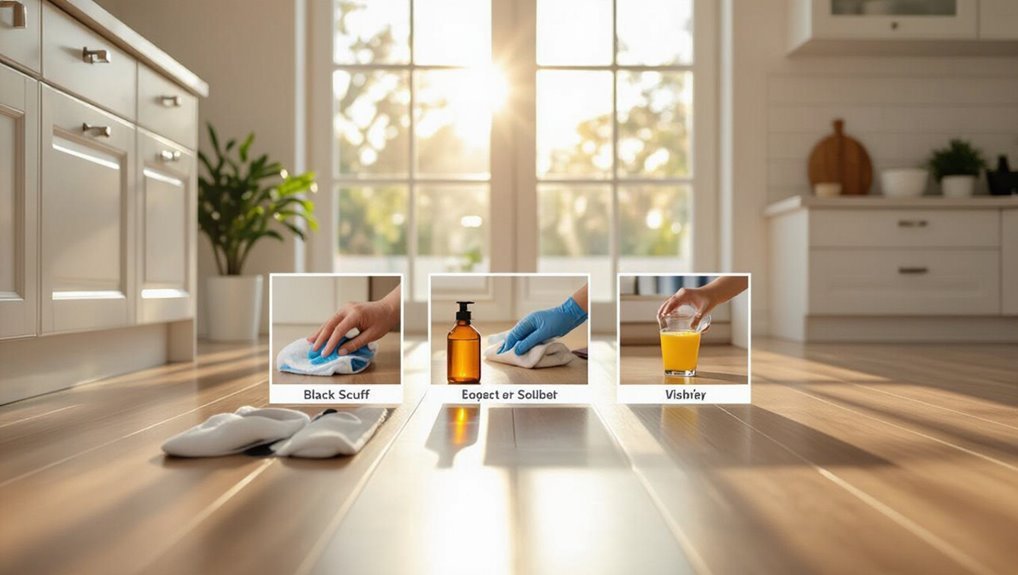
Want a fast way to identify scuff types and the best fixes? Use this quick visual guide:
light marks — try a clean microfiber and water;
stubborn rubber scuffs — use a pencil eraser or baking soda paste;
ink or grease — apply isopropyl alcohol sparingly;
deep scratches — consider laminate repair kits.
Follow each fix with a gentle rinse and dry to protect the finish.
