How to Install Floor Joists Correctly for a Strong, Level Subfloor
You’ll start by planning layout, joist size, spacing, and support per local code, then inspect and prep the rim, ledger, and foundation for level and sound bearing. Snap chalk lines at standard centers (commonly 16″), set crowns up, use hangers or toe-nails, and fasten with specified nails or screws. Add blocking, bridging, or sisters where needed, shim or plane for level, and apply adhesive before subflooring. Keep going for detailed steps, tips, and troubleshooting.
How to Install Floor Joists Correctly for a Strong, Level Subfloor
You’ll start with a quick answer: measure, layout, install joists to proper spacing, and check levels as you go.
Follow the core steps—secure ledger or beam, notch or hang joists correctly, and sister or brace where needed—to get a strong, level subfloor.
If joists are rotten, split, or severely warped, replace them; for minor damage you can repair or sister to restore strength.
Quick Answer The Core Steps at a Glance
Start by laying out a clear plan: measure the span and spacing, mark the rim joists and sill plate, and determine joist length and direction so each piece fits snugly and transfers load to the supports.
You’ll follow these core steps to learn how to install floor joists quickly and safely:
- Layout and measure accurately
- Cut and seat joists with proper hangers
- Check level and secure bracing
When to Replace vs. Repair Existing Joists
When inspecting existing joists, weigh the extent of damage against the cost and effort of replacement so you can decide whether patching, sistering, or full replacement makes the floor safe and level.
You’ll repair minor rot, sister compromised joists for added strength, or replace when structural integrity’s lost.
Consider:
- Extent: localized vs. widespread damage
- Load: expected weight and usage
- Cost: materials, labor, long-term value
Basic Understanding What Floor Joists Are and Why Proper Installation Matters
You’ll learn that floor joists are the horizontal framing members that support your subfloor and transfer loads to the foundation.
You’ll compare common materials—like dimensional lumber, engineered lumber, and steel—and their trade-offs in strength, cost, and moisture resistance.
You’ll also need to understand load, span, and deflection limits so your joist layout keeps the floor strong and level.
Definition and Roles of Floor Joists
Think of floor joists as the skeleton of any floor: they’re the horizontal structural members that carry the weight of your flooring, furniture, and people to the foundation or supporting walls.
You’ll use joists to span openings, resist bending and twisting, and create a flat plane for subflooring.
Proper layout, spacing, and secure connections keep floors level, quiet, and safe over time.
Common Joist Materials and Their Pros/Cons
Although several materials can serve as floor joists, each brings distinct strengths and trade-offs you should weigh for load, span, moisture, and budget.
| Material | Pros | Cons |
|---|---|---|
| Solid lumber | Affordable, easy to cut | Susceptible to rot/warp |
| Engineered LVL | Stable, long spans | Costlier |
| Steel | Very strong, slim profile | Prone to corrosion, needs flashing |
| Glulam | Custom lengths, durable | Higher cost |
Load, Span, and Deflection Basics Every Installer Should Know

Now that you know the pros and cons of common joist materials, you need a working grasp of load, span, and deflection because they determine which material and size will actually perform on your job.
Calculate dead and live loads, check span tables, and limit deflection (commonly L/360).
Choose joist species, depth, and spacing to meet loads while minimizing bounce and preventing structural or finish damage.
Preparation Planning, Measurements, and Required Tools & Materials
Before you cut or set a single joist, walk the site to inspect the foundation, rim joist, and subfloor and note any repairs or out-of-square conditions.
Then calculate joist size, spacing, and maximum span using local codes and common span tables, and make a checklist of required tools, fasteners, and hardware.
Finally, review safety gear and permit requirements so you won’t be stopped by inspections or unsafe conditions.
Assessing the Site: Inspecting Foundation, Rim Joist, and Subfloor
Start by walking the perimeter and inside the structure to get a clear picture of the foundation, rim joist, and subfloor conditions; you’ll be checking for levelness, rot, cracks, settling, and any previous repairs that could affect new joist layout.
Note drainage, moisture sources, and pest damage. Measure clearances, verify solid bearing points, document compromised areas, and plan repairs before joist installation.
Calculating Joist Size, Spacing, and Span (Codes and Practical Rules)
Sizing joists correctly means balancing code requirements, expected loads, and practical site conditions so your floor will be safe and level. You’ll calculate span tables, choose species/grade, and set spacing (12″, 16″, 24″) to control deflection. Verify live/dead load and local code spans before cutting.
| Factor | Action |
|---|---|
| Load | Check live/dead values |
| Spacing | 12″,16″,24″ choices |
| Span | Use code table |
Tools, Fasteners, and Hardware Checklist
Preparation is key: gather the specific tools, fasteners, and hardware you’ll need so you won’t stop midway for a missing part.
Verify measurements, joist sizes, and quantities, then collect quality materials.
- Circular saw, speed square, tape measure, chalk line, framing nailer
- Joist hangers, hurricane ties, rim board connectors, galvanized nails/screws
- Construction adhesive, shims, temporary supports and safety glasses
Safety Precautions and Permit Considerations
Before you cut or lift a single joist, confirm that your project meets local building codes and that you’ve planned safety measures for every step: secure permits, know load requirements, and set up fall protection and temporary bracing.
Wear PPE, use proper lifting techniques, and keep a clear work area.
Verify utility locations, follow permit conditions, and document inspections to avoid delays or costly corrections.
Step-by-Step Installation From Layout to Finishing
Start by laying out and marking each joist location so you can cut and position members accurately.
Next you’ll install ledger and rim boards, cut joists to length with the correct allowances and crown orientation, then set and fasten them using nails, toe-nailing, or joist hangers as appropriate.
Finish by adding blocking, bridging, and other stiffening measures to lock the system together.
Step 1 Layout and Marking the Joist Locations

1. You’ll begin by measuring the room and establishing a straight reference line across the sill plate.
Snap chalk lines at standard joist spacing (typically 16″ on center), transfer marks to rim plates and floor plates, and mark beam locations.
Label each joist position and note any openings.
Verify layout with a square and recheck measurements before cutting or fastening.
Step 2 Installing Ledger Boards and Rim Joists
Now you’ll fasten the ledger boards and rim joists that will support the floor framing, working from your layout marks to guarantee everything aligns and bears properly.
Secure ledgers to solid framing with appropriate structural screws or through-bolts, using shim where needed for level.
Attach rim joists to ledger ends, toe-screw or bolt at studs, and verify squareness before final fastening.
Step 3 Cutting and Preparing Joists (allowances, crown orientation)
With ledger boards and rim joists secured, you’ll move on to cutting and prepping the floor joists so they fit your layout and carry loads correctly.
Measure span, add any bearing and trimming allowances, and mark cuts accurately.
Identify each joist’s crown and orient crowns upward to minimize deflection.
Pre-drill holes for later fastening and label joists for their exact positions.
Step 4 Setting and Fastening Joists (nailing, toe-nailing, joist hangers)
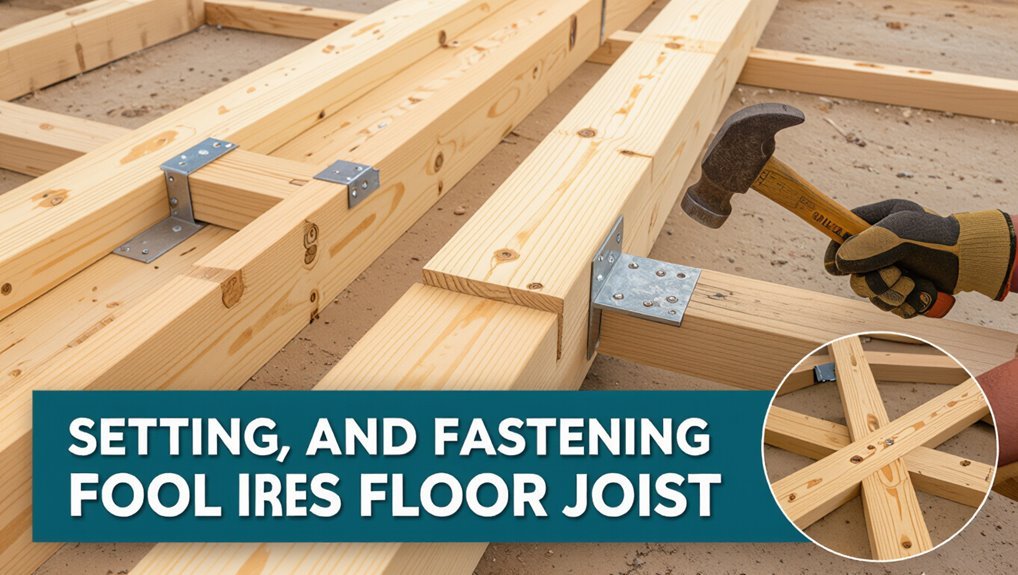
Begin setting joists by placing each member on its layout line, bearing it fully on the rim or ledger and checking that crowns face upward; align ends, shim if needed, then fasten.
Use joist hangers where specified, install hanger nails or screws per manufacturer, and toenail joists at ends when hangers aren’t used.
Space nails properly and stagger fasteners to prevent splitting for a secure, level frame.
Step 5 Blocking, Bridging, and Stiffening Techniques
After the joists are set and fastened, you’ll add blocking, bridging, and other stiffening members to lock the system together and reduce bounce and twisting.
Fit solid blocks at supports and midspan where loads concentrate, stagger blocks for continuous lines, and install cross-bridging or metal straps every 8–10 feet.
Secure with nails or screws; guarantee tight, flush fits for effective load transfer.
Step 6 Checking Level, Straightness, and Squareness During Installation
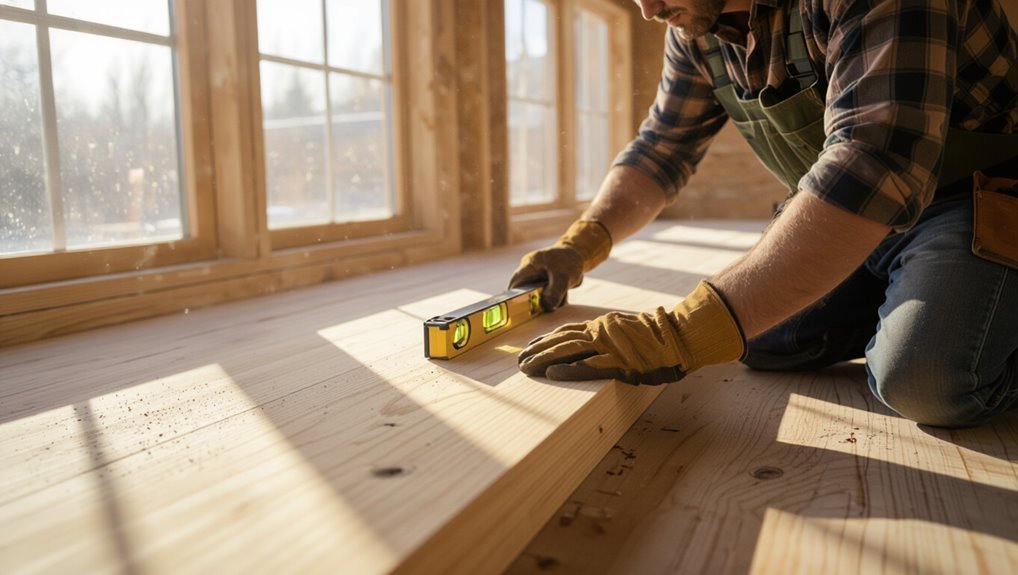
Step 6 is when you stop guessing and verify the joist system is truly level, straight, and square—because small errors now will amplify as you finish the floor.
Use a long level and laser to check crown and run, string lines for alignment, and a framing square at corners.
Shim, sister, or plane joists as needed, then recheck before proceeding.
Step 7 Installing Subfloor Over Joists (adhesive, screw patterns, staggered seams)
Lay the subfloor panels perpendicular to the joists and glue each panel edge before fastening so you get a stiff, squeak-free floor; use construction adhesive along joist lines, stagger panel seams at least two joists apart, and follow the manufacturer’s screw or nail pattern (typically screws every 6–8 inches at panel edges and 12 inches in the field) while keeping a 1/8-inch gap at panel ends for expansion.
Cut panels as needed, align seams over joists, fasten with screws, check for flatness, and clean adhesive squeeze-out before proceeding.
Step 8 Final Inspection and Load Testing
Now it’s time to inspect the joists and subfloor closely and perform basic load testing to confirm the assembly is safe, flat, and free of squeaks.
You’ll check fasteners, adhesive bonds, alignment, and deflection under a controlled load so any issues can be fixed before finishing.
Walk the floor, mark soft spots, retighten screws, reseat adhesive gaps, and apply platform loads while measuring deflection to verify performance.
Supporting Guidance Variations and Special Situations
You’ll encounter different support needs depending on whether you’re spanning a crawlspace or a basement, and you’ll use different techniques for engineered I-joists and open-web trusses.
If you’re reinforcing a sagging floor or adding joists to increase capacity, you’ll follow specific fastening and blocking patterns.
For uneven or sloped foundations, you’ll need to plan shimming, sistering, or adjustable supports to restore level and load transfer.
Installing Joists Over Crawlspaces vs. Basements
When you’re deciding whether to run joists over a crawlspace or a full basement, the key differences are in support points, moisture control, and access for future repairs.
Over a crawlspace, you’ll need more ventilation, treated sill plates, and closer support posts;
over a basement, you can span longer between supports but must coordinate with masonry bearing walls and guarantee moisture barriers and easy access for utilities and inspections.
Working with Engineered I-Joists and Open-Web Trusses
1 key difference with engineered I-joists and open-web trusses is that they require job-specific handling and fastening details you can’t treat like solid-sawn joists; you’ll follow manufacturer span charts, avoid concentrated nailing, and use specified hangers and blocking.
Protect flanges from crushing, cut only where allowed, and coordinate mechanical runs so you don’t compromise shear webs or void warranty coverage.
Adding Joists for Floor Reinforcement or to Correct Sagging
Adding one or more joists can be the quickest way to stiffen a sagging floor or bolster an overloaded span. However, you should first assess loads, framing layout, and access so you pick the right size, spacing, and connection method.
Sister joists, intermediate supports, or blocking can work; use proper fasteners, hangers, and blocking to transfer loads.
Verify level, deflection limits, and finish-floor clearances.
Dealing with Uneven or Sloped Foundations
If your foundation isn’t level or is built on a slope, you’ll need to adjust joist layout and support strategy to match changing bearing heights and load paths.
Shim, sister, or pack joists to achieve correct top-of-joist elevations, and add posts, stingers, or engineered beams where spans increase.
Check drainage and soil stability, and consult an engineer for significant grade variations or structural concerns.
Common Mistakes and How to Avoid Them
Watch for a few common mistakes that’ll compromise strength and longevity: incorrect spacing or undersized joists, poor fastening and missing blocking, and neglecting moisture, ventilation, or termite protection.
Don’t forget to check that joists are level and oriented with the crown up before you secure them. Addressing these issues early saves time and prevents costly repairs.
Incorrect Joist Spacing or Undersized Joists
Because joist spacing and sizing determine how a floor carries load, getting them wrong leads to sagging, bounce, or structural failure.
You should follow span tables, account for load type and deflection limits, and never exceed manufacturer specs.
If unsure, increase joist depth or decrease spacing.
Use proper timber grade or engineered joists and consult an engineer for long spans or heavy loads.
Poor Fastening Practices and Inadequate Blocking
When joists aren’t nailed, screwed, or blocked correctly, the whole floor can shift, creak, or fail under load; you should fasten to manufacturer and code specs and install blocking where required to keep joists aligned and share loads.
Use correct fasteners, stagger screw patterns, drive nails fully, and fit solid blocking or cross bracing at supports and spans so load transfers and vibration stop.
Ignoring Moisture, Ventilation, and Termite Protection
Proper fastening and blocking keep joists stable, but they won’t protect the structure from moisture, poor airflow, or pests—issues that quietly ruin floors over time.
You should install vapor barriers, guarantee crawlspace and ventilation openings meet code, grade exterior soil away from sill plates, and apply appropriate termite treatments or physical barriers.
Regular inspections catch leaks, mold, and early insect activity before damage spreads.
Failing to Check for Level and Proper Crown Orientation
If you skip checking that joists are level and oriented with their crowns up, you’ll end up with bouncy spots, uneven floors, and joint stress that shortens the structure’s life.
Always crown joists up, use a long level or laser to verify run, shim or pack low spots, and re-sister warped members.
Mark crown direction and recheck after fastening to maintain a true, stable subfloor.
Best Practices, Tips, and Long-Term Maintenance
To keep your floor system durable and quiet, follow recommended fastening patterns, use construction adhesives where specified, and stagger connections to reduce squeaks.
Control moisture with proper drainage, vapor barriers, insulation, and crawlspace or attic ventilation to prevent rot and mold.
Inspect joists periodically for deflection, decay, or fastener failure and reinforce or replace members as soon as you spot persistent sagging or damage.
Best Practices for Durable, Quiet Floors (fastening patterns, adhesives)
When you lay out fastening patterns and choose adhesives, think about stopping squeaks before they start and keeping the assembly stiff for decades; consistent screw spacing, strategic glue application, and attention to bearing points are the foundations of a durable, quiet floor.
Use screws at regular intervals, apply construction adhesive along joist tops, stagger joints, and tighten fasteners snugly without overdriving to prevent movement.
Moisture Control, Insulation, and Ventilation Tips
Because moisture and air movement quietly determine a floor’s lifespan, you should plan control, insulation, and ventilation together rather than treating them as separate tasks.
Seal gaps and rim joists, install a vapor barrier where required, insulate between joists with appropriate batts or rigid foam, and provide balanced ventilation to prevent condensation.
Monitor humidity and address leaks promptly to protect subfloor integrity.
Periodic Inspections and When to Reinforce or Replace Joists
Although joists are out of sight, you should inspect them regularly for signs of sagging, rot, insect damage, fastener failure, or excessive deflection; catching problems early lets you reinforce rather than replace and saves time and money.
- Check twice yearly and after floods or leaks.
- Measure deflection and probe for rot or pests.
- Reinforce with sistering or add blocking; replace only when compromised beyond repair.
Tools and Materials Comparison (Quick Reference)
You’ll choose between solid lumber and engineered joists based on span, load, and budget, and you’ll pick fasteners that match your materials and local code.
Decide whether joist hangers, a ledger, or bearing on a wall gives the best support for your layout, ease of installation, and moisture exposure.
Below we’ll compare pros and cons and list recommended fasteners for each option.
Lumber Types, Engineered Joists, and Fastener Options
Start by matching the joist material to your span, load, and budget: traditional dimensional lumber works for short spans and DIY budgets, engineered I-joists and LVLs give longer, straighter spans with less deflection, and metal web or steel joists suit heavy loads or open runs—so pick the type that meets your structural needs and then choose fasteners rated for that material and environment.
| Joist Type | Fastener |
|---|---|
| Dimensional lumber | Nails/screws, galvanized |
| I-joists/LVL | Joist screws, adhesive |
| Metal web/steel | Self-drilling screws, bolts |
Joist Hangers vs. Ledger vs. Bearing on Wall Pros and Cons
Once you’ve matched joist material and fasteners to span and load, pick the support method that fits your site and skill level: joist hangers, ledgers, or bearing on a wall each change how loads transfer, what tools you need, and how you protect against moisture and pests.
| Option | Quick pro/con |
|---|---|
| Hangers | Easy install, metal corrosion risk |
| Ledger | Strong continuous support, needs flashing |
| Bearing | Simple, durable, requires precise bearing wall |
| Hybrid | Combine methods for access or retrofit |
Troubleshooting Diagnosing and Fixing Specific Problems
When you run into sagging floors or bouncy spots, start by locating the affected joists and testing for movement and deflection.
Check for uneven subfloor, gaps between joists, rot, insect damage, or localized failures so you can decide whether to sister, reinforce, replace, or patch.
I’ll walk you through simple diagnostic steps and targeted fixes for each problem.
Fixing Sagging Floors and Bouncy Spots
If your floors feel springy or you notice dips in certain areas, you’ll want to pinpoint whether the issue is a localized joist problem, a subfloor failure, or settlement of the foundation.
Diagnosing the cause lets you pick the right fix—sistering joists, adding blocking, jacking and shimming, or replacing damaged members—so you don’t waste time repairing the symptom instead of the source.
Inspect joists for rot, nails, and splits; probe subfloor adhesion.
Sister weakened joists with full-length lumber, install blocking at midspan, tighten loose fasteners, and use controlled jacking with shims to restore level.
Replace severely damaged members and recheck for springiness before reinstalling finish flooring.
Addressing Uneven Subfloor and Gaps Between Joists
Because uneven subfloors and wide gaps between joists can lead to noisy, unstable floors and finish failures, you’ll want to diagnose and address them methodically before laying new flooring.
Check joist spacing and level with a long straightedge, shim low spots, sister or sister-span shortfalling joists for stiffness, and install bridging or blocking to distribute loads.
Re-screw or add subfloor panels to eliminate movement.
Repairing Rot, Insect Damage, and Localized Failures
Although rot and insect damage can start small, they’ll quickly undermine joist strength and transfer problems to your finished floor.
So you need to find and fix affected areas before you continue. Inspect thoroughly, probe soft spots, and remove compromised wood.
Sister new joists or splice with treated lumber, using proper fasteners and adhesive.
Treat surrounding timber and guarantee ventilation to prevent recurrence.
FAQ Common Questions About Installing Floor Joists
You’ll find answers here to common questions like joist spacing for typical residential floors and whether engineered I-joists can replace solid lumber.
I’ll also cover how to calculate joist span for your load, when to use hangers versus bearing on a wall, and the signs that joists need reinforcement or replacement.
If you have a specific scenario or measurement, mention it and we’ll go over the right approach.
How far apart should joists be for typical residential floors?
Most residential floor joists are spaced either 16 inches or 24 inches on center, with 16 inches being the common choice for living areas because it gives stronger support and reduces floor deflection.
You should follow local codes and consider span tables: shorter spans can use 24-inch spacing, longer spans need 16-inch or closer.
Also factor in subfloor thickness and anticipated loads.
Can I use engineered I-joists instead of solid lumber?
If you want stronger, straighter joists that use less wood, engineered I-joists are a great alternative to solid lumber for many residential floors.
You’ll get consistent dimensions, reduced warping, and longer clear spans.
Install per manufacturer instructions, use approved hangers and blocking, and protect flanges from cutting.
Check load ratings and local code acceptance before choosing I-joists for your project.
How do I determine the correct joist span for my load?
How far can your joists span depends on the load they must carry, the species and grade of lumber (or engineered I-joist), joist size and spacing, and local code requirements.
Check code span tables or manufacturer charts for live and dead loads, then match joist size/spacing.
For unusual loads or long spans, consult a structural engineer to verify deflection limits and safety.
When are joist hangers required versus bearing on a wall?
When joists run into a supporting wall, you can either have them bear directly on a wall plate or hang them with metal joist hangers.
The choice depends on load path, bearing depth, moisture exposure, and code requirements.
You should bear joists where full bearing (typically 1½–3 inches) is available and moisture is controlled; use hangers for rim conditions, minimal bearing, ledger connections, or when codes demand.
What are signs that joists need reinforcement or replacement?
Curious whether that creak or sag means trouble? Look for sagging floors, uneven surfaces, wide gaps at seams, bouncy or noisy spots, and visible cracks, rot, insect damage, or split/fractured joists.
Measure excessive deflection or sag between supports. If joists are compromised, warped, or undersized for load, reinforce with sistering, add blocking, or replace damaged members to restore stiffness and safety.