Does Laminate Flooring Expand and How Do You Prevent Buckling?
Yes — laminate expands with humidity and temperature, but serious buckling’s rare if you install it right. You’ll need to acclimate boards 48+ hours, check subfloor moisture, and keep indoor humidity around 35–55%. Leave manufacturer-specified expansion gaps at walls and around fixtures, use proper underlayment, and fit connector strips where needed. Fix spills and leaks promptly and don’t force planks tight. Follow these steps and you’ll avoid most problems; keep going to learn practical tips and repairs.
Does Laminate Flooring Expand and How Serious Is Buckling?
Yes — laminate will expand a bit with humidity, but serious buckling is uncommon if you left proper expansion gaps.
Watch for persistent gaps at seams, boards popping up, or visible warping—those are signs you should worry and act.
Small seasonal movement is normal, but sudden or severe lifting needs prompt repair to prevent bigger damage.
Short direct answer
Because laminate is a floating floor, it will expand and contract with humidity and temperature changes. If you don’t allow for that movement or control moisture, the boards can buckle—sometimes mildly and repairable, sometimes severely enough to require replacing sections.
In short: yes, does laminate flooring expand; small movement is normal, but unchecked moisture or no expansion gaps can cause serious buckling that needs repair or replacement.
When to worry signs of dangerous expansion vs normal movement
When you spot slight gaps or tiny cupping along seams, that’s usually normal seasonal movement you can monitor; worry starts when the floor shows persistent buckling, large ridges, or boards separating and refusing to settle back.
If you see lifting edges, popping noises, or door binding that worsens, act quickly: relieve moisture, check expansion gaps, and call a pro before repair becomes costly.
How Laminate Flooring Works: Basic Understanding
Laminate flooring is made of layered materials—usually a dense fiberboard core, a decorative printed layer, and a tough wear layer—that you click together into floating boards.
Those boards absorb and release moisture and respond to temperature changes, so they can slightly expand or contract at the seams.
Because engineered cores are dimensionally stable but not immune, you’ll need to allow expansion gaps and control humidity to prevent buckling.
What laminate flooring is made of
Think of laminate flooring as a carefully layered sandwich: a tough wear layer on top, a high-resolution printed design that mimics wood or stone, a dense fiberboard core that gives stability, and a backing layer that resists moisture and keeps the planks flat.
You’ll also find melamine resins bonding layers, sometimes added texture for realism, and beveled edges for interlocking installation.
How boards interact with moisture and temperature
Wood planks expand and contract as they absorb or release moisture and heat, and laminate boards behave similarly because their fiberboard core swells with moisture while the wear layer and backing resist that movement.
You should monitor indoor humidity and temperature, use acclimation before installation, keep spills wiped, and maintain HVAC settings so boards stay stable.
Proper gaps let panels move without buckling.
Natural expansion/contraction properties of engineered boards
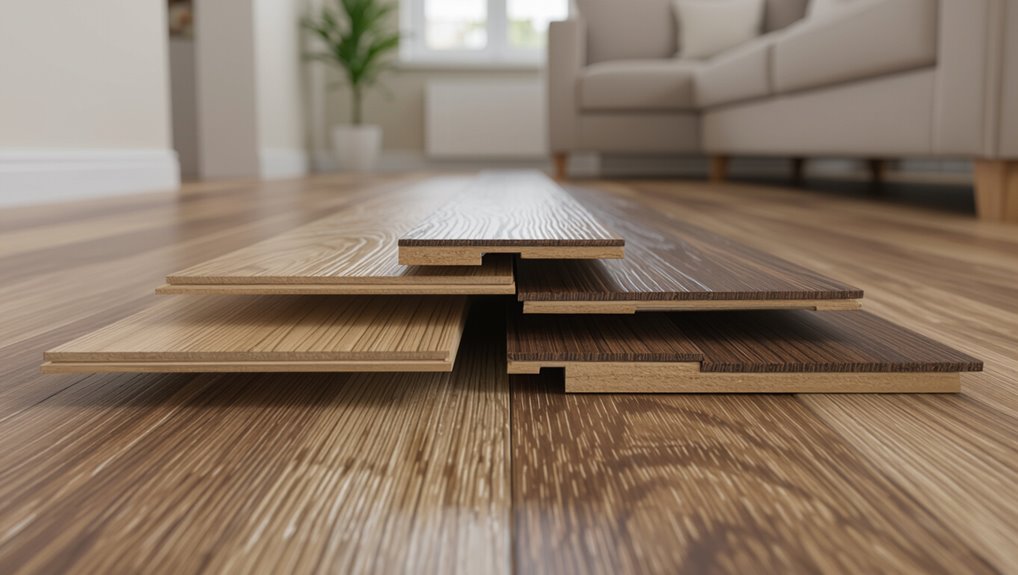
Because engineered boards combine a moisture-sensitive core with rigid surface layers, they’ll always change size a bit as conditions shift, and you should plan for that movement.
You’ll see slight expansion across length and width with rising humidity and contraction when air dries.
Gaps and expansion joints absorb most movement; improper installation or trapped edges cause buckling, so maintain proper clearances and acclimate boards before fitting.
Why Laminate Expands Causes and Contributing Factors
You’ll see laminate expand when it’s exposed to excess moisture from humidity, spills, or a damp subfloor, and when temperatures swing with the seasons.
Improper acclimation or tight installation makes that movement worse, especially in rooms with radiant heat, basements, or bathrooms.
Understanding these sources and conditions helps you prevent buckling and gaps.
Moisture sources (humidity, spills, subfloor moisture)
When humidity rises, spills occur, or moisture wicks up from the subfloor, your laminate will absorb water and swell along seams and edges.
You should control indoor humidity, wipe spills immediately, seal joints where water reaches, and guarantee subfloor vapor barriers and proper drainage.
Regularly inspect basements and plumbing for leaks so trapped moisture doesn’t cause cupping, buckling, or joint separation.
Temperature fluctuations and seasonal changes
If outdoor temperatures swing or your heating cycles change with the seasons, your laminate flooring will expand and contract as the core absorbs and releases heat and moisture.
That movement can open seams, cause slight gaps, or lead to buckling if you don’t leave proper expansion gaps and control indoor climate.
You should monitor indoor temperature and humidity, use consistent heating, and run humidifiers or dehumidifiers as needed.
Improper acclimation or installation
After monitoring temperature and humidity, pay equal attention to how your installer handled acclimation and the actual laying of the planks—improper acclimation or a rushed installation often causes the same expansion problems as seasonal changes.
If you don’t let boards stabilize in the room, skip perimeter gaps, or force tight seams, the laminate will buckle or warp. Insist on proper acclimation time and spacing.
Subfloor and room conditions (radiant heat, basements, bathrooms)
Because subfloor type and room conditions directly affect moisture and temperature at the board level, you need to evaluate radiant heat systems, basements, and bathrooms before installing laminate.
Check moisture content, use vapor barriers over concrete, and follow manufacturer’s radiant-heat limits.
In bathrooms or below-grade spaces, choose water-resistant products, allow extra expansion gap, and guarantee proper ventilation to prevent cupping and buckling.
Signs and Types of Problems from Expansion
You’ll first notice minor gaps between boards and occasional cupping where edges lift slightly.
If expansion continues, you’ll see buckling or peaking—boards push up into ridges or overlap at seams.
Left unchecked, that can cause long-term issues like warped planks or separation from the underlayment.
Minor gaps and cupping
When humidity or temperature changes, minor gaps and cupping are often the first signs your laminate floor is struggling with expansion.
You’ll notice narrow separations between planks or edges lifting slightly. These issues signal moisture imbalance or inadequate expansion gaps.
You can stop damage by controlling indoor humidity, allowing floor acclimation before installation, and ensuring proper perimeter clearance so boards can move without deforming.
Buckling and peaking what they look like
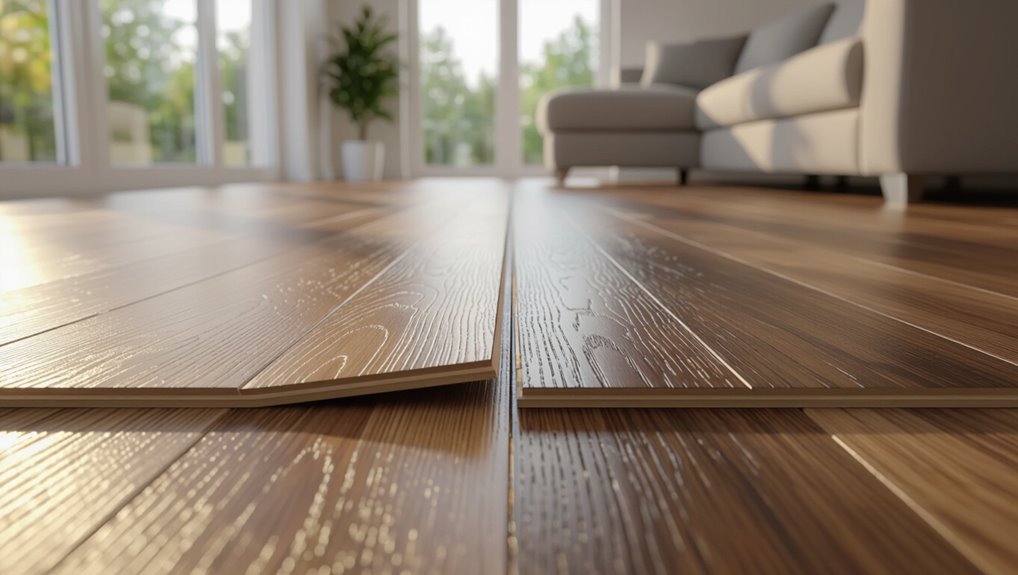
If a laminate floor can’t expand, it may buckle or peak, creating obvious ridges where planks press up against each other or the walls.
You’ll see raised seams, wavy rows, or plank ends lifting near edges. Walking can feel uneven or springy.
Peaking forms sharp ridges along joints; buckling creates broader, elevated sections. Both need prompt attention to prevent worsening.
Long-term damage risks (warping, separation from underlayment)
Because laminate needs room to move, prolonged restriction can lead to lasting damage you’ll notice over time: boards can warp into permanent cupping or bowing, seams can split apart, and planks can detach from their underlayment.
You’ll also see gaps, loose sections that shift underfoot, and finish cracking.
Left unchecked, moisture and tension worsen structural failure, forcing costly panel replacement rather than simple repairs.
How to Prevent Buckling Step-by-Step Installation and Preparation
Before you lay a single plank, follow a clear step-by-step plan to prevent buckling. Start by acclimating the boards and testing room and subfloor moisture.
Then during installation, leave proper expansion gaps, use correct connectors, choose the right underlayment, and secure planks with recommended techniques.
After installation, seal edges and thresholds to keep moisture out and maintain those gaps.
Step 1: Pre-installation: Acclimation process
While your laminate planks sit in the room where they’ll be installed, let them acclimate to the home’s temperature and humidity for at least 48 hours so they won’t expand or contract after you lock them in place.
You should:
- Stack unopened boxes flat, off the ground.
- Keep heating or AC at normal levels.
- Open a few boxes to mix planks.
- Check for visible defects before installation.
Step 2: Pre-installation: Room and subfloor moisture testing
Now that your planks have acclimated, it’s time to check the room and subfloor for moisture so your floor won’t buckle after installation.
You’ll measure ambient humidity and subfloor moisture, compare to manufacturer limits, and address excess moisture before laying planks.
- Use a hygrometer for room humidity
- Use a moisture meter for subfloor
- Compare readings to product specs
- Remediate high moisture sources
Step 3: Installation: Leave proper expansion gaps and use correct transition pieces
When you lay the planks, leave the manufacturer‑specified expansion gap around the room perimeter and at all fixed fixtures so the floor can expand and contract without buckling.
Use proper connector strips at doorways and between different flooring types, and cover gaps with molding where needed.
- Measure gaps consistently
- Use spacers during installation
- Choose compatible connectors
- Check alignment before locking planks
Step 4: Installation: Secure techniques and recommended underlayment
After leaving the proper expansion gaps and fitting connector strips, focus on fastening methods and underlayment choices that keep your laminate flat and stable.
Use a quality foam or cork underlayment with moisture barrier where needed, and guarantee subfloor is clean, level, and dry.
Click-lock panels should float; glue-down planks need recommended adhesives.
Stagger seams and avoid tight fastening at edges.
Step 5: Post-installation: Sealing edges and thresholds
Although you’ve left proper expansion gaps and fitted thresholds, you still need to seal edges and junction points to stop moisture and debris from forcing planks up; apply flexible, manufacturer-approved caulk at walls and use matching thresholds or reducer strips at doorways so the floor can expand without buckling.
After sealing, inspect periodically, keep vents clear, and replace damaged seals to maintain pressure-free movement.
Ongoing Prevention and Maintenance Strategies
Keep humidity steady with your HVAC or a dehumidifier to prevent boards from expanding or shrinking.
Wipe spills promptly with a damp (not soaking) cloth and use cleaners that won’t harm the joints, and check for leaks or moisture from basements, crawlspaces, and plumbing.
Do seasonal inspections and make minor adjustments to changes and expansion gaps before small issues become big problems.
Controlling indoor humidity levels and HVAC recommendations
When you control indoor humidity within the manufacturer’s recommended range—typically 35–55%—you’ll prevent most expansion and contraction issues with laminate flooring; use your HVAC system, dehumidifiers, or humidifiers to steady levels during seasonal swings.
- Monitor with a reliable hygrometer in key rooms.
- Set HVAC to maintain consistent temperature and ventilation.
- Run dehumidifiers in basements or damp areas.
- Service HVAC filters and drains regularly to guarantee proper moisture control.
Handling spills and cleaning without damaging joints
Controlling humidity helps prevent gaps and buckling, but everyday spills and cleaning habits can still threaten laminate joints if you’re not careful.
Wipe spills immediately with a damp, not soaking, cloth. Use pH-neutral cleaners sparingly and avoid steam mops.
Protect edges when mopping by directing water away from seams. Dry floors thoroughly to keep joints tight and stable.
Monitoring and addressing moisture intrusion (basement, crawlspace, plumbing)
Because moisture can creep in unseen from basements, crawlspaces, or plumbing, you should routinely inspect these areas for leaks, standing water, and high humidity that can migrate up into your laminate flooring.
Install and monitor dehumidifiers, fix plumbing leaks promptly, grade soil and vents to reduce dampness, and use a vapor barrier where appropriate to stop moisture before it reaches the floor.
Seasonal checks and minor adjustments
Although seasonal shifts may seem minor, they can change humidity and temperature enough to stress laminate joints and gaps.
So check your floors at least quarterly for cupping, buckling, or widened seams. Keep a hygrometer, note moisture trends, tighten loose thresholds, and adjust expansion gaps if needed.
Promptly replace damaged planks and reset junctions to prevent small issues becoming costly repairs.
Repairing Expansion and Buckling Issues
When you spot buckling or gaps, first assess the severity to decide if you can tackle it yourself or need a pro.
For simple issues you can release pressure, replace damaged boards, or re-install thresholds; for worse cases a professional may need to repair subfloor problems or replace large sections.
I’ll cover clear DIY steps and the signs that mean it’s time to call an expert.
Assessing severity: when DIY is possible vs when to call a pro
If your laminate starts to buckle or gap, you’ll want to quickly gauge whether you can fix it yourself or should call a pro.
Check extent: isolated boards or small gaps are often DIY; widespread buckling, water damage, or unstable subfloor needs a professional.
Also consider tools, experience, warranty implications, and time.
When in doubt, get an inspection to avoid costly mistakes.
DIY fixes: releasing pressure, replacing boards, re-installing transitions
Start by easing the pressure: gently pry up baseboards or quarter-round trim and check for trapped planks. Then work outward from the affected area to relieve tension before doing any replacements.
Next, release and remove buckled boards, inspect tongues and grooves, dry subfloor if needed, and fit replacement planks.
Finally, reinstall connections and trim, leaving proper expansion gaps and securing trim without pinching the floor.
Professional repairs and when full replacement is necessary
Although you can fix many problems yourself, some expansion and buckling issues demand a pro’s tools and experience to diagnose moisture sources, structural movement, or widespread installation failures.
You should hire a professional when damage spans multiple rooms, subfloor or joist issues exist, or moisture remediation is required.
Pros can repair subfloors, correct structural problems, or advise full replacement when repairs won’t restore stability or appearance.
Common Installation Mistakes That Cause Buckling
You can prevent most buckling by avoiding a few common installation errors.
Don’t skip acclimation, skimp on the expansion gap or edge treatment, or use the wrong underlayment or adhesive.
Also never install over an unsuitable subfloor or a wet surface.
Skipping acclimation
If you skip acclimating laminate before installation, the boards can absorb or lose moisture once they’re down and then expand or contract against fixed edges.
You should let packages sit in the room for 48–72 hours so they match ambient temperature and humidity.
Skipping this step risks cupping, gaps, and stress at joints.
Always follow manufacturer acclimation guidelines to prevent warping.
Insufficient expansion gap or improper edge treatment
Allowing boards to acclimate won’t help if you install them tight against walls or neglect proper edge treatment—laminate needs room to move as humidity and temperature change.
You should leave the manufacturer‑recommended expansion gap around perimeter and around fixed objects, use appropriate trim or spacers, and avoid fastening edges.
If edges are constrained, boards will buckle or gap as they expand and contract.
Incorrect underlayment or adhesive use
One common cause of buckling is using the wrong underlayment or applying adhesive where a floating laminate should remain unfixed.
If you pick an incompatible underlayment, moisture or uneven support can bind boards.
Don’t glue floating systems; follow manufacturer specs.
Use recommended vapor barriers, correct thickness, and installation methods so boards can expand, preventing stress, warping, and eventual buckling.
Installing over an unsuitable subfloor or wet surface
When you lay laminate over a subfloor that’s uneven, unstable, or still damp, the boards won’t sit or move as they should and buckling becomes likely.
Always check and repair joists, plywood, or concrete, and make certain the surface’s moisture level meets manufacturer specs.
Use a vapor barrier where required, let concrete cure fully, and never install on a wobbly or wet base.
Comparing Flooring Options for Moisture-Prone Areas
When you’re choosing flooring for moisture-prone areas, you need to weigh how each material handles expansion and water exposure. Below is a quick comparison to help you see which options swell, resist, or stay stable under wet conditions. Use this as a starting point to pick a floor that matches your room’s moisture risk and maintenance tolerance.
| Material | Moisture/Expansion Profile |
|---|---|
| Laminate | Prone to swelling at edges; requires good sealing and underlayment |
| Engineered hardwood | Better than solid wood but can still warp with sustained moisture |
| Vinyl | Highly water-resistant; minimal expansion issues when properly installed |
| Tile | Extremely moisture-resistant; grout lines may need maintenance |
| Waterproof cores (e.g., SPC) | Very stable and resistant to both moisture and expansion |
Laminate vs engineered hardwood vs vinyl vs tile expansion and moisture resistance
Curious which floor holds up best in damp rooms?
You’ll find vinyl resists moisture and hardly expands, making it ideal for basements and bathrooms.
Tile is waterproof and stable but cold and rigid.
Engineered hardwood tolerates moisture better than solid wood but can still swell.
Laminate’s core swells with water and needs careful moisture control to prevent buckling and warping.
Tools, Materials, and Products Recommended to Prevent Expansion
To prevent laminate expansion you’ll want the right tools and products on hand: moisture meters, gap spacers, quality underlayment, and thresholds.
You should also use humidity control devices and targeted waterproofing products to manage moisture before and after installation.
Below we’ll cover how each item helps you keep your floor stable and lasting.
Moisture meters, gap spacers, underlayments, thresholds
Before you lay a single plank, gather the right tools and materials—moisture meters, gap spacers, appropriate underlayment, and thresholds—to control moisture and maintain proper expansion gaps so your laminate performs as designed.
Use a moisture meter to check subfloor RH, spacer wedges for consistent gaps, underlayment for cushioning and vapor control, and thresholds to finish changes neatly.
- Moisture meter
- Gap spacers
- Underlayment
- Thresholds
Humidity control devices and waterproofing products
Humidity control devices and waterproofing products help you keep plank movement predictable and prevent swelling from excess moisture.
Use dehumidifiers in humid seasons and humidifiers in dry months to maintain 35–55% RH.
Apply waterproof underlayment or seam sealers at junctions and wet areas.
Inspect basements, toilets, and appliance connections, and address leaks promptly so boards stay stable and buckling risk stays low.
Frequently Asked Questions (FAQ)
You probably have a few practical questions about gaps, moisture, and fixing problems—like how big the expansion gap should be, whether you can use laminate in a bathroom or basement, or if fluctuating humidity will make it buckle.
You’ll also want to know how long to acclimate boards before installation and whether buckling can be repaired without full replacement.
Below are clear answers to each question.
How much expansion gap does laminate need?
How much space should you leave around your laminate floor?
You should leave a 1/4 to 3/8-inch gap for narrow rooms, and 1/2 inch or more for larger areas and long runs.
Cabinets, doorways, and junctions may need tighter tolerances or be covered with molding.
Follow manufacturer specs and account for seasonal humidity changes to prevent buckling.
Can I install laminate in a bathroom or basement?
If your room sits below grade or gets a lot of moisture, be careful about choosing and installing laminate.
You can use water-resistant or waterproof laminate in bathrooms and basements, but you must prep subfloors, guarantee proper moisture barriers, slope toward drains where applicable, seal seams and connections, and leave expansion gaps.
Avoid direct wet areas and follow manufacturer recommendations to maintain warranty.
Will laminate buckle if my house has fluctuating humidity?
Because laminate is engineered to lock together tightly, it can still expand and contract with big swings in humidity. That movement can cause buckling if you don’t control moisture and leave the proper expansion gaps.
You should monitor indoor humidity, use dehumidifiers or humidifiers as needed, maintain consistent HVAC settings, and guarantee gaps and shifts allow movement so boards don’t cup or lift.
How long should laminate acclimate before installation?
Wondering how long you should let laminate sit before installation? You should acclimate boards in the room where they’ll be installed for 48 to 72 hours.
Keep them flat, unopened or unstacked, with cartons off the wall and at room temperature (60–80°F / 15–27°C) and normal humidity.
This equalizes moisture content and reduces expansion or gaps after installation.
Can I fix buckling without replacing the floor?
Can you fix buckling without replacing the whole floor? Yes—small buckles from moisture or expansion can often be repaired.
Remove baseboards, loosen or lift affected planks, allow subfloor and laminate to dry, then re-seat or replace only damaged boards.
Guarantee proper expansion gaps and fix moisture sources.
For widespread buckling, full replacement is usually necessary.