How to Level a Concrete Floor With Self-Leveling Compound
You can level a concrete floor with self-leveling compound if the slab has only minor to moderate unevenness and no major structural or moisture problems. You’ll clean and prep the surface, repair cracks and spalls, profile and prime the concrete, then mix and pour the compound in manageable sections, using a gauge rake and smoother to spread it. Work quickly within pot life and follow cure times; keep going for step-by-step tips and troubleshooting.
Quick Answer Can You Level a Concrete Floor With Self-Leveling Compound?
Yes — you can use self-leveling compound for many uneven concrete floors, and it’s best for filling low spots and creating a smooth substrate for tile or vinyl.
Don’t use it for structural issues, large dips or hollows, or poorly prepared, crumbling concrete — those need patching, grinding, or repair first.
Before you pour, check substrate condition, slope limits, and manufacturer instructions so you get the right result.
Short verdict and ideal use cases
If your concrete has minor to moderate unevenness—think up to about 1/4–1/2 inch over a few feet—self-leveling compound is a quick, effective fix that you can pour and spread yourself or hire out.
For deeper dips, severe slopes, or areas with structural cracking, you’ll need patching, grinding, or re-pouring instead.
Use self-leveling concrete when you want a smooth, fast substrate for tile, vinyl, or light flooring.
When self-leveling compound is not appropriate
Although self-leveling compound works well for shallow irregularities, you shouldn’t use it for deep depressions, active cracks, severe slopes, or floors with moisture and adhesion problems.
If you face any of those, choose patching mortar, pourable concrete, epoxy or hydraulic cement, and address moisture with a vapor barrier or remediation.
Consult a pro for structural issues or widespread damage before proceeding.
Basic Understanding What Is Self-Leveling Compound and Why Use It?
Self-leveling compound is a cement- or gypsum-based liquid you pour over concrete that flows out to form a flat, smooth surface; there are fast-setting, polymer-modified, and featheredge types for different jobs.
Chemically it hydrates and bonds to the substrate while thixotropic additives control flow and cure, and physically it levels by gravity and surface tension.
You’ll choose it over thin overlays or patching mortars when you need a true flat plane quickly, with thinner applications and fewer joints or trowel marks.
Definition and types of self-leveling compounds
When you’re preparing to level a concrete floor, a self-leveling compound is a pourable cement-based or polymer-modified material that flows out to form a smooth, flat surface with minimal trowel work.
You’ll choose based on use, thickness, and cure time:
- Cement-based standard for most floors
- Polymer-modified for flexibility
- Fast-setting for quick walkability
- Featheredge for thin repairs
How it works chemically and physically
If you want a flat, durable surface with minimal effort, a self-leveling compound achieves this by combining a fluid carrier with fine cement and polymers that react, hydrate, and physically flow to fill low spots.
You mix with water, pour, and gravity spreads the slurry; chemical hydration hardens it while polymers improve adhesion, flexibility, and shrinkage control, producing a smooth, load-bearing substrate.
Benefits vs. other leveling methods (thin overlay, patching mortars)
Although other methods can fix uneven concrete, a self-leveling compound usually saves you time and delivers a flatter, more consistent surface than thin overlays or hand-applied patching mortars. You’ll get quicker pours, smoother finishes, and better bonding for floor coverings. It minimizes trowel marks and human error, and often reduces prep and labor compared with traditional patching.
| Method | Speed | Finish |
|---|---|---|
| Self-leveling | Fast | Very smooth |
| Thin overlay | Moderate | Smooth |
| Patching mortar | Slow | Variable |
Assess the Existing Concrete Floor Is It Suitable?
Before you start, walk the slab and check flatness and slope with a straightedge, level, or laser—know the tolerances your leveling product requires.
Look for cracks, delamination, moisture stains or contaminants, and plan repairs or cleaning where needed.
Perform moisture tests (meter, calcium chloride, or relative humidity probes) and confirm readings are within the acceptable limits for your chosen compound.
Inspecting surface flatness and slope (tools and tolerances)

Start by checking both flatness and slope with the right tools—straightedge, level, laser level, and a 3-meter (10-foot) straightedge or digital floor profiler—to quickly spot high and low spots and confirm the floor meets tolerance requirements for your planned finish.
Measure deviations every meter, note max gaps (typically ≤3–6 mm over 3 m for most finishes), and mark areas needing grinding or build-up.
Identifying cracks, delamination, moisture issues, and contaminants
You should inspect the slab for visible cracks, areas where the topping has pulled away (delamination), signs of moisture, and any contaminants that could prevent adhesion or long-term performance.
Mark and photograph defects, probe loose or hollow-sounding areas, and note oil, paint, or residue.
Plan repairs for structural cracks, removal of contaminants, and surface profiling or priming before applying self-leveling compound.
Moisture testing methods and acceptable limits
Because excess moisture will ruin most floor coverings and some leveling products, you’ll need to test the slab with reliable methods—commonly including in-situ relative humidity probes, calcium chloride (CM) vapor tests, and surface moisture meters—to determine if the concrete meets the manufacturer’s limits or if mitigation is required.
- Use RH probes for internal moisture percentage.
- CM tests measure vapor emission (lbs/1000 ft²/24h).
- Surface meters give quick checks, not definitive results.
- Compare readings to manufacturer limits; install vapor barriers or mitigation if exceeded.
Tools, Materials, and Safety Preparations
Before you start, gather the right tools and equipment—mixers, trowels, gauges, and a pump if the job’s large.
Choose the appropriate self-leveling compound (rapid-set for fast turnaround, latex-modified for flexibility, or cement-based for heavy-duty repairs) based on floor condition and use.
Put on PPE—gloves, eye protection, a respirator—and secure the jobsite with ventilation and barriers to prevent accidents.
Required tools and equipment

One essential step is gathering the right tools, materials, and safety gear so you can work efficiently and stay protected while leveling a concrete floor.
You’ll need basics for prep, mixing, placement, and cleanup:
- Heavy-duty float or gauge rake
- Mixing drill with paddle
- Protective gear: respirator, gloves, goggles
- Buckets, tape, and tarps for containment and cleanup
Types and selection of self-leveling compounds (rapid set, latex-modified, cement-based)
Now that you’ve assembled your tools and safety gear, pick the right self-leveling compound for the job—different formulas suit different surface conditions, thickness requirements, and cure times.
For fast turnaround use rapid-set; for minor repairs and flexibility choose latex-modified; for heavy fills or exterior use pick cement-based.
Match product specs to substrate, depth, traffic, and drying time before purchasing.
PPE and jobsite safety considerations
While you’ll be working with dust, chemicals, and heavy tools, use the right PPE and set up the site to prevent injuries and contamination.
Wear N95 or P100 respirator, safety goggles, chemical-resistant gloves, knee pads, and steel-toe boots.
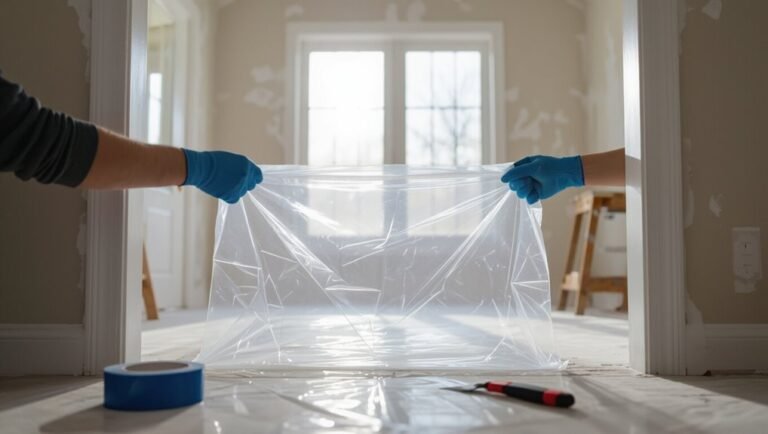
Ventilate the area, seal off unaffected rooms with plastic, keep a first-aid kit and fire extinguisher nearby, and follow product MSDS and manufacturer instructions.
Step-by-Step Process to Level a Concrete Floor
Now you’ll follow a clear sequence to get the slab ready: clean and prep the surface, repair cracks and spalls, and profile the concrete for a good mechanical bond.
Then you’ll apply the recommended primer and allow the proper dwell time before mixing the self-leveling compound.
Mix the compound to the manufacturer’s ratios with the right tools, minding pot life so you can pour and finish without rushing.
Step 1 Surface cleaning and preparation
Before you pour any leveling compound, clear and inspect the slab so you know what you’re dealing with.
Remove debris, dust, oil, paint flakes, and loose particles with a broom, vacuum, and degreaser.
Etch or mechanically scuff smooth areas for better adhesion, then rinse and let the concrete dry completely.
Tape perimeter joints and protect adjacent surfaces before mixing compound.
Step 2 Repairing cracks, spalls, and weak spots
Patch cracks and hollow spots so your leveling compound has a solid, stable base to bond to.
Remove loose concrete, dust, and debris.
Widen hairline cracks slightly, then fill with epoxy or polymer-modified repair mortar.
For spalls or deteriorated areas, chisel to sound concrete, apply bonding primer, and pack repair mortar.
Allow proper cure before proceeding to the next profiling step.
Step 3 Profiling the surface and creating mechanical bond (grinding/shotblasting)
Start by profiling the concrete to create a strong mechanical bond for your leveling compound; you’ll remove laitance, coatings, and weak surface material using grinding or shotblasting so the substrate is clean, rough, and ready to accept the overlay.
Choose equipment based on area and contamination, control dust with vacuum systems, check profile depth, and remove debris before proceeding to priming or patching.
Step 4 Applying primer and recommended dwell time
Once the surface is clean and properly profiled from grinding or shotblasting, you’ll apply a primer to lock in dust, improve adhesion, and control the substrate’s porosity.
Use the manufacturer-recommended primer, roll or squeegee evenly, and avoid puddles.
Allow the specified dwell/cure time—usually 30 minutes to 24 hours depending on product and temperature—before seeding or installing the self-leveling compound.
Step 5 Mixing the self-leveling compound (ratios, mixing tools, pot life)
Now you’ll mix the self-leveling compound, following the manufacturer’s powder-to-water ratio exactly to get the right flow and strength; use a clean bucket, a drill with a mixing paddle, and measure water by volume or weight as specified.
Mix slowly to avoid air entrapment until smooth, and note the compound’s pot life (often 20–40 minutes) so you pour and spread before it begins to thicken.
Mix only what you can apply within that time, tap the bucket to release bubbles, and keep tools clean to prevent premature setting.
Step 6 Pouring, spreading, and using a gauge rake and smoother

Pour the mixed compound onto the floor in a continuous ribbon, working in manageable sections so you can spread it before the pot life ends.
Use a gauge rake to pull material evenly, setting blade height to desired thickness.
Follow with a smoother or spiked roller to remove trowel marks and air bubbles.
Move steadily, keep overlaps minimal, and finish each section before it skins over.
Step 7 Dealing with edges, transitions, and control joints
When you reach edges, changes, and control joints, plan each detail so the level layer bonds cleanly and moves with the slab; treat edges with feathered tapers, use connection strips where floor heights change, and respect control joints by either routing and filling or creating movement joints in the topping to mirror the slab’s breaks.
Tape, foam, or backer rod help seal edges; sealant accommodates movement.
Step 8 Curing, drying time, and when to install floor coverings
Because proper curing controls strength and moisture release, you’ll need to follow specific drying times before walking on the surface or installing coverings.
Keep the area sealed from drafts and temperature swings, maintain recommended humidity, and protect from traffic.
Check manufacturer moisture and cure-rate specs; typical light foot traffic is 4–24 hours, full coverings 24–72+ hours depending on thickness and conditions.
Common Problems and How to Fix Them
You’ll run into a few common issues—bubbles, pinholes, and popouts; poor adhesion or delamination; shrinkage cracks; and uneven thickness or feathering—and each has a specific cause and fix.
I’ll explain how to diagnose causes like trapped air, contaminant-laden substrate, rapid drying, or incorrect mix/placement and show the corrective steps.
Follow the troubleshooting and preventive measures to get a flat, durable finish.
Bubble formation, pinholes, and popouts causes and fixes
If air, water, or loose particles get trapped under the surface of your topping, you’ll see bubbles, pinholes, or popouts form as the mix cures or gets walked on.
To fix this, remove loose debris, vacuum and prime the substrate, mix per instructions to avoid excess air, pour slowly, and use a spiked roller to release trapped air.
Repatch popouts and recoat.
Poor adhesion or delamination troubleshooting steps
When your topping peels, flakes, or lifts from the slab, start by identifying where adhesion failed and why—common causes include dirty or damp substrates, improper priming, wrong mix ratios, or applying over incompatible coatings.
Remove loose material, clean and dry the surface, mechanically profile glossy or contaminated areas, reapply correct primer, and mix per manufacturer specs.
Test a small patch before full repair.
Excessive shrinkage or cracking prevention and remedies
After fixing adhesion issues, check for another common problem: excessive shrinkage and cracking in toppings and repair mortars.
You can prevent it by using low-shrinkage mixes, proper water ratios, and additives like shrinkage-reducing admixtures or fiber reinforcement.
Cure properly—avoid rapid drying—and control temperatures.
For hairline cracks, rout and seal; for larger cracks, remove loose material and patch with compatible repair mortar.
Uneven thickness and feathering issues corrective methods
Address uneven thickness and feathering problems promptly to avoid weak spots, poor adhesion, and premature wear in your topping or repair.
Grind high spots, build low areas with a bonding slurry or patching mortar, then reapply self-leveling compound in controlled passes.
Use proper mixing, flow control, and a gauge rake.
For feathered edges, chamfer and bond with primer to guarantee adhesion.
Best Practices and Pro Tips
You’ll want to follow recommended thickness ranges and layer strategically to keep the slab stable without wasting material.
Control temperature, humidity, and ventilation and plan timing for multi-room pours and seams so sections cure uniformly.
Use value-minded choices—proper prep, bulk material buys, and renting tools—to cut costs without sacrificing performance.
Recommended thickness ranges and layering strategy
Start with a clear plan for thickness and layering so each zone of your floor gets the right support: thin skim coats (1/8″–1/4″) fix surface imperfections, medium repairs (1/4″–1″) build back damaged areas, and full overlays or new slabs (1–4″+ depending on load) provide structural capacity—stack layers only when each has cured properly and bond adhesives or primers are used between lifts.
Map low spots, set drainage slope, and sequence pours from low to high.
Temperature, humidity, and ventilation control
Because curing and bonding are highly sensitive to moisture and temperature, you’ll need to control the jobsite environment before and during leveling to avoid weak patches, cracking, or adhesion failures.
Keep substrate and room temperatures within manufacturer specs, use heaters or coolers as needed, and maintain 40–60% relative humidity.
Guarantee steady ventilation to remove moisture but avoid drafts that cause uneven drying.
Timing considerations for multi-room pours and seams
When working across multiple rooms or creating seams, plan pours so adjacent bays cure within compatible timeframes to prevent cold joints and uneven shrinkage; that means sequencing pours, matching mix designs, and coordinating crew timing to keep junction areas cohesive.
You’ll schedule overlapping windows, monitor pot life, and finish seams promptly. Use primers and bonding agents at joints and document pour order to maintain consistent cures.
Cost-saving tips without compromising performance
If you want to cut costs without sacrificing quality, focus on smarter planning, material choices, and crew efficiency—these yield the biggest savings per dollar invested.
You can buy quality mix from reputable suppliers, reuse clean tools, and prep thoroughly to avoid rework.
Train your crew on correct mixing and pour techniques, batch efficiently, and schedule work to minimize downtime and waste.
Comparison: Popular Self-Leveling Products and When to Use Each
When choosing a self-leveling product, you’ll want to match the mix weight to the job: lightweight for slight smoothing, standard for typical repairs, and heavy-duty for deep fills or high-traffic areas.
Consider whether a professional-grade mix is worth the extra strength and faster cure, or if a DIY kit’s convenience and ease of use better suit a small project.
We’ll compare the pros and cons of each so you can pick the right product for your floor.
Lightweight vs. standard vs. heavy-duty mixes
Although all self-leveling compounds aim to create a flat surface, they differ in density, strength, and recommended applications, so choosing the right mix matters. You’ll pick lightweight for thin, low-load overlays; standard for general floors; heavy-duty for garages or industrial use. Compare:
| Type | Best for | Strength |
|---|---|---|
| Lightweight | Thin toppings | Low |
| Standard | Homes | Medium |
| Heavy-duty | Workshops | High |
Professional-grade vs. DIY kits pros and cons
Many homeowners and pros face the same choice: professional-grade mixes deliver higher strength, longer working times, and larger-batch consistency, while DIY kits simplify mixing and application for small repairs and first-time users.
You’ll pick pro products for large areas, thicker pours, or subcontractor schedules; choose DIY kits for quick fixes, tight budgets, and simple rooms.
Consider skill, tools, and cure time.
Mistakes to Avoid
Don’t skip moisture tests or leave substrate repairs for later — trapped damp or a cracked base will ruin your leveling.
Mix precisely (not too much or too little) and respect the compound’s pot life and the manufacturer’s instructions.
Also don’t apply leveling compound over incompatible floor coverings or adhesives without proper removal.
Skipping moisture tests or not repairing substrate
If you skip moisture testing or leave cracks and weak spots in the substrate unrepaired, your new floor leveler can fail, bubble, or peel off within months.
You need to test for moisture, repair cracks, and remove loose concrete before pouring.
Follow manufacturer moisture limits, use patching compounds for damaged areas, and guarantee a clean, sound substrate so the leveler bonds correctly.
Overmixing or under-mixing compound
While mixing might seem like a small step, getting the water-to-powder ratio and mixing time wrong will wreck the leveler’s performance.
If you under-mix, lumps and poor fluidity prevent smooth flow and bonding. If you overmix, you’ll entrain air, shorten working time, and weaken strength.
Mix steadily to a uniform, lump-free consistency and use recommended mixing tools and speeds.
Ignoring manufacturer instructions and pot life
Mixing correctly matters, but following the manufacturer’s instructions and respecting pot life matters just as much—these guidelines tell you how long the mix stays workable and how the product will perform.
If you ignore them, the compound can harden too fast or lose strength, causing poor flow, weak bonds, and cracks.
Follow ratios, temps, and open time to guarantee reliable results.
Applying over unsuitable floor coverings or adhesives
Because old adhesives and incompatible coverings can trap moisture, prevent bonding, or chemically react with leveling compounds, you shouldn’t pour a new layer over them without proper removal or testing.
Inspect surfaces, strip glue or flooring down to sound concrete, and test small areas for adhesion.
Use approved primers or consult the compound manufacturer when doubt exists to avoid failures, delamination, or costly rework.
When to Hire a Professional
If the slab has major cracks, severe slope, or hidden moisture issues, you’ll want to call a pro rather than risk a failed DIY fix.
A contractor can assess the problem, propose a clear scope of work, and give you written quotes with timelines.
Expect to ask about warranties, permits, and follow-up care before you sign.
Signs the project is beyond DIY
When problems go beyond minor high spots or hairline cracks, it’s time to contemplate a pro—especially if you spot structural cracks, persistent moisture, major unevenness, or you lack the tools and experience for large-scale leveling.
If floors slope badly, subfloor damage exists, drains or embedded utilities are involved, or the job needs permits and engineered fixes, hire a contractor to avoid costly mistakes.
What to expect from a pro: scope, quotes, and warranties
After you decide a pro is the right call, know what their work should cover and how they’ll charge for it.
You’ll get clear scope, timelines, and materials; ask for written estimates and compare. Expect warranty terms and cleanup.
Questions? Get answers before work starts.
- Detailed scope and prep
- Itemized quote and payment schedule
- Warranty length and exclusions
- Cleanup and disposal included
FAQ
You probably have specific questions like whether you can pour self-leveling compound over tile and how long before you can walk on it or install carpet or new tiles.
You’ll also want to know the compound’s minimum and maximum thickness, how to handle expansion joints and changes, and whether you can tint or paint the finished surface.
Below are concise answers to these common FAQs.
Can I pour self-leveling compound over existing floor tile?
Wondering if you can pour self-leveling compound over existing tile? Yes, in many cases, but you must clean, degrease, and roughen the tile surface, remove loose or cracked tiles, and use a primer specified by the compound manufacturer.
Height build-up and waterproofing beneath tiles matter—check adhesive and substrate compatibility.
For glazed or smooth tiles, mechanical profiling or a bonding primer is essential.
How long before I can walk on the leveled floor and install carpet/tiles?
How soon can you walk on a newly leveled floor and lay carpet or tile?
You can usually walk on self-leveling compound after 1–4 hours for light traffic, depending on product and temperature.
Wait the manufacturer’s recommended cure time before installing carpet or tile—often 24 hours for carpet and 24–48 hours or longer for tile with adhesive or thinset to bond properly.
What is the minimum and maximum thickness for self-leveling compound?
After you’ve waited the proper cure time for walking and installing finishes, the next question is often how thick that self-leveling compound should be.
Typically, minimum featheredge is about 1/16 inch for specialized mixes; standard mixes require 1/8–1/4 inch.
Maximum single pour ranges 1/2–1 inch; thicker fills need multiple pours or reinforcement per manufacturer instructions to avoid cracking.
How do I handle expansion joints and transitions?
Where should you place expansion joints and how do you handle shifts between different floor materials?
You must keep existing control and expansion joints exposed; don’t cover them with compound.
Install flexible joint filler or foam backer rod and use an appropriate flexible sealant at changes.
Use transition strips where materials meet (tile, wood, carpet) to allow movement and protect edges from cracking.
Can I tint or paint the self-leveling compound surface?
Keeping joints exposed and using flexible sealants protects edges and movement—and you’ll want the same care before adding color to a self-leveling surface.
You can tint compound with manufacturer-approved pigments or paint after full cure and proper priming.
Test adhesion and color on a small area, follow pot life and coverage guidance, and avoid solvent-based coatings that can soften or discolor the leveler.