
Can You Fit Laminate Flooring Over Carpet? Here’s Why Most Pros Say No
You can physically fit laminate over low‑pile, firmly anchored carpet, but most pros say don’t. The soft, uneven backing lets boards flex, causes locking joints to pop, and speeds wear while likely voiding warranties and trapping moisture. It’s only tolerable for short‑term or staging situations; permanent installs need a flat, stable subfloor. If you must, there are prepping tricks and limits to follow — keep going to learn when it’s ever acceptable and how to do it right.
Can You Fit Laminate Flooring Over Carpet? and Overview
Yes—you can install laminate over carpet in some cases, but it’s generally not recommended unless the carpet is very low-pile and firmly attached.
You might consider this route to save time, avoid removing old flooring, or temporarily upgrade a rental, but it can cause stability, warranty, and feel issues.
Before you proceed, weigh the convenience against potential problems like uneven seams, reduced durability, and manufacturer restrictions.
Direct answer in one paragraph
Wondering if you can install laminate over carpet? You technically can in limited cases, but pros usually advise against it.
Thick, plush carpet, uneven padding, and poor support cause instability, gaps, and premature wear.
If you must, only low-pile, firmly attached carpet with minimal padding might work, yet removing carpet and prepping a flat subfloor is the recommended route.
When homeowners consider this option (common motivations)
If you’re weighing the risks vs. convenience of laying laminate over carpet, it’s helpful to look at why homeowners consider it in the first place.
You might want faster installation, lower labor costs, temporary solutions for rentals, or to avoid ripping up padding and tack strips.
Some hope to test appearance before fully committing, but these motivations must be balanced against performance and warranty issues.
Basics What Is Laminate Flooring and How It Installs
Laminate flooring is made of layered materials with a hard wear layer and a click-together core that usually installs as a floating floor, so it just rests on top of your subfloor.
You’ll want the surface beneath to be flat and stable because gaps, soft spots, or moisture can cause boards to warp, separate, or make noise.
Before you consider laying laminate over carpet, check that the underlying structure meets those flatness, stability, and moisture control requirements.
Laminate flooring components and floating installation method
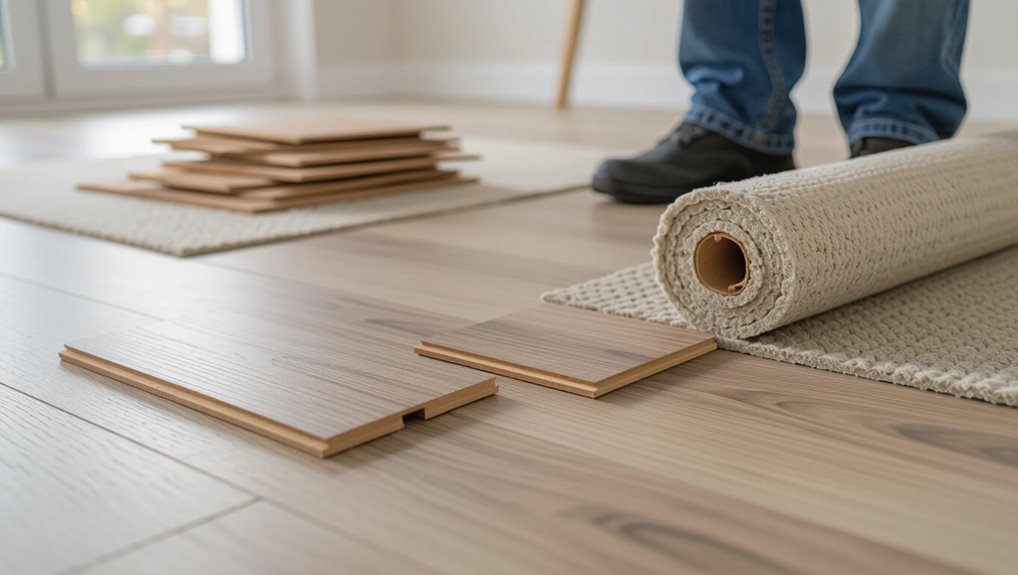
A typical laminate board stacks four key layers—wear layer, print/design layer, core, and backing—to give you durability, realistic appearance, and stability.
You’ll click planks together with a floating installation, so the floor isn’t glued or nailed down.
You’ll leave expansion gaps at edges, use underlayment for cushioning and noise reduction, and can replace individual planks if they’re damaged.
Why subfloor flatness, stability, and moisture control matter
Those layers and the floating click system perform well only when they’re supported by a flat, stable, and dry subfloor.
You need flatness to prevent gaps, rocking, and joint stress that cause squeaks or plank failure. Stability keeps the floor aligned under traffic. Moisture control prevents swelling, mold, and adhesive or core damage.
Inspect and correct issues before installing to guarantee longevity.
Why Most Professionals Advise Against Installing Laminate Over Carpet
You might think laying laminate over carpet saves time, but it creates structural and performance problems like squeaking, movement, and uneven wear.
It can also void warranties or violate building codes and manufacturer instructions.
Plus, trapped moisture increases long-term risks and can lead to premature failure.
Structural and performance problems (squeaking, movement, uneven wear)
Although installing laminate over carpet might seem convenient, professionals usually warn against it because the soft, springy layer creates serious structural and performance issues.
You’ll get excessive movement, locking joints that pop or separate, and a squishy surface that squeaks underfoot.
Over time uneven support causes accelerated wear, gaps, and edge damage, reducing lifespan and creating ongoing maintenance headaches.
Warranty, code, and manufacturer restrictions
Because installers and manufacturers set clear requirements for underlayment and subfloor conditions, fitting laminate over carpet usually voids warranties and can violate building codes or local ordinances.
You’ll face denied claims, inspection failures, and liability. Consider these consequences:
- Warranty nullified for improper substrate
- Installer refusal or limited liability
- Failed code inspections or permits
- Resale complications and disclosure requirements
Long-term risks (moisture trapping, premature failure)
Beyond warranty and code headaches, installing laminate over carpet creates real long-term performance problems that most pros won’t accept.
You trap moisture in the carpet and pad, promoting mold, mildew, and adhesive breakdown.
The unsupported laminate flexes, gaps, and delaminates sooner, shortening lifespan and raising repair costs.
You’ll pay more over time and risk unhealthy indoor air quality.
Situations Where Installing Laminate Over Carpet Might Be Possible
You might be able to install laminate over carpet in a few specific cases, like when the carpet is low-pile and the padding is thin or firm.
It can also work for temporary setups—such as rentals or home staging—where long-term performance isn’t critical.
Always check the laminate manufacturer’s guidelines, since some products allow conditional approvals while others strictly forbid it.
Types of carpet and padding that could allow it (low-pile, thin pad)
If your carpet’s low-pile and rests on a thin, firm pad—or no pad at all—you may be able to lay laminate over it without creating major stability issues.
Choose dense, tightly woven berber or commercial loop carpet and replace fluffy foam with low-profile rubber or jute.
Confirm the surface is flat, seams secure, and pile doesn’t compress under walkways to prevent locking failures.
Temporary or short-term installations (rental, staging)
Considering a short-term solution—like staging a home or outfitting a rental—can make laying laminate over carpet more acceptable, provided you plan for removal and accept some trade-offs.
You’ll want low-pile carpet, minimal padding, and secure but nonpermanent installation methods.
Expect reduced durability, potential stability issues, and visible seams; plan to remove the laminate before lease end or resale to avoid problems.
Exceptions and conditional approvals from manufacturers
Although most manufacturers advise against installing laminate over carpet, some will allow it under strict conditions and with explicit approval—so check the warranty and installation guidelines before proceeding. If approved, you’ll need low-pile, firmly anchored carpet, rigid underlayment, moisture checks, and documented manufacturer consent to avoid voiding warranty. Choose installers who follow those conditions exactly.
| Risk | Requirement | Feeling |
|---|---|---|
| Voided warranty | Written approval | Uneasy |
| Damage | Low-pile carpet | Hopeful |
| Failure | Proper underlayment | Cautious |
Step-by-Step: How to Prepare and Install Laminate Over Carpet (If You Must)
Before you start, you’ll want to check the carpet type, pad thickness, and subfloor condition to see if installation is even feasible.
If you proceed, remove excess padding or secure the carpet (or glue it down), then level and stabilize the surface with the right underlayment.
Finally, follow floating-installation best practices and finish with proper connections, thresholds, and trims.
Step 1 Evaluate carpet type, pad thickness, and subfloor condition
Once you decide to install laminate over existing carpet, the first thing you need to do is evaluate the carpet type, pad thickness, and subfloor condition to make sure the surface can support a stable, long-lasting floor.
Check these points before proceeding:
- Carpet type: low-pile only, not shag or plush
- Pad thickness: thin, firm padding under 6mm ideal
- Subfloor: flat, dry, structurally sound
- Look for odors, mold, or soft spots
Step 2 Remove excessive padding or glue down the carpet (methods)
You’ll need to either remove thick padding or secure the carpet down so your laminate has a stable base—thin, firm carpeting can stay, but anything plush or cushioned must go.
Pull up padding and tack strips where possible, or stretch and glue down the carpet edges with contact adhesive or double-sided carpet tape.
Trim loose fibers and vacuum thoroughly before proceeding.
Step 3 Level and secure the surface (underlayment options)
3. You’ll need a firm, level base before laying laminate over carpet. Remove loose fibers, trim remaining pile, and reinstall thin, dense underlayment—plywood or cement board works best.
Secure panels to prevent movement using adhesive or screws into subfloor where possible. Use a moisture barrier if needed.
Check for gaps and shim low spots so the surface stays flat and stable.
Step 4 Floating installation best practices over carpet
With your underlayment secure and low spots shimmed, you’re ready to start the floating installation over the carpet.
Work perpendicular to carpet nap, leaving the manufacturer’s expansion gap and using spacers.
Stagger end joints at least 12 inches, click boards firmly together, and tap with a block—not excessive force.
Check alignment frequently and trim boards for tight fits around obstacles.
Step 5 Finishing touches (transitions, thresholds, trims)
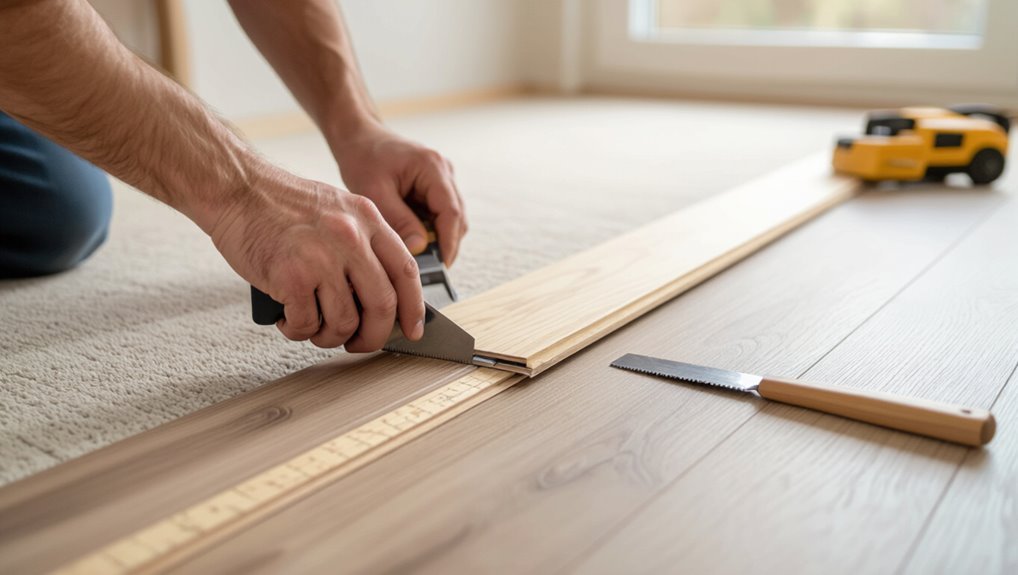
Before you call the job done, install connections, thresholds, and trims to protect edges, cover gaps, and allow for the required expansion space.
Fit changeover strips at doorways, use reducer profiles where laminate meets lower surfaces, and secure thresholds at exterior or tiled openings.
Nail or adhesive-mount trim sparingly so the floor can float freely, then caulk and clean for a finished look.
Preferred Alternative: Proper Removal and Installation Over Subfloor
You’ll usually get better, longer-lasting results by pulling up the carpet and installing laminate directly over a prepared subfloor.
Remove carpet with a utility knife, pry bar, and pliers—most rooms take a few hours—and then clean, level, and perform a moisture test before you lay underlayment and planks.
I’ll walk you through efficient removal steps, time-saving tips, and the key subfloor checks to guarantee a professional finish.
Why removing carpet is usually the best choice
Although it takes more effort up front, pulling up the carpet and installing laminate over the actual subfloor gives you a far more stable, long-lasting result.
You’ll avoid unevenness, moisture traps, and worn padding that shorten laminate life. Removing carpet also guarantees proper acclimation, secure locking, and correct expansion gaps.
In short, you get better performance, easier maintenance, and a more professional finish.
Efficient carpet removal steps (tools, time estimates)
Tackle carpet removal in a few organized steps so you can get to the subfloor quickly and cleanly:
Clear the room, cut carpet into manageable strips, pull up and roll each piece.
Pry out tack strips and trim pad remnants with a utility knife.
Use pliers and a pry bar for stubborn staples.
Expect 1–3 hours for a typical 200–300 sq ft room, depending on condition.
Preparing the subfloor for laminate (cleaning, leveling, moisture testing)
Before laying laminate, make sure the subfloor is clean, level, and dry—these three checks prevent most installation problems.
Remove debris, adhesive, and old padding; vacuum and wipe with a damp cloth.
Fix low spots with self-leveler and sand high areas.
Test moisture with a meter or plastic-sheet method; address excess humidity before installing underlayment and laminate to avoid warping and failures.
Comparison: Laminate Over Carpet vs. Laminate Over Subfloor
You’ll notice big differences in performance and durability when laminate goes over carpet versus a proper subfloor—carpet cushioning can cause movement and premature wear.
Installing over carpet might save time and some labor up front, but it often raises costs later through repairs, reduced resale appeal, or voided warranties.
We’ll compare those trade-offs so you can decide which option makes sense for your budget and long-term goals.
Performance and durability comparison
Although laying laminate over carpet can seem easier, it usually compromises long-term performance compared with installing it over a proper subfloor. You’ll notice more movement, faster wear, and moisture risks on carpet, while a solid subfloor gives stability, longer lifespan, and easier maintenance.
| Issue | Over Carpet | Over Subfloor |
|---|---|---|
| Stability | Poor | Excellent |
| Durability | Reduced | High |
Cost, time, and labor trade-offs
When you weigh laying laminate over carpet against tearing the carpet up and installing over a subfloor, the immediate savings in time and labor can look appealing, but they often hide higher long-term costs.
You’ll save on removal labor and waste hauling now, but expect extra underlayment, fit adjustments, and faster replacement cycles later, which can erase initial savings.
Resale and warranty implications
Because buyers and manufacturers care about installation standards, fitting laminate over carpet can hurt both resale value and warranty coverage compared with installing over a proper subfloor.
You’ll face skeptical appraisers and buyers who see nonstandard installs as shortcuts.
Manufacturers often void warranties for improper substrates, so you’ll lose protection.
Installing over a proper subfloor preserves value, reduces disputes, and keeps warranties intact.
Common Mistakes and Problems to Avoid
Don’t try to install laminate over thick or plush carpet — it won’t support the floor and will cause instability.
Make sure you check for moisture and levelness, and follow the manufacturer’s guidelines exactly.
Pay attention to edge and junction treatments so seams stay secure and the finish looks professional.
Installing over thick or plush carpet
If you try installing laminate over thick or plush carpet, you’ll quickly run into problems: the flooring won’t lock properly, seams will gap, and the surface will feel unstable and springy.
You’ll also compress the underlayment unevenly, causing indentations and accelerated wear.
Pull back the carpet, install a firm subfloor or plywood, then lay laminate per manufacturer specs to guarantee stability and warranty compliance.
Skipping moisture and level checks
When you skip moisture and level checks, you’re gambling with the integrity of the whole installation—excess moisture can warp or cup laminate, and uneven subfloors cause gaps, clicking, and premature failure.
You should test carpet padding, subfloor moisture, and use a straightedge to spot high or low spots.
Fix dampness and level issues first; otherwise your new floor won’t last.
Ignoring manufacturer guidelines
After you’ve checked moisture and level, the next big mistake is ignoring the manufacturer’s installation guidelines—doing so invites warranty voids, improper acclimation, and incompatible underlayments that can ruin the job.
You’ll also risk incorrect expansion gaps, fastening methods, and substrate prep. Follow specified products, acclimation times, and fastening or floating instructions to keep performance predictable and your warranty intact.
Poor edge and transition treatments
Because laminate over carpet creates uneven edges and movement, you’ll need precise edge and junction treatments to avoid gaps, trip hazards, and visible seams.
If you skip proper trim, thresholds, or underlayment stabilization, joints will separate and look amateur.
Use connector strips, secure perimeter molding, and trim the carpet pile.
Test movement before finishing so connectors stay safe and neat.
Tips and Best Practices for a Successful Laminate Installation
Before you start, know when to call a pro—complex subfloors, uneven surfaces, or unclear warranty issues are worth an expert eye.
Pick the right underlayment and leave proper expansion gaps to prevent buckling and noise.
Finally, follow simple long-term care like keeping moisture low and using furniture pads to protect your investment.
When to consult a pro
If you’re tackling a tricky subfloor, complex layout, or want assured results, call a pro—it’s faster and reduces costly mistakes.
Hire help when you spot uneven floors, mold, water damage, or joist problems, or if rooms have built-ins, stair changes, or unusual angles.
Pros guarantee proper removal, structural fixes, and a durable finish, saving time and preventing warranty issues.
Choosing right underlayment and expansion gaps
When you lay laminate over carpet, choosing the right underlayment and leaving proper expansion gaps are essential to prevent buckling, noise, and joint failure; select a dense, firm underlayment rated for floating installations over soft surfaces and follow the manufacturer’s gap recommendations at walls and around fixtures to accommodate seasonal movement.
Also, tape seams, avoid cushioned pads, and maintain consistent gap widths during installation.
Long-term maintenance and care recommendations
Though laminate can handle everyday traffic, you’ll extend its life and keep it looking great by following a few simple care routines:
- Sweep or vacuum daily to remove grit that scratches.
- Use a damp mop with manufacturer-approved cleaner; avoid soaking.
- Place mats at entries and felt pads under furniture to prevent dents.
- Maintain humidity between 35–55% and fix spills quickly to prevent warping.
Cost, Time, and Tools: What to Expect
You’ll want to compare estimated costs for removing carpet versus laying laminate over it, since removal adds labor and disposal fees.
Consider timeframes too: removal and prep can take a day or more, while installing over carpet may be faster but could require more adjustments.
Finally, make a checklist of essential tools and supplies—saw, underlayment, spacers, adhesive or clips, and safety gear—so you’re ready before you start.
Estimated costs for carpet removal vs. installing over carpet
If you’re weighing the choice between pulling up carpet or laying laminate over it, cost — both money and time — is usually the deciding factor.
Removing carpet typically costs $1–$3 per sq ft DIY, $2–$6 pro, plus disposal and subfloor prep.
Installing over carpet might save upfront cash but risks extra underlayment and faster laminate replacement, raising long-term costs.
Timeframes for each approach
When planning your project, remember that pulling up carpet adds a distinct demolition phase that typically takes a few hours for a single room.
Removing carpet, prepping subfloor, and acclimating laminate usually means a full day to a weekend.
Installing over carpet cuts demo time but extends preparation and risks longer adjustment and settling periods, potentially delaying furniture return by several days.
Essential tools and supplies checklist
With the demolition and prep timeline in mind, you’ll want a compact list of tools and supplies to keep the job moving and avoid costly delays.
Gather essentials, estimate quantities, and plan time for each step.
- Pry bar, utility knife, hammer
- Measuring tape, chalk line, square
- Underlayment, vapor barrier, adhesive
- Laminate planks, connector strips, spacers
Real-World Scenarios and Case Examples
You’ll see three common situations where the question comes up: quick rental staging that needs a temporary fix, a budget-minded homeowner weighing cheaper alternatives, and a full renovation where subfloor prep is on the checklist.
Each scenario has different risks, costs, and recommended approaches.
Keep reading to match your situation to the right solution.
Scenario 1 Rental staging: quick temporary solution
Need a quick, nonpermanent flooring fix for a rental? You can lay floating laminate over low-pile, firmly stretched carpet for short-term staging, but expect height, stability, and warranty issues.
Use underlayment and secure connections; avoid glued or heavy traffic areas.
This is a temporary cosmetic trick—remove it before lease end to prevent damage and disputes with your landlord.
Scenario 2 Homeowner on a budget choosing alternatives
If you’re a homeowner on a tight budget, you can still improve a room’s look without tearing out carpet by choosing cost-effective alternatives to laying laminate directly over it.
Consider floating vinyl planks, peel-and-stick tile, or durable area rugs to modernize style.
Raise padding only where needed, secure junctions, and focus on targeted rooms to stretch funds without full demolition.
Scenario 3 Full renovation with subfloor prep
When you’re planning a full renovation and want to lay laminate correctly, prepping the subfloor is the step that determines longevity and performance. Proper removal of old carpet, inspection and repair of the subfloor, and leveling will save you headaches later.
You’ll strip padding, fix rot or squeaks, sand high spots, and install moisture barriers and underlayment so your laminate lays flat, locks properly, and lasts.
Frequently Asked Questions
You’ll find quick answers here to common concerns like whether laminate can go over any carpet, if it’ll void your warranty, and how carpet padding affects performance.
We’ll also cover cost comparisons for installing over carpet versus removing it and the signs that mean the carpet has to come up first.
Read on to make the best decision for your floor and budget.
Can laminate be installed over any carpet?
Although installing laminate over carpet might seem like a quick option, it isn’t suitable for every type of carpet—thick, plush, or heavily cushioned flooring will prevent the laminate from locking together properly and can cause uneven wear or damage.
You can install over low-pile, firm carpets or densely woven commercial-grade rugs, but you’ll need proper underlayment and assessment to guarantee stability and moisture control.
Will installing laminate over carpet void the warranty?
Can installing laminate over carpet void your warranty? Often, yes.
Manufacturers usually require a stable, flat subfloor and specific underlayment; carpet can violate those conditions. If you install over carpet, the maker may deny claims for warping, separation, or premature wear.
Always check warranty terms and get written confirmation from the manufacturer before proceeding to avoid losing coverage.
How does carpet padding affect laminate performance?
Since manufacturers expect a firm, even base, carpet padding can directly undermine laminate performance by introducing too much give and unevenness underfoot.
You’ll get increased flexing, joint stress, and faster wear from constant movement. Padding compresses differently across a room, promoting gaps, clicks, and possibly water infiltration at seams.
For stable, lasting laminate, remove the padding first.
Is it cheaper to install over carpet than to remove it?
Is it truly cheaper to lay laminate over your existing carpet than to remove the carpet first?
You might save labor and disposal costs short-term, but uneven substrata and padding compressibility can cause problems that raise repair or replacement expenses later.
Removing carpet adds upfront cost and time but creates a stable base, often preventing warranty issues and long-term failures.
What signs indicate the carpet must be removed before installing laminate?
Wondering whether you have to pull up the carpet before laying laminate? If the carpet is thick, worn, stained, or has uneven padding, remove it.
Ripples, loose seams, lingering odors, or visible mold and moisture mean removal. Also pull up carpet if tack strips, threshold strips, or padding compress underfoot—laminate needs a flat, stable subfloor for proper locking and warranty compliance.
