Vinyl vs Laminate Flooring: How to Tell the Difference Instantly
You can tell vinyl from laminate instantly by touch and sound: press the plank—vinyl will flex slightly, feel softer and smoother, and often has a shinier surface, while laminate stays rigid, feels firmer with a textured wood grain, and rings or clicks when you step on it. Check edges for a uniform PVC core on vinyl versus a layered fiberboard on laminate, and do a quick water/bead test near a seam. Keep going and you’ll get practical tests, costs, and room-suitability tips.
Quick Answer Which Is Vinyl and Which Is Laminate?
Think of vinyl as waterproof and flexible, often best for bathrooms and basements, while laminate looks more like real wood and works great in living areas where moisture is low.
If you want durability and moisture resistance, you’ll probably pick vinyl; if you want a wood-like appearance on a budget, laminate’s a smart choice.
Below you’ll find a quick chart of key differences and which scenarios suit each.
One-sentence summary of key differences
Although both mimic hardwood, vinyl is a waterproof, flexible synthetic plank made mostly of PVC, while laminate is a rigid, fiberboard-based plank with a photographic wood layer and only water-resistant seams.
To quickly see how to tell the difference between vinyl and laminate flooring, check flexibility, edge treatment, backing material, and how seams handle water—you’ll spot vinyl by bend, waterproof backing, and seamless joints.
Best choice scenarios at a glance
1 quick rule: pick vinyl for wet, high-traffic, or budget-conscious rooms and pick laminate when you want a more rigid, hardwood-like feel and a slightly higher-end look in dry areas.
You’ll choose based on moisture, traffic, budget, and appearance:
- Vinyl: bathrooms, kitchens, rentals
- Laminate: living rooms, bedrooms, formal spaces
- Vinyl: easy maintenance
- Laminate: sharper wood realism
How to Recognize Vinyl and Laminate Instantly
When you want to tell vinyl from laminate at a glance, start by scanning visual cues like surface pattern, bevels, and seam tightness.
Then feel the plank—vinyl is usually more flexible and lighter with a smoother, often softer texture, while laminate feels firmer and heavier.
Tap and walk on the floor to note differences in step response and sound: laminate tends to be louder and more hollow, vinyl quieter and more muted.
Visual cues to inspect on sight
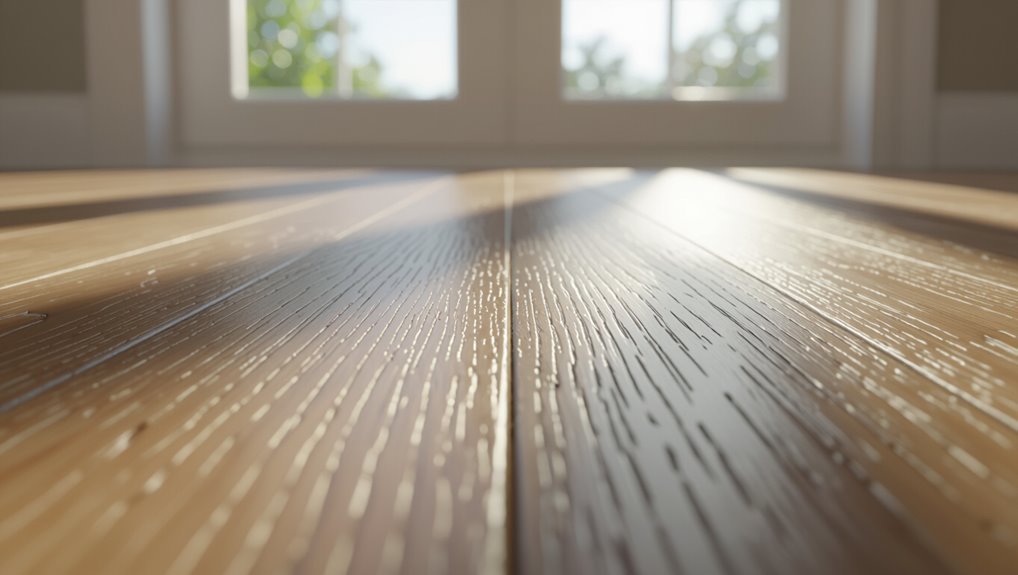
Start by scanning the surface: vinyl often has a softer, slightly glossy finish and printed patterns that repeat regularly, while laminate shows a more textured, wood-like grain and planks with beveled edges that mimic real hardwood.
Look for seam lines: vinyl seams are often welded or nearly invisible; laminate seams are tighter but visible.
Check pattern repeat and edge profile for quick identification.
Touch and feel: texture, flexibility, and weight
Texture gives you immediate clues: run your hand across the surface—vinyl feels smoother and slightly springy under pressure, while laminate has a drier, more pronounced wood grain that you can feel with your fingertips.
Press a plank—vinyl bends a bit and feels lighter; laminate resists bending and seems heavier.
Flexibility and heft help you tell them apart quickly.
Edge and plank construction: seams, bevels, and click systems
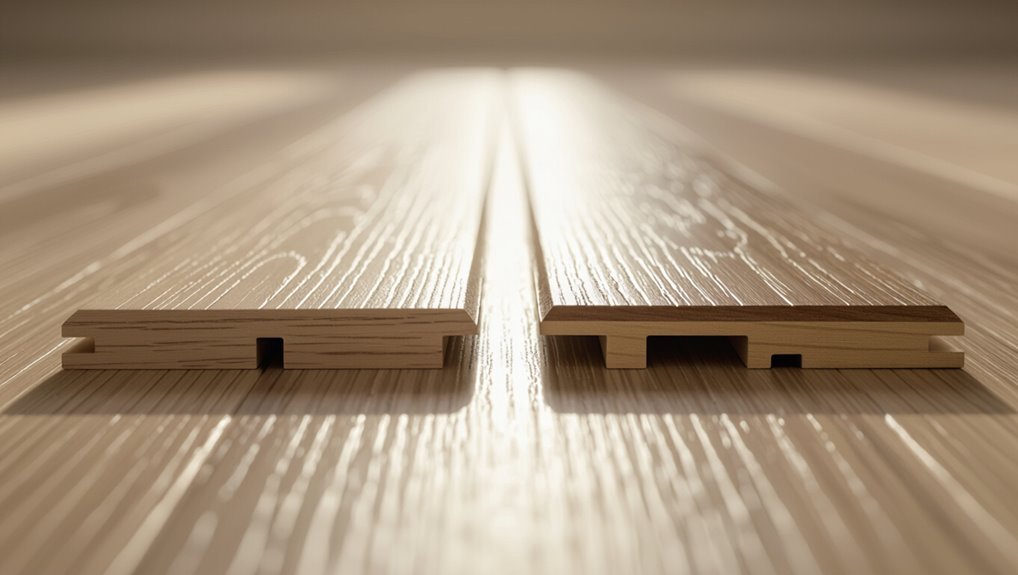
Although edge details are subtle, they’re one of the quickest ways you can tell vinyl from laminate at a glance: vinyl planks often have tighter seams and softer micro-bevels or completely flush edges, while laminate typically shows more pronounced V-grooves and firmer beveled edges to mimic real wood.
Check click systems too: vinyl often snaps or glues; laminate uses click-lock tongues for rigid joins.
Sound and step response differences
When you walk across a floor, the noise and feel underfoot give away whether it’s vinyl or laminate: vinyl tends to produce a quieter, slightly springy thunk because its softer, often cushioned layers absorb impact, while laminate sounds sharper and hollow with a more rigid, clicky response due to its dense HDF core and firmer joints.
You’ll notice vinyl mutes footsteps; laminate echoes more and transmits vibration.
Basic Understanding What Each Floor Is and Why It Matters
To choose the right floor you need to know what each one is: vinyl is made from PVC layers and plasticizers, often welded or extruded, while laminate is a fiberboard core with a printed decorative layer and protective wear layer.
Those core materials and how they’re manufactured determine real-world traits like water resistance, scratch resistance, and how easy repairs or replacements are.
Understanding construction helps you match performance — for example, waterproof vinyl suits wet areas, while laminate can offer durable, affordable wear options in dry spaces.
What is vinyl flooring? core materials and manufacturing
Think of vinyl flooring as a layered synthetic sheet designed to mimic real materials while staying durable and affordable.
You get a wear layer, printed design film, cushioned core (or rigid SPC/WPC), and backing. Manufacturers fuse or heat‑press layers, often adding plasticizers and stabilizers.
The result resists moisture, scuffs, and stains, making vinyl a low‑maintenance, cost‑effective option for many rooms.
What is laminate flooring? core materials and manufacturing
Laminate flooring is a multilayered, engineered product that gives you the look of hardwood or stone without the same cost or upkeep: a tough wear layer protects a printed decorative layer, which sits atop a high-density fiberboard (HDF) core and a stabilizing backing.
You’ll find HDF made from compressed wood fibers and resins, which provides dimensional stability and supports the decorative surface.
How construction affects performance (water resistance, wear, repair)
Because the layers and materials determine how a floor performs, you should read a product’s construction before choosing it.
Vinyl’s waterproof wear layer and solid core resist moisture and are easy to spot-repair or replace.
Laminate’s fiberboard core swells with water unless it has a sealed core; its wear layer resists scratches but repairs are harder, often requiring plank replacement.
Side-by-Side Technical Comparison
Now you’ll compare vinyl and laminate side-by-side across key technical factors: appearance and design, durability and scratch resistance, water performance, installation difficulty, and maintenance.
I’ll highlight how each material stacks up so you can pick the right fit for your space and lifestyle.
Focus on the specific pros and cons of each point to make a clear choice.
Appearance and design options
While both vinyl and laminate can convincingly mimic wood, stone, and tile, you’ll notice key differences in texture, print realism, and customization options that affect how each will look in your space. You’ll find vinyl offers truer embossing and waterproof patterns, while laminate gives layered grain depth and wider plank styles.
| Feature | Vinyl | Laminate |
|---|---|---|
| Texture realism | High | Moderate |
| Pattern variety | Extensive | Broad |
| Customization | Flexible | Limited |
Durability and scratch resistance
Although both vinyl and laminate are engineered for everyday wear, they handle impact, abrasion, and surface damage differently, so you’ll want to match the product to your home’s traffic and activities.
| Property | Vinyl | Laminate |
|---|---|---|
| Scratch resistance | High | Moderate |
| Impact durability | Flexible | Rigid |
| Surface repair | Easier | Harder |
| Pets/kids | Better | Less ideal |
Water and moisture performance
Because moisture is the single biggest deal-breaker when choosing flooring, you should compare how vinyl and laminate stand up to water at every layer. Vinyl resists spills and subfloor moisture; laminate swells if core gets wet. Choose based on room humidity and waterproof rating.
| Layer | Vinyl | Laminate |
|---|---|---|
| Wear layer | Waterproof | Water-resistant |
| Core | Stable (WPC) | Swells (HDF) |
Installation methods and difficulty
When you compare installation methods, vinyl and laminate take different approaches that affect tools, time, and skill level: vinyl often offers click-lock planks, glue-down sheets, or peel-and-stick tiles that you can install with basic tools, while laminate almost always uses a floating click-lock system that snaps together over an underlayment and typically goes in faster but requires precise subfloor leveling.
| Feature | Quick note |
|---|---|
| Tools | Vinyl: basic; Laminate: basic + leveler |
| Time | Vinyl: variable; Laminate: generally faster |
| Difficulty | Vinyl: DIY-friendly; Laminate: needs precision |
| Subfloor | Vinyl tolerates more; Laminate needs flatter surface |
Maintenance and cleaning needs
Having a floor that’s easy to keep clean matters as much as how it goes down, since different installation types affect seams, edges, and moisture resistance you’ll deal with during upkeep. You’ll mop vinyl wet, resist stains, and tolerate spills; laminate needs quick drying and gentler cleaners to protect cores and joins.
| Vinyl | Laminate |
|---|---|
| Waterproof comfort | Quick-dry caution |
| Tough stains | Sensitive seams |
Typical cost ranges and lifespan
1 major factor you’ll weigh is cost versus longevity: vinyl typically runs $1–$7 per square foot for basic to mid-range planks and can last 10–25 years depending on wear layer and installation, while laminate often costs $1–$5 per square foot but usually lasts 10–20 years and is more sensitive to moisture and edge damage.
| Type | Cost/ft² | Lifespan |
|---|---|---|
| Vinyl | $1–$7 | 10–25 yrs |
| Laminate | $1–$5 | 10–20 yrs |
Quick Diagnostic Tests You Can Do in Minutes
You can run a few quick checks to tell vinyl and laminate apart.
Bend a plank, tap it to hear the sound, inspect the edge for the core and pattern repeat, drop a small amount of water to watch absorption, and confirm the backing or underlayment.
These simple tests only take minutes and give clear clues about material and construction.
Step 1 Bend or flex test
Before committing to a purchase, try the bend or flex test on a sample plank to quickly tell vinyl from laminate: hold one end and gently flex it—vinyl will bend smoothly and return to shape, while laminate will feel rigid and may resist or snap back abruptly.
Check edges and printed layer: vinyl stretches slightly, laminate shows a firmer core and may crack under pressure.
Step 2 Tap and listen (sound test)
After the bend test gives you a feel for flexibility, try the tap-and-listen method to check density and construction.
Tap several spots with your knuckle or a coin. Vinyl sounds quieter, muted, or slightly hollow; laminate often rings or clicks, indicating a denser composite core.
Compare tones across planks and between suspected samples to spot consistent differences quickly.
Step 3 Edge inspection for core layer and pattern repeat
When you flip or examine a plank’s edge, look closely for the core material and how the printed pattern aligns—vinyl cores are usually uniform PVC or foam and show a continuous colored layer, while laminate reveals a stacked composite with a distinct printed décor layer on top of a fiberboard core.
Check for repeating motifs along the edge to confirm whether the pattern is printed (common in vinyl) or a separate wear layer over a décor sheet (typical of laminate).
Inspect seams for glue lines, pressed layers, or foam fill; vinyl edges feel homogeneous, laminate shows layered sheet boundaries and printed repeats at cut ends.
Step 4 Water/absorption test (small controlled drop)
If you drip a small amount of water onto a plank’s surface and watch for a minute, you’ll quickly see how each material handles moisture: vinyl beads or soaks in slowly depending on the core type, while laminate will darken or swell at cut edges where the fiberboard core absorbs liquid.
Use a paper towel to blot; no change implies vinyl or sealed SPC, darkening/swelling signals laminate.
Step 5 Check backing and underlayment presence
You’ve just seen how moisture reveals a plank’s core; now check what’s on the underside.
Flip a loose plank or edge to inspect backing: vinyl often has a uniform foam, felt, or plastic backing; laminate usually has a darker, fiberboard layer or attached underlayment strip.
Backing texture and material quickly distinguish types and indicate noise, insulation, and moisture resistance.
Real-world Scenarios: Which to Choose Where (Room-by-room)
Now let’s look at which flooring works best in each room so you can make a practical choice.
You’ll weigh water resistance for kitchens and bathrooms, comfort and style for living rooms and bedrooms, moisture tolerance for basements, and durability for high-traffic commercial or rental spaces.
I’ll point out where vinyl or laminate usually comes out ahead.
Kitchens and bathrooms
Because kitchens and bathrooms face frequent spills, humidity, and heavy foot traffic, choosing between vinyl and laminate comes down to water resistance and durability for your specific layout.
Pick waterproof vinyl where standing water, steam, or frequent mop cleaning occur; it tolerates sinks, dishwashers, and showers.
Use laminate only in dry, well-ventilated zones and avoid seams near fixtures to prevent swelling.
Living rooms and bedrooms
After handling moisture-prone areas like kitchens and bathrooms, consider how living rooms and bedrooms have different demands: lower moisture, more focus on comfort, and heavier emphasis on aesthetics.
You’ll want warmer textures and authentic wood visuals; laminate offers realistic looks and firmness, while vinyl gives softer, quieter underfoot options and better scratch resistance.
Choose based on feel, traffic, and decor.
Basements and high-moisture areas
When you’re dealing with basements and other high-moisture areas, moisture resistance and installation method become the deciding factors: choose waterproof vinyl for true damp environments and click-lock or glued luxury vinyl for stable performance, while only select laminate if it’s specifically labeled water-resistant and the space stays consistently dry.
Also consider subfloor prep, vapor barriers, and raised installations to prevent mold and warping.
High-traffic commercial or rental properties
For high-traffic commercial or rental properties, durability and ease of maintenance should drive your flooring choice.
You want something that resists wear, cleans fast, and lowers replacement frequency. Vinyl often wins for moisture and heavy traffic; laminate offers cost-effective looks but can chip.
Consider:
- Scratch and dent resistance
- Moisture tolerance
- Replacement and repair speed
- Budget versus lifespan
Common Mistakes When Identifying or Choosing Between Them
Don’t assume a plank that looks like wood is laminate—you could be looking at luxury vinyl plank (LVP).
Check installation clues (floating click systems vs glued sheets), moisture ratings, and warranties before you buy.
Don’t base your choice only on appearance or price.
Confusing luxury vinyl plank (LVP) with laminate visually
Although they can look nearly identical at a glance, confusing luxury vinyl plank (LVP) with laminate is a common mistake that can lead you to buy the wrong flooring for your needs.
Check texture, edge profile, and surface sheen closely: LVP often feels softer and has welded edges, while laminate has a distinct click joint and firmer, wood‑fiber core feel underfoot.
Overlooking installation clues (floating vs glued)
When you skip looking at how a floor is installed, you can miss key differences that affect performance and upkeep: laminate almost always clicks together as a floating floor, while many luxury vinyl planks are designed to be glued or fully adhered.
Check edges and backing: a rigid, dense backing often means glue, while tongue-and-groove profiles indicate floating installation—don’t assume by sight alone.
Ignoring moisture ratings and warranties
If you skip checking moisture ratings and warranties, you could end up with a floor that warps, delaminates, or costs you a lot to replace.
Don’t assume all products tolerate damp areas; compare ASTM/AC ratings and manufacturer moisture limits.
Read warranty fine print for water damage exclusions, installation requirements, and transferability.
That prevents expensive mistakes and guarantees the material suits your room’s conditions.
Relying solely on appearance or price
Because looks and sticker price are easy to compare, you might be tempted to pick the floor that looks best or costs least, but doing so can lead to regret.
Don’t ignore durability, maintenance, moisture resistance, or installation complexity. A cheap laminate might warp; an inexpensive vinyl could fade.
Compare specs, warranties, and real-world performance to make a practical, long-lasting choice.
Best Practices and Tips for Buyers, Sellers, and Inspectors
When you’re comparing vinyl and laminate, start by verifying product specs and warranty details on the manufacturer’s website and ask the retailer or contractor for documentation.
Request a sample before you buy and test it at home for color in different light, water resistance, and how it handles foot traffic.
Watch for red flags like vague thickness claims, missing wear-layer info, or marketing that blurs material type and installation requirements.
How to verify product specs and warranty quickly
Although product labels and marketing can look similar, you should verify specs and warranty details directly with the manufacturer and retailer before you buy or list flooring.
Check these quickly:
- Scan model numbers against manufacturer PDFs or site listings.
- Verify wear-layer/thickness and water ratings.
- Confirm warranty scope, duration, and transferability in writing.
- Save screenshots, receipts, and contact names for claims.
Questions to ask retailers or contractors
What should you ask a retailer or contractor before committing to vinyl or laminate?
Ask about water resistance, wear layer thickness, installation method, and recommended underlayment.
Confirm warranty scope, exclusions, and transferability.
Request expected lifespan for your traffic level and maintenance needs.
Ask if they’re certified for the brand, get a written estimate, and clarify cleanup, disposal, and post-installation support.
When to request a sample and how to test it at home
Anyone thinking about new flooring should request samples early—before you finalize style or color—so you can test them in the actual rooms where they’ll be installed.
Order multiple pieces of each option, test for color in daylight and artificial light, feel texture, check bevels and thickness, perform a water spot test, and set samples on the subfloor to assess fit and connections before committing.
Red flags in product labeling and marketing
After you’ve tested samples in your rooms, start scrutinizing labels and marketing claims before you buy.
Don’t trust vague terms like “water-resistant” without specs, unclear wear-layer thickness, or missing core composition.
Watch for exaggerated warranties, non‑existent certifications, and photography that masks texture.
Ask sellers for technical sheets, independent test results, and installation details so you can compare apples to apples.
Short Checklist for Instant Identification (Printable)
Keep a handy 8-point checklist with you for quick, on-the-spot ID when you’re shopping or inspecting floors.
It’ll help you confirm material, surface texture, plank edges, backing, water resistance, thickness, wear layer, and installation method at a glance.
Print it out and tuck it in your phone case or clipboard for instant reference.
8-point quick checklist for in-store or on-site use
Use this 8-point quick checklist to instantly identify vinyl vs. laminate on-site or in-store—it’s compact, printable, and designed for fast, reliable decisions when you can’t wait for lab tests.
Use the list below, then run through texture, edge, core, and weight checks. Carry a knife, magnet, and loupe for quick confirmation.
- Feel texture and flexibility
- Inspect bevels and seams
- Check core density
- Test weight and sound
FAQ
You’re probably wondering practical things like whether you can install laminate in a bathroom and if luxury vinyl plank is truly waterproof.
You’ll also want quick ways to tell engineered wood, laminate, and vinyl apart, plus which option helps resale value and whether laminate will swell after getting wet once.
Read on for clear, concise answers to each question.
Can I install laminate in a bathroom?
Wondering if laminate works in a bathroom? You can install laminate, but it’s risky.
Standard laminate resists spills briefly but swells with standing water or high humidity. Use water-resistant or specially sealed products, tight seams, proper underlayment, and excellent ventilation.
Expect more maintenance and faster replacement than with waterproof alternatives. Consider moisture-prone areas carefully before choosing laminate.
Is luxury vinyl plank considered waterproof?
Is luxury vinyl plank (LVP) truly waterproof? Yes—most LVP is waterproof because its core and wear layer resist water, so spills and humid rooms are usually fine.
However, seams and underlayment matter: imperfect installation or damaged edges can let water reach the subfloor.
Choose fully waterproof products and install per manufacturer guidelines to maintain performance and warranty.
How can I tell if flooring is engineered wood, laminate, or vinyl?
Since waterproofing concerns often push people to compare products, you’ll want to be able to spot engineered wood, laminate, and vinyl at a glance and by feel.
Check edges and weight: engineered wood feels denser with real-grain surface and plywood layers visible on cut edges.
Laminate has a fiberboard core and repeating printed pattern.
Vinyl is lighter, flexible, and often waterproof with a plastic backing.
Which has better resale value: vinyl or laminate?
Which adds more to your home’s value depends on quality and market expectations: high-end luxury vinyl plank (LVP) often outperforms basic laminate because buyers prize waterproofing and realistic wood visuals.
However, premium laminate installed well can still be attractive in markets that favor traditional hardwood looks.
You should choose durable, well-reviewed products and professional installation to maximize resale appeal and buyer confidence.
Will laminate swell if it gets wet once?
A quick splash or brief spill usually won’t ruin laminate, but you should wipe it up immediately because repeated or prolonged exposure lets moisture seep into the core and cause swelling.
If water soaks through seams or the protective layer stays compromised, boards can warp, cup, or separate.
Prompt drying, good underlayment, and sealed edges prevent single incidents from becoming permanent damage.