How to Change Your Bathroom Floor Without a Full Renovation
You can update your bathroom floor without a full renovation by choosing low‑disruption options like peel‑and‑stick vinyl, floating vinyl planks, tile overlays, or floor paint. Prep the substrate: check for moisture, level and repair soft spots, remove trim, and follow product specs. Install per manufacturer directions, leave expansion gaps, and use proper underlayment or membranes to avoid future problems. These approaches save time and money, and if you want specifics on methods, timelines, and tips you can keep going.
Quick Answer Can You Change a Bathroom Floor Without a Full Renovation?
Yes—you can update your bathroom floor without a full renovation by using options like peel-and-stick vinyl, luxury vinyl plank, floating engineered wood, or tile-over strategies.
You’ll typically finish a small bathroom in a day or two for DIY-friendly vinyl (costs $100–$800) or take a few days to a week for professional tile or LVP installs (costs $500–$3,000+).
Choose based on durability, water resistance, and your budget.
Short summary of options and typical time/cost ranges
If you don’t want a full renovation, you’ve still got several practical ways to change your bathroom floor—each varies in cost, time, and how invasive it is. You can learn how to change bathroom floor with peel-and-stick, vinyl plank, tile overlay, painting, or floating install. Compare time/cost to pick what fits your budget and schedule.
| Option | Typical time/cost |
|---|---|
| Peel-and-stick | 1 day / $50–$200 |
| Vinyl plank | 1–2 days / $200–$800 |
| Tile overlay | 1–3 days / $300–$1,200 |
| Paint | 1 day / $20–$100 |
| Floating install | 1–2 days / $150–$600 |
Basic Understanding Why Avoid a Full Renovation?
You can save a lot by updating just the floor — partial fixes cut costs, take less time, and cause far less disruption to your home.
Stick to a targeted replacement when the subfloor, plumbing, and layout are sound.
Only consider a full renovation if there’s structural damage, persistent leaks, or you need to reconfigure the space.
Benefits of partial floor updates (cost, time, disruption)
Because a full bathroom renovation eats time, money, and often disrupts your home routine, doing a partial floor update lets you target the problem areas and get big visual and functional gains with far less cost, shorter project timelines, and minimal upheaval to daily life.
You’ll replace worn sections, refresh style, and fix leaks quickly, keeping plumbing intact and avoiding major demolition or prolonged inconvenience.
When a full renovation is actually necessary
While partial updates solve many issues quickly, a full renovation becomes necessary when problems run deeper than surface wear—like chronic water damage, major structural rot, persistent mold, outdated plumbing or wiring that won’t meet code, or a layout that simply won’t function for your needs.
You should choose renovation when safety, code compliance, long-term costs, or fundamentally changing layout and flow are at stake.
Overview of Non-Destructive and Low-Disruption Flooring Options
You can update your bathroom without tearing out the subfloor by choosing from several low-disruption options.
Consider peel-and-stick tiles or sheet vinyl for quick installs, floating luxury vinyl planks or interlocking click-lock floors for a durable, water-resistant finish, or paint and epoxy coatings if you’re working over concrete or existing tile.
Each approach varies in cost, skill level, and waterproofing, so pick the one that fits your timeline and comfort with DIY.
Peel-and-stick vinyl tiles and planks
If you want a quick, low-disruption update, peel-and-stick vinyl tiles and planks let you refresh a bathroom floor without demolition or a long contractor timeline.
You’ll cut, press, and smooth pieces directly onto a clean, dry subfloor. They’re affordable, water-resistant, and DIY-friendly, but inspect edges for lifting, avoid heavy-duty wet areas, and follow adhesive and substrate instructions for longevity.
Luxury vinyl plank (floating) installations
Peel-and-stick tiles work well for quick updates, but if you want a more durable, upscale look without ripping up the subfloor, luxury vinyl plank (LVP) floating installations are a strong next step.
You’ll float planks over an existing, level floor using an underlayment for moisture and sound control. Installation’s fast, reversible, and resilient to bathroom traffic while staying budget-friendly and low-disruption.
Interlocking vinyl or click-lock floors
Consider interlocking vinyl (also called click-lock) when you want a water-resistant, sturdy floor that goes in fast without tearing out the subfloor.
You’ll fit planks together with a simple tongue-and-groove system over underlayment, allowing floating installation. It’s durable, repairable by swapping boards, and suitable for damp spaces when seams are tight.
You’ll need minimal tools and little downtime.
Peel-and-stick waterproof sheet vinyl
When you want a nearly instant, low-disruption upgrade, peel-and-stick waterproof sheet vinyl gives you a smooth, continuous surface that stays right over your existing floor. Its adhesive backing lets you apply large sheets without nails or glue guns, minimizing dust and demolition.
You’ll cut sheets to fit, seam-weld or overlap edges, and roll surfaces for adhesion. It’s waterproof, easy to clean, and quick to install.
Paint and epoxy coatings for concrete or tile
If you liked the low-disruption approach of peel-and-stick vinyl, paint and epoxy coatings offer another quick way to refresh concrete or glazed tile without ripping up the subfloor.
You’ll prep by cleaning and etching, use primer, then apply durable epoxy or porch-and-floor paint.
Expect improved appearance, slip-resistant additives, and a few days of curing—an affordable, low-profile upgrade.
Tile-over-tile and thin-set porcelain options
Although it adds a bit more weight, tile-over-tile and thin-set porcelain let you install a new durable surface without tearing out the old floor, so you’ll save time, labor, and disposal costs.
You’ll prep and level existing tile, use a polymer-modified thin-set, and set new porcelain tiles or large-format tile. This minimizes disruption while delivering a long-lasting, water-resistant finish.
Floating engineered wood designed for bathrooms
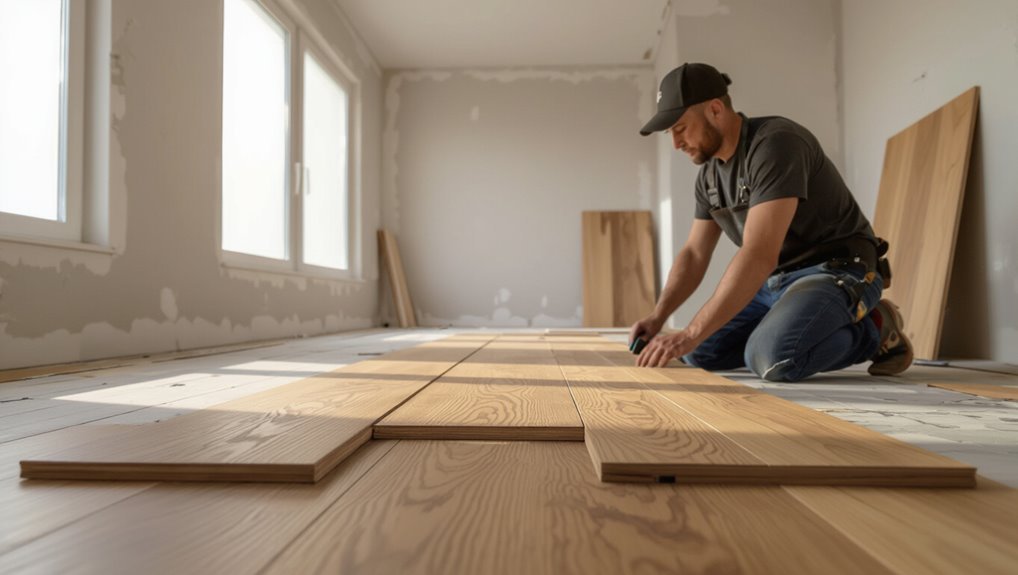
Because it installs without gluing or nailing to the subfloor, floating engineered wood gives you a bathroom floor that looks warm and natural while keeping demolition and dust to a minimum.
You can DIY or hire pros, use waterproof cores, and swap planks later without major fuss.
- Quick, low-dust install
- Waterproof or water-resistant options
- Gentle on subfloors
- Replaceable planks
Step-by-Step Guide Preparing Your Bathroom Floor (Step 1)
Start by inspecting the substrate—plywood, concrete, or existing tile—to see what you’re working with and note any soft spots or loose tiles.
Check moisture levels and floor flatness with a moisture meter and straightedge; most floors need to be within 1/8″ over 6 feet unless your product specifies otherwise.
Repair minor issues (patch, shim, or level) and remove trim or connector strips so you can install new flooring with clean edges.
Inspecting substrate: plywood, concrete, existing tile
Before you lay any new flooring, inspect the substrate—plywood, concrete, or existing tile—to make certain it’s sound, level, and free of moisture or bonding issues.
Check plywood for rot, loose or squeaky boards, and proper fastening.
On concrete, look for cracks, spalling, or efflorescence.
For tile, verify tiles are firmly bonded and grout is intact before proceeding.
Moisture and level checks (tools and tolerances)
1 quick set of checks will tell you if your floor is dry and flat enough to accept new material: use a moisture meter for wood or concrete, a vinyl moisture test or calcium chloride kit for slabs, and a long level or 6–10 ft straightedge to spot dips and high spots.
Take multiple readings across the room; acceptable moisture and flatness tolerances depend on your chosen flooring—consult its specs.
How to repair minor substrate issues
Repair small substrate problems promptly so your new floor has a level, stable base.
Remove loose mortar or thinset, clean debris, and let the area dry.
Fill shallow hollows or cracks with patching compound or self-leveler per manufacturer instructions.
Sand or feather edges once cured, then vacuum and wipe.
Check again for flatness before installing underlayment or new flooring.
Removing trim and preparing transitions
Start by removing baseboards, shoe molding, and any threshold strips so you can work on a clean, unobstructed floor edge.
Label and store trim for reinstallation. Pry carefully to avoid damaging drywall; patch any nicks.
Measure door clearances and trim doors if needed.
Install or plan transition strips matching new flooring thickness to guarantee smooth, watertight joins at doorways and tub or shower entries.
Step-by-Step Guide Installation Methods (Step 2)
Now that the subfloor’s ready, you’ll choose an installation method and follow the specific prep and technique for that material.
For peel-and-stick tiles you’ll focus on surface prep, layout, and adhesion; for floating vinyl planks you’ll set underlayment, leave expansion gaps, and make precise cuts; for sheet vinyl you’ll measure carefully, seam and glue properly; for painted or epoxy finishes you’ll clean, prime, and roll; and for thin porcelain over tile you’ll use a decoupling membrane, thinset, and grout.
Pick the method that fits your skill level and tools, and work methodically to avoid costly mistakes.
Installing peel-and-stick tiles: surface prep, layout, adhesion tips
Before you lay any peel-and-stick tiles, make sure the floor is completely clean, dry, and smooth so the adhesive can bond properly.
Measure and snap chalk lines from the room center, dry-fit tiles to confirm layout and pattern.
Peel backing gradually, press firmly with a roller, and trim edges precisely.
Allow adhesive to cure per manufacturer instructions before light use.
Laying floating vinyl planks: underlayment, expansion gaps, cutting
When you’re ready to install floating vinyl planks, begin by laying the proper underlayment, planning expansion gaps, and prepping your cutting tools so each row fits snugly without binding.
Roll out foam or cork underlayment, tape seams, and stagger joints for stability.
Leave 1/4–1/2 inch gaps at walls, cut end pieces with a utility knife or saw, and dry-fit before locking planks.
Applying sheet vinyl: measurements, seams, adhesive techniques
Start by measuring the room carefully and planning your sheet layout so seams fall in low-traffic or less-visible areas; you’ll want to account for pattern repeat, wall irregularities, and a 3–6 inch overlap at seams for trimming.
Cut accurately, dry-fit, then trim. Use pressure-sensitive or full-spread adhesive per manufacturer, roll seams with a seam roller, and weight seams until set for a smooth, watertight finish.
Painting or epoxy coating tile/concrete: cleaning, priming, rolling
Prep the surface thoroughly so paint or epoxy bonds and lasts: clear away loose grout, dirt, and grease with a stiff brush and a pH-neutral cleaner, then etch or sand glazed tile and mechanically abrade concrete to create a profile for adhesion.
Rinse, dry, vacuum, then apply a compatible primer.
Roll thin, even coats, allow proper cure between layers, and lightly sand for smooth finish.
Installing thin porcelain/tile over existing tile: membrane, thinset, grout
If you decide against painting or coating your old tile, you can lay thin porcelain or tile right over it for a durable, long-lasting floor.
Clean and degrease, then assess flatness.
Apply a bonded membrane for waterproofing and adhesion, trowel thinset properly, set tiles with spacers, and grout after cure.
Check manufacturer specs and movement joints for a reliable result.
Sealing and finishing: grout sealers, caulk, transitions
Once your tiles and grout have cured, you’ll seal and finish the job to protect joints, prevent stains, and create watertight connections where the floor meets walls, fixtures, or different materials.
Apply a penetrating grout sealer per instructions, wipe excess, and let cure.
Run silicone caulk at wall and fixture joints.
Install threshold strips between dissimilar floors and secure them tightly for a clean, durable edge.
Tools, Materials, and Cost Checklist
Before you start, make a quick checklist of the essential tools for your chosen method—tile, vinyl, or floating planks—so you won’t get held up mid-job.
Compare material tiers (budget, midrange, premium) and note typical costs per square foot to match durability and style to your budget.
With tools and material prices mapped out, you can plan time, helpers, and a realistic total cost.
Essential tools by method
Tackle the tools and materials for each flooring method the same way: match the job to the right gear so you don’t waste time or money.
For peel-and-stick, grab a utility knife, straightedge, roller, and cleaner.
For vinyl plank, add spacers, tapping block, and pull bar.
For tile, include a wet saw, trowel, spacers, grout float, and sponge.
Material quality tiers and estimated costs
You’ve lined up the right tools for each method; now match those tools to material quality and cost so you can budget accurately. Choose low, mid, or premium tiers: vinyl or laminate save money; porcelain or engineered wood costs more but lasts. Factor installation difficulty and adhesives. Compare expected lifespan to price before buying.
| Tier | Est. cost/sq ft |
|---|---|
| Low | $1–$3 |
| Mid | $3–$7 |
| Premium | $7–$15 |
| Luxury | $15+ |
Comparison Pros and Cons of Each Option
You’ll want to weigh each flooring option by how well it handles water and wear, since durability and waterproofing vary a lot.
Consider maintenance needs and expected lifespan alongside how the floor will look and whether it fits your style.
Finally, think about installation difficulty and whether you’ll tackle it yourself or hire a pro.
Durability and waterproofing comparison
While different flooring types can look similar at first glance, their durability and waterproofing vary a lot, so you should pick materials based on how the room gets used.
Porcelain tile resists water and wear but needs good grout sealing.
Luxury vinyl handles moisture and impacts well.
Engineered wood tolerates humidity short-term.
Sheet vinyl and epoxy offer seamless waterproofing but vary in scratch resistance.
Maintenance and longevity
Because maintenance routines and lifespan vary so much by material, pick a floor that matches how much time and care you’ll realistically give it.
Vinyl needs simple sweeping and occasional mopping, resists stains, and lasts 10–20 years.
Tile demands grout upkeep but endures decades.
Engineered wood cleans easily but can need refinishing sooner.
Consider replacement cost, repair ease, and warranty.
Aesthetics and style flexibility
Maintenance needs and lifespan will shape what you’ll tolerate visually, but style matters just as much—your bathroom floor sets the room’s mood and can make small spaces feel larger or cozier.
Pick tile for timeless, varied patterns; vinyl for realistic wood or stone looks; painted or stenciled concrete for bold, custom designs. Each offers trade-offs in texture, color range, and long-term appearance.
Installation difficulty and DIY-friendliness
Different materials demand very different skill levels, so pick a floor you can actually install or afford to have installed. You’ll weigh time, tools, and tolerance for mistakes. Some options are beginner-friendly; others need pros.
| Material | DIY Difficulty | Notes |
|---|---|---|
| Vinyl plank | Low | Click system, minimal tools |
| Sheet vinyl | Low | Faster coverage, tricky seams |
| Tile | High | Wet saw, grout skills |
| Laminate | Medium | Needs flat subfloor |
Common Mistakes and How to Avoid Them
When you change a bathroom floor, watch for common mistakes that cause failures: poor substrate prep and adhesion, unchecked moisture and mold risk, and using the wrong underlayment or incompatible materials.
Don’t skip proper expansion gaps and junctions, which lead to buckling and edge damage. Addressing these issues early will save time and money down the road.
Poor substrate prep and adhesion failures
If you skip proper substrate preparation or use the wrong adhesives, your new floor can fail long before it should—tiles lift, grout cracks, and water finds its way underneath.
Clean, dry, and level the subfloor; remove old glue and loose material.
Choose adhesive and thinset rated for your substrate and tile.
Test adhesion, follow manufacturer cure times, and work in small sections.
Ignoring moisture issues and mold risk
Because bathrooms are constantly exposed to water, ignoring moisture and mold risks will sabotage even the best-looking floor.
You must inspect for leaks, fix plumbing or grout issues, and guarantee proper ventilation.
Use moisture-resistant backer where needed and allow substrates to dry fully before installing.
Monitor hidden cavities for dampness and treat any mold promptly to prevent recurrence and health hazards.
Wrong underlayment or incompatible materials
1 common mistake is choosing the wrong underlayment or mixing incompatible materials, and that error will ruin a new bathroom floor fast.
You’ll get cracking, buckling, or adhesive failure if substrates, underlayments, and tile or vinyl don’t match.
Check manufacturer specs, use moisture-resistant underlayment, and avoid mixing plywood, cement board, and unsupported vinyl without proper adhesives and primers to guarantee longevity.
Skipping proper expansion gaps and transitions
When you skip proper expansion gaps and shifts, your new bathroom floor won’t have room to move and will buckle, pop loose, or crack as temperatures and humidity change.
Don’t force boards tight against walls or thresholds. Leave manufacturer‑recommended gaps, use connector strips at doorways, and install flexible caulk where needed.
These simple steps prevent buckling, squeaks, and costly repairs down the road.
Best Practices and Tips for a Long-Lasting Update
Pick waterproof, slip-resistant materials and match thresholds so floor heights stay consistent between rooms.
Keep a simple maintenance routine—clean grout, reseal where needed, and address leaks quickly—to extend the life of your floor.
Tackle straightforward installs yourself, but call a pro for complex subfloor work, mold, or plumbing changes.
Choosing waterproof materials for bathrooms
Because bathrooms face constant moisture and spills, choosing genuinely waterproof materials is the single best step you can take to prevent damage and cut long-term maintenance.
Pick waterproof vinyl, porcelain tile with sealed grout, or waterproof engineered wood rated for bathrooms. Use moisture-resistant underlayment, silicone seals at edges, and waterproof threshold strips.
Prioritize durability, slip resistance, and easy cleaning for lasting results.
Matching thresholds and maintaining consistent heights
If you want a professional, safe finish, match threshold profiles and keep floor heights consistent across doorways so alterations remain smooth and tripping hazards are eliminated.
Check subfloor levels, use shims or underlayment to raise low spots, and select transition strips that match thickness and style.
Test door clearance, secure thresholds firmly, and seal edges to prevent moisture and movement.
Regular maintenance tips to extend life
While a quality installation sets the foundation, regular care keeps your new bathroom floor performing and looking its best—clean spills promptly, sweep or vacuum grit that can scratch surfaces, and follow manufacturer-recommended cleaners and sealers for your material.
Mop with gentle solutions, dry damp areas, use mats at entries, trim pet nails, and tighten loose trim or grout spots early to prevent bigger damage.
When to call a pro vs. DIY
When you’re planning a floor update, weigh the complexity, your skill level, and the value of your time.
Simple tasks like swapping out vinyl planks or regrouting small areas are often doable yourself, but structural fixes, extensive waterproofing, or leveling subfloors call for a pro.
If you’re uncertain, get a consult estimate; pros prevent costly mistakes, while DIY saves money on straightforward, low-risk jobs.
Timeframes and Project Planning
Start by mapping out a realistic timeline for your chosen method—tile, vinyl, or engineered wood—since each has different prep and installation steps.
Account for access to the bathroom, where you’ll shower and store supplies, and schedule drying and cure times into the plan so you don’t rush the work.
Staging materials and tools before you begin will keep the project efficient and help you stick to the schedule.
Typical timeline for each method
Plan each bathroom floor method around realistic blocks of time so you know what to expect and can book trades or clear your schedule.
Peel-and-stick or vinyl planks: 1 day for prep and installation.
Tile over existing: 2–3 days for layout, tile, grout.
Full subfloor repair plus tile: 3–5 days.
Professional hardwood or encaustic tile may take longer—plan accordingly.
How to plan access, drying/cure times, and staging
Because bathroom projects block a small but essential part of your home, map access, drying windows, and staging before you begin so you won’t be surprised by downtime or traffic bottlenecks.
Plan overnight or alternate-bathroom use, schedule adhesive and grout cure times, and ventilate to speed drying.
Keep tools, towels, and toiletries staged nearby. Communicate timelines with household members and contractors.
Real-Life Scenarios and Case Examples
You’ll see practical examples like a small powder room refresh under $500 that lists materials and simple steps.
You’ll also read a mid-budget full-bath floor swap using floating vinyl and what that process looks like.
Finally, you’ll learn when tile-over-tile made sense, with clear pros and cons to help you decide.
Small powder room refresh under $500 (materials and steps)
Refresh a tiny powder room for under $500 by focusing on high-impact, low-cost swaps: peel-and-stick flooring, a fresh coat of paint, updated hardware, and a few decorative touches.
Buy 12–15 sq ft of vinyl tiles, primer and paint, new faucet/knob, and a mirror.
Prep, remove trim, install tiles, paint, swap hardware, caulk edges, and style with a small rug and plant.
Mid-budget full-bath floor swap using floating vinyl
Tackle a mid-budget full-bath floor swap with floating vinyl when you want durability, water resistance, and a professional look without hiring a pro.
You’ll remove baseboards, level subfloor, install underlayment, click-lock planks, and trim edges.
Expect one weekend for a 40–70 sq ft room, moderate tools, and modest cost.
Real-life results: clean seams, easy maintenance, and quick resale appeal.
When tile-over-tile made sense pros and cons
When the existing tile is sound, well-bonded, and level, laying new tile over it can save time and money while minimizing demolition dust and disruption.
You’ll avoid subfloor repair in many cases, cut labor costs, and finish faster.
Downsides: added floor height, limited pattern options, and hidden issues remain.
Choose tile-over-tile for stable substrates and temporary upgrades, not for long-term fixes.
FAQ
You’ll likely have a lot of practical questions as you plan your bathroom floor project, from whether you can install new flooring over existing tile to how waterproof it really needs to be.
We’ll cover peel-and-stick durability, options for fixing a sagging subfloor without replacing joists, and whether painting tile will hold up around a shower or tub.
Read on for clear, actionable answers to these common concerns.
Can I install new flooring over existing tile?
Wondering if you can put new flooring over existing tile? Yes — in many cases you can, saving time and mess.
Verify tile is level, secure, and clean. Use an appropriate underlayment or self-leveler for height and adhesion, and choose flooring compatible with subfloor conditions.
Check door clearances and local building codes; when in doubt, consult a pro.
Is peel-and-stick flooring durable enough for bathrooms?
If you liked the idea of laying new flooring over existing tile, peel-and-stick tiles might seem like an even quicker option—so are they durable enough for bathrooms?
They hold up well in low-moisture bathrooms if you choose quality vinyl with a strong wear layer and install on a clean, flat surface.
Seal seams near tubs and use bath mats to extend life.
How do I fix a sagging or bouncy subfloor without replacing joists?
A sagging or bouncy subfloor doesn’t always mean you need to tear out joists—there are several effective repairs you can do from above or between joists to stiffen the floor and stop movement.
You can add plywood or OSB overlays, install blocking or sistering plates between joists, fasten with long screws and construction adhesive, and stiffen areas with rim joist strapping or metal reinforcement to eliminate bounce.
Will painting over tile last in a shower or tub area?
Painting tile in a shower or tub area can work for a short time, but it rarely lasts under constant water and steam exposure.
You can improve adhesion with thorough cleaning, etching primer, and a high-quality epoxy or urethane coating, but expect chips, peeling, and discoloration over months to a few years.
For durability, consider true waterproof resurfacing or replacing damaged tile.
How waterproof does bathroom flooring really need to be?
How waterproof your bathroom floor needs to be depends on where it’s installed and how it’s used: high-traffic zones and wet areas like around tubs, showers, and toilets demand much more protection than a powder room.
Choose materials with appropriate water resistance—vinyl, tile with sealed grout, or waterproof laminates—for wet zones, and use underlayments and sealants.
Maintain seals and fix leaks promptly.