How to Remove Old Vinyl Tile Flooring From Any Subfloor Surface
You can remove old vinyl tile from virtually any subfloor if you prepare, protect yourself, and pick the right method for the substrate and adhesive. Start by evaluating the subfloor, testing for hazards like asbestos or mold, and wearing a respirator, gloves, and eye protection. Use scrapers, heat, solvents, or a floor machine as needed, work in small sections, and clean up adhesive residue before repairing the subfloor. Keep going to learn specific steps, tools, and safety tips.
Quick Answer Can You Remove Old Vinyl Tile from Any Subfloor?
You can usually remove old vinyl tile from most subfloors, but the effort and outcome depend on what’s underneath—plywood, concrete, or particleboard all behave differently.
If the substrate is sound and you want a fresh finish, removal makes sense; if it’s fragile, heavily damaged, or bonded with asbestos-containing adhesive, covering might be safer and faster.
Use those quick checks—substrate type, damage level, and hazard signs—to decide whether to remove or cover.
Short summary of feasibility and expected outcomes
Although many vinyl tiles come off fairly easily, whether you can remove them from any subfloor depends on the subfloor type and how the tiles were installed.
You can usually remove vinyl tile with hand tools or a floor scraper, but glued or backed tiles may need heat, adhesive remover, or sanding.
Expect variable effort, minor subfloor repairs, and possible professional help for stubborn cases.
When to remove vs. cover (quick decision criteria)
If the tiles come up easily and the subfloor is sound, removing them usually makes sense; otherwise covering can be faster and cheaper.
Remove when adhesives, damage, or height limits prevent a reliable new finish, or when you want full control over subfloor repairs.
Cover when tiles are well-adhered, flat, and structurally stable, or when time, budget, or minimal disruption matter most.
Basic Understanding What Is Old Vinyl Tile and Why Removal Matters
Old vinyl tile can be sheet, vinyl composite tile (VCT), or peel-and-stick, and it’s usually bonded with mastic or pressure-sensitive adhesives that vary in removal difficulty.
You’ll often be working over concrete, plywood, OSB, or cement board, so knowing your subfloor helps you choose tools and repair steps.
Be aware that older materials and adhesives can contain asbestos, harbor mold, or emit VOCs, so you should test and take precautions before you start.
Types of vinyl tile and typical adhesives
Many homeowners run into two main categories of vinyl tile: luxury vinyl tile (LVT) and vinyl composition tile (VCT), and each behaves differently during removal.
You’ll also face adhesives: pressure-sensitive, mastic, and cutback. Know which you’re dealing with to choose tools and safety gear.
- LVT: often glued or click-lock
- VCT: glued with strong mastics
- Cutback: contains asbestos risk
Common subfloor materials (concrete, plywood, OSB, cement board)
Wondering what’s under your vinyl tile? You’ll find common subfloors that affect removal method and repair needs. Know each type so you’ll choose proper tools and avoid damage.
- Concrete: durable, may need scrapers or grinders for residual adhesive.
- Plywood: fastens tiles; watch for splinters and seam gaps.
- OSB/cement board: rough surfaces; cement board is water-resistant, OSB swells if wet.
Potential hazards: asbestos, mold, adhesive VOCs
Because vinyl tile installations span decades, you could encounter hidden hazards—friable asbestos in tiles or mastics, mold in moisture-damaged areas, and volatile organic compounds (VOCs) from old adhesives—that affect how you should remove and dispose of materials.
You should test suspect materials, use proper PPE, and follow local disposal rules to protect yourself and others.
- Test before disturbing
- Wear respirator and gloves
- Dispose per regulations
Safety Precautions and Required Tools
Before you start, protect yourself and the area with proper safety gear—respirator, gloves, eye protection—and control dust to limit contamination.
Gather essential hand tools like scrapers and floor knives, plus optional powered tools such as a heat gun or oscillating tool if you’re comfortable using them.
If you suspect asbestos, lead, or structural problems, stop and call a qualified professional for testing and removal.
Safety gear and contamination controls
Start by gearing up properly: you’ll need a fitted NIOSH‑approved respirator (P100 for dust and N95 for low-risk jobs), chemical-resistant gloves, eye protection, and disposable coveralls with booties to limit skin contact and spread of debris.
Seal the work area, run negative air if possible, and bag waste promptly to prevent contamination.
- Isolate and seal HVAC vents
- Use dedicated waste containers
- Decontaminate tools and boots before exiting
Essential tools and optional powered tools
When you’re ready to remove old vinyl tile, gather a few reliable hand tools—floor scraper or putty knife, pry bar, hammer, utility knife, bucket, stiff-bristle broom and dustpan, and a quality tape measure—so you can work methodically and minimize damage; consider adding knee pads and a small heat gun for stubborn adhesive.
Use optional powered tools cautiously to speed the job.
- Oscillating multi-tool
- Floor scraper machine
- Heat gun (larger)
When to call a professional (testing, asbestos, structural issues)
After you’ve gathered your hand tools and decided whether to use power equipment, know when a pro should handle the job:
If tiles predate 1980 or labeling’s unclear, get asbestos testing. Call licensed abatement if positive.
If subfloor sagging, rotten, or joists exposed, hire a contractor for structural repairs.
For large projects or permit needs, consult professionals to guarantee safety and code compliance.
Quick Preparation Steps Before You Start
Before you lift a single tile, walk the floor to mark damaged areas and adhesive hotspots so you know where to focus your efforts.
Clear the room and seal off adjoining spaces to control dust and debris while you work.
If the vinyl was installed before 1980, get a professional asbestos test and follow the results—don’t start removal until you know it’s safe.
Inspecting the floor and mapping trouble spots
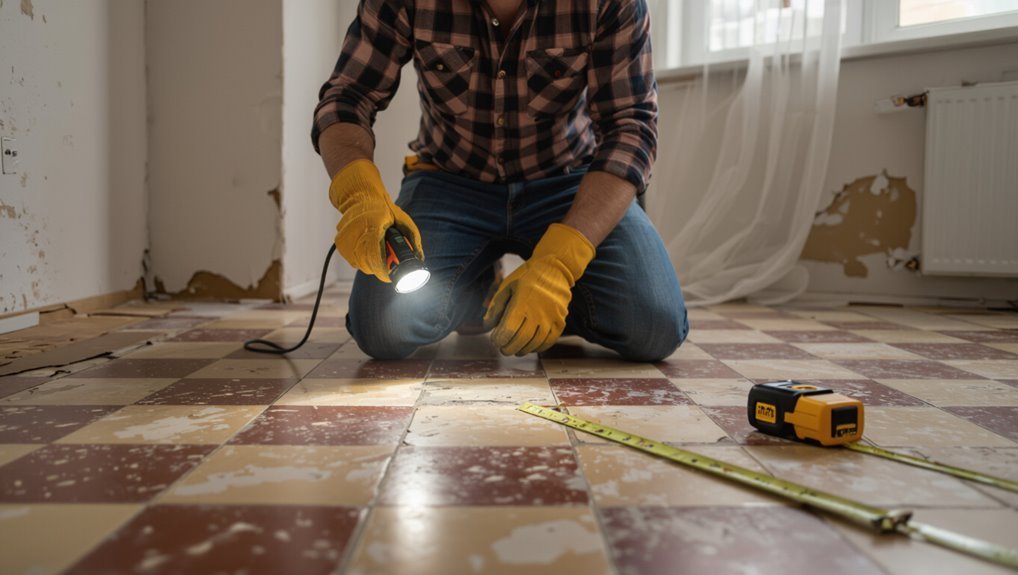
Although you can jump straight into scraping, take a few minutes to walk the room and map trouble spots so you know what tools and time you’ll need.
Check for cracked, loose, or bubbled tiles, adhesive residue, seams, changes, and moisture stains.
Note areas with nails, adhesive buildup, or uneven subflooring, then mark them so you can prioritize repairs and appropriate equipment.
Clearing the space and creating containment
When you’re ready to start, clear the room of furniture, rugs, and loose items so you’ve got an open, safe workspace; remove wall hangings and switch plates, and roll up any door thresholds that could catch your tools.
Seal vents, doorways, and adjoining rooms with plastic sheeting and painter’s tape.
Lay down drop cloths, position a trash bin, and set up good lighting and ventilation.
Testing for asbestos and interpreting results
If your vinyl tiles were installed before the 1980s, you should assume they might contain asbestos and arrange for testing before you start demo.
Hire a certified asbestos inspector to collect samples safely. Don’t disturb tiles yourself.
Wait for lab results: non-detect means proceed with normal removal; positive means hire licensed abatement contractors or follow strict containment, PPE, and disposal rules to protect health.
Step-by-Step Removal Process (Primary How To Framework)
Start by pulling up any loose tiles and trim so you can see where adhesive remains.
Then soften stubborn glue with steam, a heat gun, or a chemical remover before scraping depending on whether you’re on concrete or a wood subfloor.
Finish by tackling glued backing and mastic with stronger heat, solvents, or a floor scraper as needed.
Step 1 Remove loose tiles and edging pieces
Pull up any loose vinyl tiles and the base edging first so you can see what you’re working with and remove tripping hazards.
Work methodically across the room, prying edges gently with a putty knife and keeping removed pieces organized for disposal.
- Start at room corners or where tiles lift naturally
- Use gloves and eye protection
- Bag debris as you go to keep the area safe
Step 2 Soften adhesive (steam, heat gun, chemical adhesive remover)
Soften the adhesive to make tile removal easier and reduce damage to the subfloor — you can use steam, a heat gun, or a chemical adhesive remover depending on the adhesive type and your ventilation options.
Work in small sections, test a spot, and protect yourself with gloves and a respirator if using chemicals.
- Use steam for heat-sensitive adhesives.
- Use a heat gun for localized softening.
- Use solvent for stubborn glue.
Step 3 Scrape tiles and adhesive from hard floors (concrete)
Set your leverage tools at a low angle and work in manageable sections so you can remove tiles and the softened adhesive without gouging the concrete; a margin trowel, floor scraper, or 4-in-1 tool held close to the slab will lift tiles while a wide, flat scraper clears residual glue.
Work steadily, keep blades sharp, and discard tile debris safely.
- Use overlapping strokes
- Replace dull blades promptly
- Vacuum dust between passes
Step 4 Scrape tiles and adhesive from wood subfloors (plywood/OSB)
Start by protecting the subfloor and yourself, then work in small sections to lift tiles and scrape adhesive from plywood or OSB without damaging the wood.
Use a floor scraper and putty knife at a low angle; pry gently, keeping blades flat to avoid gouges. Sand minor residue smooth and vacuum between passes.
- Use sharp tools and steady pressure
- Keep wood wetting minimal
- Check for thin veneer damage
Step 5 Dealing with glued backing or stubborn mastic
Once you’ve removed the bulk of the tiles and scraped the easy adhesive, you’ll often find a stubborn glued backing or mastic that won’t come off with a scraper alone.
Use these steps:
- Apply a solvent approved for your subfloor, let it soften per instructions.
- Scrape gently with a stiff scraper, reapplying solvent as needed.
- Clean residue with mineral spirits and allow to dry completely.
Step 6 Mechanical removal options (floor grinder, oscillating tool, floor stripper)
When manual scraping and solvents can’t budge the toughest mastic, bring in mechanical tools—floor grinders, oscillating tools, or powered floor strippers—to remove adhesive and level the subfloor more quickly and efficiently.
Choose based on scale, access, and substrate; control dust and wear PPE. Match blades/discs to adhesive type and test a small area first.
- Floor grinder: fast, large areas
- Oscillating tool: precise, edges
- Floor stripper: efficient, mid-size jobs
Step 7 Cleaning residual adhesive and preparing surface for new flooring
Tackle the sticky residue now by removing every bit of old adhesive and leveling the subfloor so your new flooring will bond properly.
Scrape, apply adhesive remover where needed, and sand or skim high spots until the surface is smooth, clean, and dust-free.
Vacuum thoroughly and wipe with a damp mop before flooring installation.
- Scrape and chemically treat stubborn glue
- Sand or skim high spots
- Vacuum and wipe clean
Step 8 Moisture and flatness checks after removal
Before you install new flooring, check both moisture levels and flatness so your materials won’t warp or fail later.
You should test concrete or wood with a moisture meter, perform a calcium chloride or relative humidity test if needed, and use a straightedge and level to find high or low spots.
Repair or seal before laying new material.
- Use a moisture meter
- Run a straightedge check
- Patch and seal defects
Subfloor-Specific Considerations and Techniques
Once you’ve stripped the vinyl, check the subfloor type so you can choose the right repairs and prep.
For concrete that’s pitted or glossy you’ll be etching, patching, and using self-leveling compounds, while plywood/OSB may need sanding, panel replacement, or additional fastening.
Decide whether water-damaged backer board or underlayment can be spot-repaired or should be replaced entirely before installing new flooring.
Concrete subfloors etching, patching, levelers
Prepare the concrete subfloor by checking for contaminants, repairing damage, and creating the right profile for adhesion; this guarantees any new material bonds correctly and the finished floor lays flat.
Clean, etch or grind to remove sealers. Patch cracks and low spots with polymer-modified repair mortar. Use self-leveling compound where needed; follow manufacturer moisture and cure guidelines.
- Etch or grind
- Patch cracks
- Self-leveler
Plywood and OSB sanding, replacing damaged panels, fastening
Assess your plywood or OSB subfloor for structural integrity and surface condition before you proceed.
Sand high spots, remove adhesive residue, and check for rot or delamination. Replace panels that flex or crumble.
Fasten loose panels with appropriate screws and adhesive to joists, stagger seams, and guarantee a smooth, stable surface for new flooring.
- Sand and clean
- Replace damaged sheets
- Screw and glue panels
Cement backer board and underlayment repair vs. replacement
When you’re working over cement backer board or an underlayment, decide quickly whether repair will give you a reliably flat, stable base or if replacement’s the safer long-term choice.
Small cracks, isolated delamination, or surface voids can often be patched and reinforced, but widespread movement, bowed seams, or water-damaged sections usually call for full panel replacement.
Patch, screw, and seam-tape where sound.
- Patch small voids with thinset.
- Replace panels with movement or rot.
- Fasten and tape seams for stability.
Common Problems and How to Solve Them
You’ll likely hit a few common problems when removing vinyl tile, so be ready to tackle stubborn adhesive, damaged subfloor, hidden moisture or mold, and uneven surfaces that telegraph through new flooring.
Start by identifying each issue early—scrape and test adhesives, inspect for rot or soft spots, check for dampness or mold, and use a straightedge to find hollows or high spots.
Address each with the right fix—adhesive remover and scraping, subfloor repair or replacement, mold remediation and drying, and leveling compounds or plywood to smooth the surface.
Stubborn adhesive that won’t come off
If adhesive refuses to scrape off, don’t panic—you’ve got several effective options for breaking it down.
Work safely: ventilate, wear gloves and a mask. Try heat, solvents, or mechanical methods, testing a small area first. Remove residue gradually to avoid gouging the subfloor.
- Use a heat gun on low and scrape gently.
- Apply a recommended adhesive remover.
- Sand or grind stubborn spots carefully.
Damaged subfloor revealed after removal
A damaged subfloor can show up as soft spots, rot, mold, or uneven areas once the vinyl and adhesive are gone. You’ll want to assess the extent before moving forward.
Inspect, probe, and measure to decide repair or replacement. Follow safety precautions and document damaged zones.
- Cut out and replace rotten sections
- Sister joists for sagging areas
- Use exterior-grade plywood where needed
Hidden moisture or mold under tiles
When you pull up old vinyl tiles, trapped moisture or hidden mold can quickly become obvious and demand prompt action; don’t ignore musty smells, staining, or dampness, because they signal conditions that can worsen structural damage and health risks.
You should dry, test, and remediate promptly to protect health and subfloor integrity.
- Dry thoroughly and ventilate
- Test and identify mold species
- Remediate or replace damaged materials
Uneven surface and telegraphing through new flooring
Moisture and mold aren’t the only issues you’ll face after removing old vinyl—uneven subfloors can cause new coverings to telegraph seams, bumps, and adhesive lines right through.
You’ll need to inspect, level, and repair before installing. Use a self-leveler, patch low spots, and sand high ridges. Follow manufacturer flatness specs to prevent telegraphing.
- Use a floor leveler
- Patch and feather edges
- Sand high spots
Best Practices and Prevention Tips
When you strip vinyl tiles, work slowly and use the right tools to minimize damage to the subfloor.
Pick prep methods that match your new flooring—underlayment, moisture barriers, and smoothing compounds vary by type.
Finally, plan disposal and recycling for old vinyl and adhesive so you stay compliant and reduce waste.
How to minimize damage during removal
Start by planning each step so you can lift tile without harming the subfloor or surrounding surfaces. Work slowly, score grout lines, and pry tiles at low angles to avoid gouges.
Use protective coverings for trim and floors, and keep adhesive removal gentle with heat and scraper.
- Use sharp, narrow scrapers
- Protect adjacent surfaces
- Remove adhesive gradually, not aggressively
Choosing the right preparation for your new flooring type
Although you’ve removed the old vinyl, choosing the right prep for your new flooring is essential to guarantee durability and a professional finish. Assess the subfloor type, levelness, and moisture conditions, then select underlayment, adhesives, or vapor barriers that match your final material’s requirements.
You’ll want to:
- Choose underlayment compatible with tile, wood, or LVT.
- Test and mitigate moisture.
- Level and repair imperfections before installation.
Disposal and recycling tips for old vinyl and adhesive waste
1 clear plan for disposing of old vinyl and adhesive will save you time, reduce environmental harm, and may even cut costs.
You should separate materials, check local recycling or hazardous-waste rules, and bag adhesive scraps. Consider hazardous testing for older floors.
Reuse, donate salvageable tiles, or hire a certified hauler for asbestos risk.
- Check local facility rules
- Use sealed bags
- Donate usable tiles
Tools and Methods Comparison
You’ll choose between hand tools and powered options based on speed, cost, and how rough they are on the subfloor. Here’s a quick visual to compare common trade-offs:
| Tool/Method | Key points |
|---|---|
| Hand tools | Lower cost, slower, gentler on surface |
| Powered tools | Faster, higher cost, can damage subfloor |
| Chemical removers | Effective on adhesive, require safety precautions |
| Mechanical methods | Quick removal, more dust and surface impact |
Consider safety, budget, and the condition of your floor when deciding.
Hand tools vs. powered tools speed, cost, surface impact
Decide which tools match your priorities: hand tools give you low cost and fine control but take longer, while powered tools speed the job at higher expense and greater risk to the subfloor.
If you favor precision and minimal damage, pry bars, scrapers, and chisels work.
If you need speed on large areas, use oscillating or rotary tools carefully and protect the substrate.
Chemical removers vs. mechanical methods effectiveness and safety
When weighing chemical removers against mechanical methods, consider both what you need removed and how much risk you’ll accept: solvents and softeners can dissolve old adhesive without heavy scraping, but they require ventilation, PPE, and careful disposal.
On the other hand, mechanical approaches—scrapers, grinders, or powered oscillating tools—remove material faster and without toxic fumes yet increase the chance of gouging the subfloor and creating dust that you’ll need to contain.
Choose based on residue, time, and safety controls.
Estimated Time, Cost, and Labor Expectations
Expect a few hours for a small room and a full day or more for larger rooms, with time increasing if you’ve got glued tiles or damaged subflooring.
Costs vary widely—DIY mainly costs tools and disposal fees while pros charge labor plus removal and hauling, often making professional work pricier but faster.
We’ll compare specific time ranges by room size and subfloor type and break down typical DIY versus contractor costs next.
Time estimates by room size and subfloor type
Because room size and subfloor type directly shape the work, estimate time and cost by matching the space to realistic labor rates and removal difficulty. You’ll adjust hours for tile condition, adhesive, and access. Use this quick guide to set expectations and plan help.
| Room/Subfloor | Typical Time |
|---|---|
| Small/plywood | 2–4 hrs |
| Medium/concrete | 4–8 hrs |
| Large/plywood | 6–12 hrs |
| Large/concrete | 8–16 hrs |
Cost breakdown: DIY vs. professional removal
Now that you’ve matched time estimates to room size and subfloor type, let’s compare what those hours mean for your wallet and labor choices.
You can save on labor by DIYing—expect tool rental, disposal, and 1–3 days of hard work. Hiring pros costs more but speeds things up and protects subfloor integrity.
- DIY: lower cash, higher time
- Pro: higher cost, less risk
- Hybrid: DIY prep, pro finish
FAQ Frequently Asked Questions
You probably have a lot of questions, so let’s answer the basics about asbestos, covering up old vinyl, adhesive issues, hidden mold or rot, and legal disposal.
I’ll explain how to spot possible asbestos and when to call a pro, whether you can install new flooring over existing tile, and how residue affects adhesion.
You’ll also get quick guidance on handling mold or rot and disposing of tile and adhesive properly.
How can I tell if my old vinyl contains asbestos?
If your home was built or renovated before the late 1980s, there’s a chance older vinyl tiles or the adhesive beneath them contain asbestos, but you can’t tell just by looking.
Assume risk, avoid sanding or breaking tiles, and don’t remove material yourself. Hire a certified asbestos inspector to collect samples and test them.
Follow removal or encapsulation recommendations based on lab results.
Can I install new flooring over old vinyl instead of removing it?
Thinking about laying new flooring over old vinyl? You can in many cases, provided the vinyl is flat, firmly bonded, and clean.
Thin-set tile, vinyl plank, and floating floors often work over stable vinyl, but check manufacturer guidelines and local building codes.
Remove loose sections, level seams, and guarantee door clearances. When in doubt, remove the old layer for best long-term results.
Will adhesive residue prevent new flooring from adhering?
When adhesive residue remains on the subfloor, it can block proper bonding and cause new flooring to lift, telegraph, or wear unevenly. You’ll need to assess the type and amount of residue and follow manufacturer guidelines for the new material before proceeding.
Light, non-crumbly residue might accept some adhesives, but most installations require complete removal or approved primers to guarantee reliable adhesion and warranty compliance.
What if I find mold or rot under the tiles?
Adhesive problems aren’t the only hidden issue you might uncover — mold or rot under vinyl tiles requires immediate attention because it can damage the subfloor and create health risks.
Stop work, isolate the area, and wear PPE.
Remove damp material, dry and treat with a mold killer, and replace rotten subfloor sections.
If contamination is extensive, call a professional for remediation and structural repair.
How do I dispose of vinyl tile and adhesive legally?
How should you dispose of old vinyl tile and the adhesive that held it down?
Check local regulations — some areas classify vinyl and asbestos-containing adhesives as hazardous.
Wet-scrape residues to reduce dust, bag waste in heavy-duty plastic, and label containers if required.
Take materials to a licensed construction-demolition landfill or hazardous-waste facility.
Don’t burn or dump; follow disposal and recycling programs.