
What Is Laminate Flooring? Types, Benefits, and Common Misconceptions
Laminate flooring is a multi-layer synthetic plank that mimics wood or stone while staying budget-friendly and DIY-friendly. You’ll get a decorative image, a rigid core (HDF, MDF, WPC, or SPC) and a tough wear layer that resists scratches and fading. Options include matte, gloss, embossed or hand-scraped surfaces and click-lock or glue installations. It’s not fully waterproof unless specified and can’t be refinished; keep humidity controlled. Keep going to learn about types, costs, and care.
What Is Laminate Flooring?
Laminate flooring is a multi-layer synthetic product that mimics wood or stone with a durable wear layer on top.
It’s great for budget-conscious homeowners, renters, and busy households—ideal in living rooms, bedrooms, and high-traffic areas.
You’ll get easy installation and low maintenance, though it can be less durable than real hardwood and isn’t always water-proof.
One-sentence definition
A durable, multi-layered flooring product, laminate mimics wood or stone by sandwiching a photographic layer and protective wear layer over a fiberboard core.
When you ask what’re laminate floors, know they’re engineered panels with a rigid core, decorative image, and clear wear layer that resist scratches and fading.
They install via click-lock or glue, and provide a cost-effective, low-maintenance alternative to natural materials.
Who it’s best for and common uses
If you want durable, low-maintenance flooring that looks like wood or stone without the price tag, laminate is a smart choice for many situations.
You’ll find it ideal for busy households, rentals, starter homes, and DIY installs. Use it in living rooms, bedrooms, hallways, and some kitchens.
Avoid high-moisture areas unless you choose water-resistant or specifically designed planks.
Quick pros and cons
When you want wood- or stone-look flooring without the upkeep or cost, laminate gives you that look with tough, scratch-resistant wear layers and easy, floating installation.
You’ll get affordability, durability, and low maintenance, though it’s less water-tolerant and can’t be refinished.
- Pros: budget-friendly, scratch-resistant, quick install
- Cons: vulnerable to standing water, can sound hollow
- Consider: underlayment for comfort and moisture barrier
Basic Understanding Composition and How Laminate Works
You’ll learn how laminate is built layer by layer—from the tough wear layer and printed design to the dense core and stabilizing backing.
I’ll also explain the two main manufacturing methods (HPL vs. DPL) and what that means for durability.
Finally, you’ll see how realistic looks are made with high‑resolution printing, textures, and embossing.
Layer-by-layer breakdown (wear layer, design layer, core, backing)
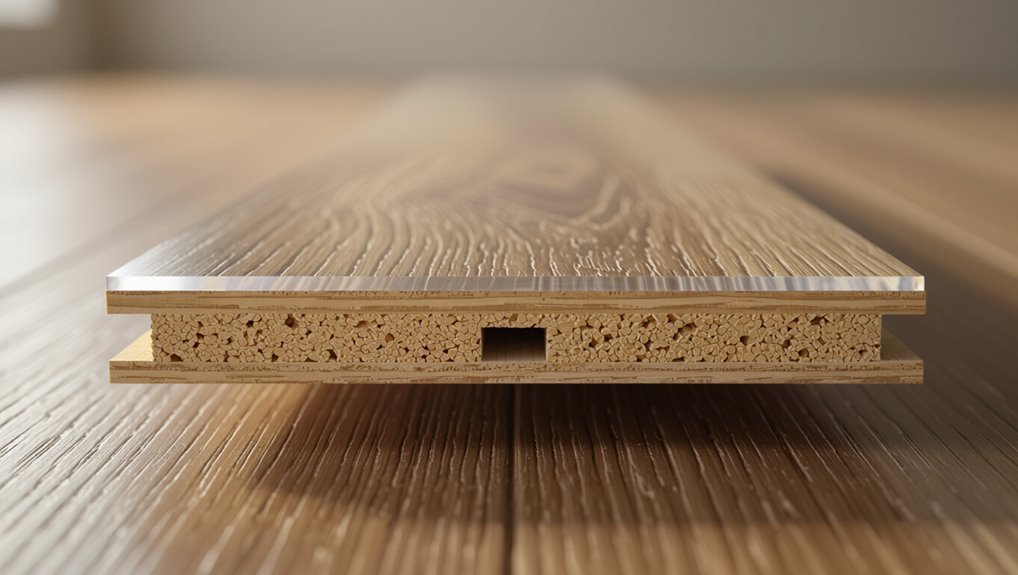
Think of laminate flooring as a stacked system where each layer has a specific job: the wear layer resists scratches and stains, the clear protective sheet preserves appearance, the design layer provides realistic wood or tile visuals, the core gives structure and impact resistance, and the backing stabilizes moisture balance and prevents cupping.
Together they deliver durability, aesthetics, and dimensional stability.
Manufacturing process overview (HPL vs. DPL)
After looking at how each layer contributes to performance, it helps to see how those layers are actually made—laminate flooring is produced mainly by two pressing methods: High-Pressure Laminate (HPL) and Direct-Pressure Laminate (DPL).
You’ll find HPL uses separate layers fused under heat and high pressure for greater durability, while DPL consolidates layers in a single press for cost-effective, thinner panels with faster production.
How appearance is created (printing, textures, embossing)
Appearance in laminate flooring comes from a combination of printed décor papers, surface textures, and embossing techniques that work together to mimic real wood or stone.
You’ll see high-resolution prints for grain and color, then textures aligned to the print.
Embossing presses patterns into the wear layer, adding depth and realism.
This coordination determines authenticity, gloss, and tactile feel underfoot.
Types of Laminate Flooring
Now that you know how laminate is made, you’ll want to compare types by core material (HDF, MDF, WPC, SPC), surface/finish (high gloss, matte, hand‑scraped, embossed), and installation style (click‑lock, glue‑down, floating).
Pay attention to thickness and AC rating too, since they determine durability and where you can use the flooring.
I’ll walk you through what each option means and which situations they suit best.
By core material (HDF, MDF, WPC, SPC)
Core material defines how a laminate floor performs, so choosing between HDF, MDF, WPC, and SPC matters more than the surface pattern alone. You’ll pick HDF for durability, MDF for budget, WPC for waterproof comfort, and SPC for toughness. Compare quickly:
| Core | Strength | Best use |
|---|---|---|
| HDF | High | Homes |
| MDF | Moderate | Low-traffic |
| WPC | Waterproof | Bathrooms |
| SPC | Rigid | Commercial |
By surface/finish (high gloss, matte, hand-scraped, embossed)
While the core determines performance, the surface finish shapes how the floor looks and feels underfoot.
You’ll choose high gloss for sleek shine and light reflection, matte for subtle, modern appeal, hand-scraped for rustic texture that hides wear, or embossed for realistic grain and depth.
Each finish alters maintenance, slip resistance, and visual warmth, so match finish to style and lifestyle.
By installation style (click-lock, glue-down, floating)
You’ll pick an installation style based on skill level, subfloor condition, and how permanent you want the floor to be.
Click-lock (tongue-and-groove) snaps together for fast, DIY-friendly floating installs over underlayment. Glue-down bonds planks to concrete for stability and lower height buildup.
Floating systems can be loose-laid or glued at seams—choose based on moisture, movement, and future removal plans.
By thickness and AC rating explained
Once you’ve chosen an installation style, the next decision is plank thickness and AC rating, which determine durability, comfort, and where the floor performs best. Thicker planks feel sturdier and reduce noise; higher AC ratings suit heavy traffic. Match thickness to subfloor and AC to room use for best longevity.
| Thickness (mm) | Typical Use |
|---|---|
| 6–8 | Low traffic |
| 8–10 | Moderate |
| 10–12 | High |
| 12+ | Commercial |
Benefits of Laminate Flooring
You’ll find laminate gives strong bang for your buck compared with hardwood and many vinyls, offering realistic looks at a lower cost.
It’s built to resist scratches, cleans up easily, and comes in tons of styles to match your decor.
Plus, you can install it quickly yourself, which saves time and money.
Cost and value comparison vs. hardwood and vinyl
Although laminate usually costs less up front than hardwood and high-end vinyl, it gives you strong value for money by balancing price, durability, and ease of installation. You get attractive looks at lower cost, simpler DIY fit, and reasonable longevity. Compare options quickly:
| Option | Upfront Cost | Value |
|---|---|---|
| Laminate | Low | High |
| Hardwood | High | Medium |
| Vinyl | Medium | Medium |
Durability and scratch resistance
Durability matters, and laminate delivers by using a tough wear layer that resists scratches, dents, and everyday scuffs better than many hardwood finishes.
You’ll find options with enhanced abrasion ratings for high-traffic rooms and pet-friendly surfaces that hide claw marks.
While not indestructible, laminate holds up to daily life, reducing visible wear and preserving appearance longer than many budget alternatives.
Maintenance and ease of cleaning
Because laminate resists stains and won’t trap dirt like some textured floors, you’ll spend less time cleaning and more time enjoying your space.
Sweep or vacuum regularly, mop with a damp (not wet) microfiber cloth, and use manufacturer-approved cleaners.
Wipe spills promptly to prevent warping at seams.
Avoid abrasive tools, steam cleaners, and waxes to preserve the wear layer and finish.
Aesthetic versatility and design options
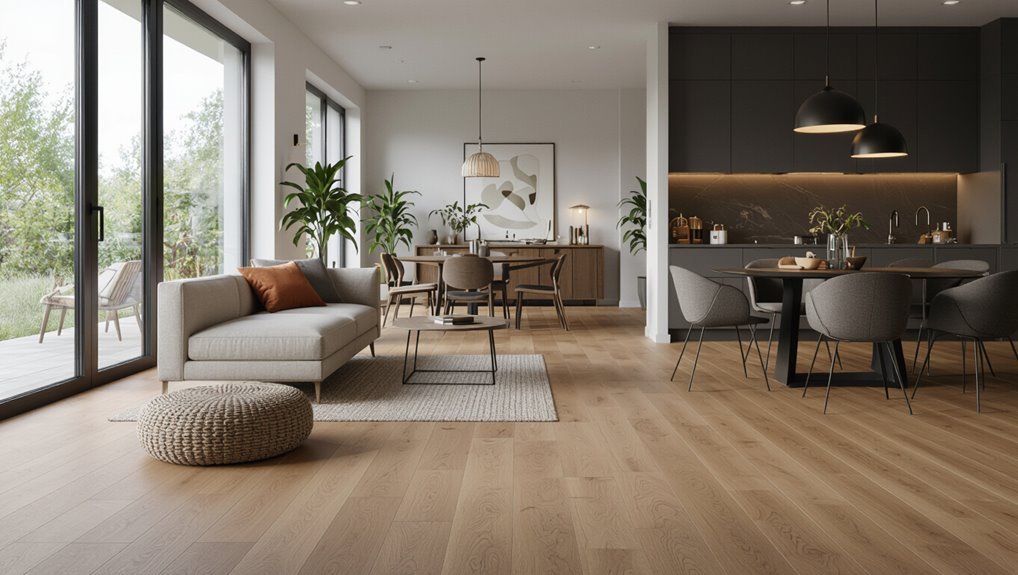
Besides being low-maintenance, laminate gives you a huge range of looks to match any room or style.
You can pick realistic wood grains, stone, tile, or contemporary patterns in many colors and plank sizes.
Layered textures and protective finishes keep visuals crisp, while coordinated trims and connections let you tailor the final look to suit traditional, modern, rustic, or minimalist interiors.
Installation speed and DIY-friendliness
One of the biggest perks of laminate is how quickly you can get new floors in—many rooms go from bare to finished in a day or two.
You’ll find click-lock planks simple to handle with basic tools, so you can tackle installation yourself and save labor costs.
Pre-finished surfaces and straightforward underlayment make projects predictable, fast, and suitable for confident DIYers.
Common Misconceptions and Myths
You might’ve heard that laminate is just cheap-looking vinyl, but modern laminates can mimic wood and stone convincingly.
Don’t assume laminate can’t handle moisture—performance varies by core type and specific product.
Also, laminate generally can’t be refinished like hardwood, and quality differs widely, so check ratings rather than trusting blanket judgments.
“Laminate is just cheap-looking vinylâ
Don’t confuse laminate with cheap vinyl—laminate’s come a long way and often mimics real wood and stone much more convincingly.
You’ll find high-definition photographic layers, realistic textures, and bevels that create depth. Quality laminates resist scratches and wear better than many vinyls, offer varied plank sizes and finishes, and generally provide a more authentic look at a competitive price.
“Laminate can’t handle moisture†nuance by core type
While laminate often gets lumped together as vulnerable to water, performance actually depends on the core type: standard HDF cores swell when exposed to moisture, while newer water-resistant or waterproof cores—like hydrocore, SPC (stone plastic composite), and WPC (wood plastic composite)—are engineered to stand up to spills and higher humidity.
You should still follow manufacturer installation and maintenance guidelines, but these cores let you use laminate confidently in many moisture-prone spaces.
“Laminate can be refinished like hardwoodâ
Think of laminate as a finished, replaceable surface rather than a refinishable hardwood floor: its wear layer is a printed decorative film sealed with a clear coating, so you can’t sand and refinish it the way you’d solid wood.
If the surface is worn or damaged, you replace individual planks or the whole floor; refurbishing means swapping, not sanding and re-staining.
“All laminates are low-quality†how ratings matter
Although some people dismiss laminate as cheap, the category covers a wide range of quality levels, and ratings help you tell the difference: manufacturers and third-party standards rate durability, wear resistance, moisture tolerance, and installation ease.
So a high-rated laminate can perform far better than a low-end option and sometimes rival engineered wood for everyday use.
Check AC ratings, warranty terms, and core type to match performance to your needs.
How to Choose the Right Laminate for Your Home
When choosing laminate for your home, match the AC rating and thickness to the room’s use and pick a core type suited for kitchens, basements, or high-traffic areas.
Consider color, plank size, and texture to fit your style while weighing budget and comparing warranties.
These choices will help you balance performance, appearance, and long-term value.
Match use-case to AC rating and thickness
Pick the right AC rating and thickness by matching them to how you’ll actually use the room: higher AC ratings mean better wear resistance for heavy-traffic or commercial-style spaces, while greater thickness improves feel, sound insulation, and longevity.
- Entryways/living rooms: choose AC3–AC4, 8–12 mm for durability and comfort.
- Bedrooms: AC2–AC3, 8 mm for economy and adequate wear.
- High-traffic/commercial: AC4–AC5, 12+ mm for maximum resilience.
Choosing core type for rooms (kitchens, basements, high-traffic)
Different core constructions handle moisture, impacts, and heavy use in distinct ways, so you’ll want to match the core to the room’s demands.
Use HDF or water-resistant cores for kitchens, damp-proof or SPC/WPC for basements, and thicker, high-density cores for hallways and living rooms with heavy traffic.
Prioritize warranties and installation method for longevity and stability.
Selecting color, plank size, and texture for style
After matching the core to each room’s demands, you’ll want the look and feel to fit your home’s style and daily use.
Choose light tones to enlarge small spaces, dark for warmth. Pick plank width—wide for modern, narrow for traditional.
Prioritize texture: smooth for formal rooms, embossed or hand-scraped for rustic resilience.
Test samples under your lighting before deciding.
Budget considerations and warranty comparison
Budget matters—you’ll want to balance upfront cost with long-term value. Compare wear layers, core type, and installation needs against warranties. Longer, transferable warranties often signal quality. Prioritize realistic coverage for pets, water, and heavy traffic, and factor installation and maintenance into your budget before deciding.
| Tier | Cost | Typical Warranty |
|---|---|---|
| Basic | Low | 5–10 yrs |
| Mid | Moderate | 10–25 yrs |
| Premium | High | Lifetime |
Installation Overview
Before you start, you’ll acclimate the flooring, check the subfloor and moisture, and plan your layout and underlayment.
Then you’ll follow clear steps for installing click-lock or glue-down planks and finish with trim, junctions, and proper expansion gaps.
Finally, use a brief checklist to decide whether it’s a DIY job or time to hire a pro.
Preparation: acclimation, subfloor checks, moisture testing
While acclimating your laminate and checking the subfloor, you’ll guarantee a smooth, long-lasting installation by confirming temperature, humidity, flatness, and moisture levels meet the manufacturer’s requirements.
Test moisture with a meter, repair or level uneven spots, and let boards sit in the room 48–72 hours. Follow specs to avoid warping or warranty voids.
- Use a reliable moisture meter
- Check for squeaks or high spots
- Keep HVAC running during acclimation
Step 1 Layout planning and underlayment selection
With your boards acclimated and the subfloor checked, plan your layout to minimize waste and guarantee a balanced appearance across the room.
Measure length and width, mark a straight starting line, and decide plank direction for light and traffic.
Choose underlayment based on subfloor type, sound reduction, and moisture barrier needs.
Keep spacers for expansion and note trim and threshold placements.
Step 2 Installing click-lock or glue-down planks (key steps)
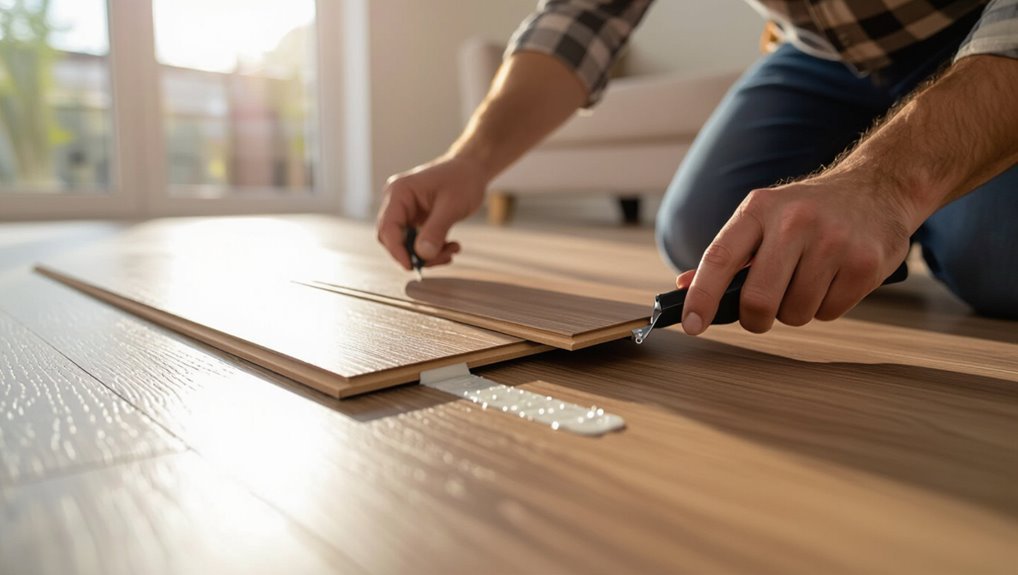
Once you’ve laid out your starter row and set spacers, begin installing either click-lock or glue-down planks by working left to right and keeping joints staggered at least 6–8 inches (or per manufacturer specs).
For click-lock, angle and snap each plank, tapping gently with a mallet and pull bar.
For glue-down, apply recommended adhesive, press firmly, and clean excess immediately.
Step 3 Finishing touches: trim, transitions, and gaps
3 finishing touches tie the room together: install base and quarter-round trim to cover expansion gaps, fit threshold strips at doorways and between different floor surfaces, and leave the manufacturer-recommended expansion space at walls and fixed objects.
Cut trim to size, fasten without compressing the gap, seal connections for moisture protection, and check clearances around pipes and cabinets so flooring can expand freely.
When to hire a pro vs. DIY checklist
Wondering whether you should tackle laminate flooring yourself or call a pro? Assess room size, subfloor condition, and complex layouts—large areas, uneven floors, or plumbing/heating obstacles mean hire a pro.
DIY if you’ve got basic carpentry skills, simple room shapes, appropriate tools, and time.
Create a checklist: measure, acclimate boards, gather tools, prep subfloor, install underlayment, follow pattern, trim edges, allow expansion.
Common Problems and How to Avoid Them
You’ll learn how to prevent and fix common issues like buckling, gapping, and swelling by addressing installation errors and moisture sources.
I’ll cover ways to prevent wear and repair surface damage, plus waterproofing strategies to avoid moisture-related failures.
Finally, we’ll check compatibility concerns with radiant heating so you don’t void warranties or cause damage.
Buckling, gapping, and swelling causes and fixes
If your laminate starts buckling, gapping, or swelling, it usually signals moisture issues, improper acclimation, or installation errors that need quick attention to prevent bigger damage.
Check for leaks, wet subfloor, or high humidity, then dry the area and fix moisture sources.
Remove and re-acclimate boards if needed, guarantee correct expansion gaps, and replace warped planks to restore a stable floor.
Wear and surface damage prevention and repair options
Once you’ve stopped moisture and installation problems that warp boards, the next concern is everyday wear and surface damage—scratches, dents, fading, and finish wear that accumulate from traffic and furniture.
Prevent damage by using felt pads, area rugs, and heavy-traffic mats; keep pet nails trimmed and vacuum grit.
Repair minor scratches with color-matched fillers or laminate repair kits; replace planks for severe damage.
Moisture-related failures and waterproofing strategies
Because laminate’s core swells and the seams can delaminate when moisture gets in, preventing water exposure is the top priority for durable floors.
You should wipe spills immediately, use mats at entries, maintain humidity between 30–50%, and install proper perimeter gaps with moisture barriers underlay.
For bathrooms or basements, choose water-resistant or waterproof products and follow manufacturer installation and maintenance guidelines to avoid costly failures.
Compatibility issues with radiant heating
Although radiant heat can make rooms more comfortable, not all laminate flooring handles it well—heat can warp the core, damage the finish, or loosen joints if you don’t match the product and installation to the system.
Check manufacturer ratings for maximum surface temperature, use low-profile, engineered laminate approved for radiant systems, maintain consistent subfloor temperature, and allow proper expansion gaps to prevent buckling and delamination.
Maintenance, Cleaning, and Longevity Best Practices
You should follow a simple daily and weekly cleaning routine—sweeping or vacuuming with a soft brush and using a damp (not wet) microfiber mop—for the best results.
Avoid harsh chemicals, steam cleaners, and abrasive tools, and stick to manufacturer-approved cleaners and mild solutions.
For long-term care, address scratches and chips promptly with repair kits or plank replacement to keep your floor lasting its full lifespan.
Daily and weekly cleaning routine
A simple daily and weekly routine keeps your laminate floors looking new and prevents long-term damage.
You’ll sweep or vacuum daily to remove grit, spot-clean spills immediately, and mop weekly with a lightly damp microfiber mop.
Keep traffic rugs and felt pads at entryways and under furniture to minimize wear.
- Sweep or vacuum daily
- Spot-clean spills instantly
- Lightly damp mop weekly
Products to avoid and safe cleaning agents
When cleaning laminate, steer clear of harsh chemicals and excess water—these can dull the finish, swell seams, and void warranties—so stick to gentle, pH-neutral cleaners and just a barely damp microfiber mop.
Avoid bleach, ammonia, wax, oil soaps, abrasive scrubs, and steam cleaners.
Use manufacturer-approved sprays or a diluted vinegar solution sparingly, and always dry spots promptly to prevent damage.
Long-term care to maximize lifespan
Though laminate’s durable surface holds up well, regular care will keep it looking and performing at its best for years.
Sweep or vacuum soft-brush weekly, wipe spills immediately with a damp (not wet) cloth, use pH-neutral cleaners sparingly, and place mats at entries.
Maintain humidity between 35–55%, protect from furniture with felt pads, and avoid prolonged sun exposure to reduce fading and warp.
Repair tips for scratches, chips, and plank replacement
If you spot scratches, chips, or a damaged plank, act promptly to prevent moisture intrusion and further wear.
For light scratches, use a color-matched repair marker or wax filler; buff gently.
For deeper gouges, apply putty, level it, then seal.
Replace badly warped or cracked planks: release adjacent boards, remove the damaged piece, fit a new plank, and reseal seams.
Comparison: Laminate vs. Alternatives
Now let’s compare laminate to the main alternatives so you can pick what fits your home and budget.
You’ll see how laminate stacks up against hardwood, luxury vinyl plank (LVP/LVT), and tile or stone on cost, durability, and moisture resistance.
I’ll finish with a concise room-by-room, budget-aware rundown of the best picks.
Laminate vs. Hardwood
Choosing between laminate and hardwood comes down to how you balance cost, durability, and appearance. You’ll find laminate is cheaper, scratch-resistant, and low-maintenance, while hardwood offers authentic grain, refinishing, and higher resale value. Match choice to budget, traffic, and lifespan expectations.
| Feature | Laminate | Hardwood |
|---|---|---|
| Cost | Low | High |
| Durability | High | Variable |
Laminate vs. Luxury Vinyl Plank (LVP/LVT)
Having compared laminate to hardwood, it helps to look at how laminate stacks up against luxury vinyl plank (LVP/LVT), since both mimic wood while offering different strengths. You’ll find LVP is waterproof and softer underfoot; laminate is often firmer and more scratch-resistant. Consider budget, moisture, and installation when choosing.
| Feature | Quick Note |
|---|---|
| Water resistance | LVP wins |
| Durability | Laminate often wins |
| Comfort | LVP cushier |
| Cost | Varies by quality |
| Installation | Both click-lock |
Laminate vs. Tile and stone
While laminate can mimic wood and feel warmer underfoot than tile, you’ll want to weigh its pros and cons against real stone and ceramic before deciding. Laminate is lighter, easier to install, and often cheaper, but it’s less durable and moisture-resistant than tile or stone, which last longer and handle wet areas better.
| Feature | Laminate | Tile/Stone |
|---|---|---|
| Cost | Low | High |
| Durability | Moderate | High |
| Moisture | Poor | Excellent |
| Installation | Easy | Hard |
| Warmth | Warmer | Cooler |
Best picks by room and budget (summary list)
Room and budget both shape the smart choice: pick waterproof, high-density laminate for busy kitchens and basements; go mid-range textured planks for living areas where comfort and looks matter; and consider engineered hardwood or tile for high-end rooms and wet zones where longevity and resale value justify the cost.
For tight budgets, choose durable entry-level laminate; for resale-focused projects, invest in engineered or real wood.
Cost Breakdown and Budgeting
You’ll want to compare material costs across low-, mid-, and high-end laminate and factor in how style or wear layer affects price.
Decide whether you’ll install it yourself or hire a pro, since DIY can cut labor costs but pros add speed and warranty.
Finally, estimate expected lifespan to calculate a cost-per-year so you can judge long-term value.
Material cost ranges by quality and type
1 key factor in budgeting for laminate flooring is understanding how material costs vary by quality and type, since that determines most of your upfront spend and long-term satisfaction. You’ll find budget, midrange, and premium options with different wear layers and visuals. Compare costs, warranties, and durability before buying.
| Type | Typical per-sq-ft cost |
|---|---|
| Budget | $0.70–$1.50 |
| Midrange | $1.50–$3.00 |
Installation cost estimates (DIY vs. professional)
Material prices set the baseline, but installation can equal or exceed that expense depending on whether you do it yourself or hire pros.
If you DIY, expect lower labor costs but budget for tools, underlayment, and possible mistakes.
Hiring installers adds labor (often $2–$6/ft²) plus removal and disposal fees.
Get multiple quotes and factor warranty, time, and skill level into your decision.
Expected lifespan and cost-per-year calculation
When weighing laminate options, consider expected lifespan alongside upfront cost so you can calculate a true cost per year.
Typical residential laminate lasts 10–25 years depending on quality, traffic, and maintenance, so divide total installed cost by your estimated years to compare value.
Factor in repair, refinishing alternatives, and replacement risk; include warranties and maintenance costs to get realistic annualized expense.
Environmental and Health Considerations
When choosing laminate, you’ll want to check for low-VOC and low-formaldehyde ratings and look for certifications like GREENGUARD or CARB compliance.
Consider the recyclability and whether the core and wear layers are made from sustainably sourced or recycled materials.
If you prefer eco-friendly options, prioritize products with transparent material disclosures and take-back or recycling programs.
VOCs, formaldehyde concerns, and certifications to look for
Because indoor air quality affects your health every day, it’s important to understand that some laminate flooring can release volatile organic compounds (VOCs) and trace amounts of formaldehyde—especially from adhesives, backing materials, or low-quality resins.
To minimize risk, choose products with CARB Phase 2, EPA TSCA Title VI, GREENGUARD Gold, or FloorScore certification. Ventilate during installation, and let new flooring off-gas before regular use.
Recyclability and sustainability of materials
If you care about the planet and your indoor air, look beyond appearance and price to how laminate is made and disposed of: some laminates use recycled content and low-impact resins, while others rely on virgin wood fiber, formaldehyde-containing adhesives, or mixed materials that are hard to separate for recycling.
You should note end-of-life fate, energy used in production, and whether panels can be reused or accepted by recycling programs.
Choosing eco-friendly laminate options
Since your choices affect indoor air and long-term waste, pick laminates that minimize toxic emissions and use responsibly sourced materials.
Look for low-VOC certifications (like FloorScore), formaldehyde-free cores, and recycled or FSC-certified HDF.
Prefer water-based finishes and durable wear layers to extend life.
Ask suppliers about end-of-life recycling programs so you reduce landfill impact and protect household health.
FAQ
You probably have a few key questions about laminate: can it handle bathrooms or basements, how long will it last, and can you install it over existing floors?
You’ll also want to know about noise and soundproofing options, and whether new laminate boosts your home’s resale value.
I’ll answer each so you can make a practical choice.
Can laminate flooring be used in bathrooms and basements?
Wondering whether laminate’s a good choice for bathrooms and basements?
You can use water-resistant or waterproof laminate in basements and limited bathroom areas, but standard laminate risks swelling with prolonged moisture.
Guarantee proper underlayment, slope and ventilation, and seal edges and junctions.
For full bathrooms or flood-prone basements, consider true waterproof options like vinyl plank or tile to avoid damage and costly replacements.
How long does laminate flooring last?
Lifespan depends mostly on quality and use: good-quality laminate typically lasts 15–25 years with normal foot traffic and proper care, while budget options may wear out in 5–10 years.
You can extend life by avoiding moisture, using furniture pads, cleaning gently, and replacing damaged planks promptly.
Heavy wear areas may need earlier replacement; regular inspections catch issues before they spread.
Can I install laminate over existing flooring?
Can you install laminate over existing flooring? Yes—if the current floor is flat, dry, and securely attached.
You can lay laminate over vinyl, tile, or wood, but remove loose material and repair high spots.
Use an underlayment for moisture control and to even minor imperfections.
Avoid carpeting and floors with significant height changes; follow manufacturer guidelines for warranty protection.
Is laminate flooring noisy and how to reduce sound?
How noisy is laminate flooring, and what can you do about it?
Laminate can sound hollow or click when walked on, especially over concrete or uneven subfloors.
Use quality underlayment with acoustic padding, install sound-absorbing underlayment for impact noise, guarantee tight plank joints, and add rugs in high-traffic areas.
Proper installation and padding cut noise considerably.
Will laminate increase home resale value?
Reducing noise and ensuring a solid installation can make laminate feel more like real hardwood. However, you may still wonder if it boosts your home’s resale value.
Good-quality, well-installed laminate can improve appeal and show-ready condition, especially in budget-conscious markets. It won’t match premium hardwood’s prestige, but it offers durable, attractive flooring that can help sell your home faster and at a competitive price.
