How to Fix Vinyl Flooring That’s Lifting, Bubbling, or Cracked
You can often fix lifting, bubbling, or cracked vinyl yourself by first diagnosing moisture, adhesive, or subfloor issues, then choosing the right repair: re-glue small lifts with vinyl adhesive and a roller, puncture and inject adhesive into blisters, or patch cracks with a repair kit or replacement plank. Clean and dry surfaces, use proper tools, and weight or heat as needed. Large or recurring problems usually need a pro, and the steps ahead show how to proceed.
Can you fix vinyl flooring that is lifting, bubbling, or cracked?
You can often fix small lifts, bubbles, or hairline cracks yourself with adhesive, a roller, or a heat gun and patch kit.
If the damage is widespread, the subfloor is compromised, or seams keep reopening, you’ll want a pro to assess and repair it.
We’ll cover quick DIY steps and clear signs that it’s time to call a flooring contractor.
Short, direct solutions summary
Start by evaluating the damage: lifting can often be re-adhered, bubbling usually comes from trapped moisture or poor installation and can be repaired or replaced depending on severity, and small cracks or tears can be patched or filled.
For quick guidance on how to fix vinyl floor, clean, dry, re-glue lifted areas, pop and heat small bubbles, or use a vinyl patch kit for cracks; replace if extensive.
When professional help is required vs DIY feasible
When damage is limited—small lifted edges, a few bubbles, or minor cracks—you can often handle repairs yourself with basic tools and a patch kit; however, call a pro if the problem covers large areas, the subfloor is wet or uneven, seams are separating extensively, or the vinyl keeps failing after attempted fixes.
You should hire a pro for moisture, structural issues, complex seams, or repeated failures.
Basic Understanding What causes vinyl to lift, bubble, or crack?
Different vinyl types fail in different ways: sheet vinyl tends to wrinkle or seam-separate, luxury vinyl planks/tiles can cup or gap, and peel-and-stick often loses adhesive and lifts.
You’ll usually see problems from moisture, temperature swings, subfloor issues, or poor installation. Knowing the material and common causes helps you pick the right repair approach.
Types of vinyl flooring and how failure modes differ (sheet, luxury vinyl plank/tile, peel-and-stick)
Although all vinyl floors look similar at a glance, sheet vinyl, luxury vinyl plank/tile (LVP/LVT), and peel-and-stick products fail in different ways because of their construction and installation methods; knowing those differences helps you diagnose lifting, bubbling, or cracking quickly.
| Type | Common issue | Quick check |
|---|---|---|
| Sheet | Edge gaps | Look for seams |
| LVP/LVT | Plank cupping | Check adhesion |
| Peel-and-stick | Corner lift | Peel test |
Common causes
You’ll usually find that vinyl problems trace back to a few key causes: moisture or a bad subfloor, poor installation or failing adhesive, and temperature-driven expansion or contraction.
Heavy traffic, impacts, UV exposure, aging, and occasional material defects also weaken vinyl and lead to lifting, bubbling, or cracking.
Understanding which of these is at work helps you choose the right fix.
Moisture and subfloor issues
When vinyl floors lift, bubble, or crack, moisture and subfloor problems are often the root cause — and they can be subtle.
You should check for leaks, high humidity, or wet concrete that releases vapor.
Uneven, rotting, or soft subflooring warps vinyl and prevents proper adhesion.
Address leaks, dry the area, and repair or replace compromised subfloor before reinstalling or patching vinyl.
Poor installation and adhesive failure
If installers skip proper surface prep or use the wrong adhesive, your vinyl will lift, bubble, or separate long before its time.
You’ll notice edges peeling, seams opening, or tiles shifting because adhesive didn’t bond.
Fixes include reattaching with the correct pressure-sensitive or wet-set glue, cleaning substrate, and replacing damaged sections.
Always follow manufacturer specs and use recommended trowel and open time.
Temperature and expansion/contraction
Because vinyl expands and contracts with temperature and humidity changes, you’ll see lifting, buckling, or gaps if it wasn’t allowed room to move.
You should leave proper expansion gaps at edges and around fixtures, acclimate planks before installation, and avoid tight seams.
If seasonal movement caused separation or edge lift, reattach edges with flexible adhesive and restore expansion space to prevent recurrence.
Heavy traffic, impact damage, and wear
1 common reason vinyl lifts, bubbles, or cracks is sustained heavy traffic and repeated impacts that break down the wear layer and loosen seams.
You’ll see scuffs, thinning, and exposed backing where carts, furniture, or dropped items concentrate stress.
Address high-use routes with protective mats, felt pads, or targeted repairs—replace damaged planks or reglue seams before moisture or dirt worsens the problem.
Aging, UV exposure, and material defects
Wear and impact aren’t the only things that make vinyl fail—time, sunlight, and manufacturing flaws also play a big role.
Over years, vinyl hardens, loses flexibility, and becomes brittle, so it’s more prone to cracking. UV rays fade color, weaken binders, and cause delamination.
Manufacturing defects—thin wear layers, poor adhesives, or uneven curing—can lead to bubbling and premature failure.
How to Diagnose the Problem (quick inspection checklist)
Start by gathering a few simple tools—flashlight, utility knife, tapping block, seam roller, and a moisture meter or probe—to inspect and test the floor.
Look for visual cues like lifting, bubbling, discoloration, or adhesive residue and note whether they’re localized or widespread.
Use a moisture meter and surface probes (wood: ≤12% or manufacturer spec; concrete: surface reading under 3% or follow spec) and small cut-tests to tell if the issue is surface wear, adhesive failure, or structural/subfloor problems.
Tools and materials to inspect and test
Before you begin poking at the floor, gather a few basic tools and materials so you can inspect and test efficiently: a flashlight, tape measure, utility knife, straightedge or level, moisture meter (or a reliable analog alternative), a small pry bar, putty knife, clean cloths, and a camera or phone to document findings.
- Check moisture and flatness
- Measure damaged area
- Pry minimal edge samples
- Cut small test pieces
- Photograph locations and labels
Visual signs and what they indicate
When you walk a room looking for trouble, focus on clear visual cues—bubbling, buckling, seams lifting, discoloration, or surface scratches—and note exactly where each appears, since different signs point to different causes (moisture, subfloor issues, wear, or adhesive failure).
Map patterns: isolated bubbles suggest trapped adhesive air; widespread buckling hints at subfloor movement or moisture; edge lifts indicate adhesive failure; stains show water intrusion; scratches equal surface wear.
Moisture testing methods and thresholds
How do you know if moisture’s the culprit? Use a moisture meter (pin or non‑destructive) across several spots, and perform a calcium chloride or relative humidity (RH) test for concrete.
Compare readings to vinyl manufacturer limits—typically ≤3 lb/24hr/1000 ft² for calcium chloride or ≤75% RH (some require ≤70%).
Repeat after repairs; document results before reinstallation.
How to determine if damage is surface, adhesive-related, or structural
Wondering whether the problem is just surface scuffs, a failing adhesive, or something structural?
Check for shallow scratches, finish wear, or isolated stains—those are surface.
Lift a corner: if planks peel easily and re-adhere, adhesive or moisture is likely.
Look for uneven subfloor, large gaps, or warped boards; those indicate structural issues.
Note sounds, movement, and moisture readings for confirmation.
Step-by-Step Repairs for Lifting Vinyl
If you spot small lifts or loose edges, you can often fix them yourself with the right adhesive and technique.
I’ll cover which glues and tools to use, how to fill gaps and seams in LVP/LVT, and when a damaged plank or tile needs replacing.
Follow the steps carefully to get a secure, long-lasting repair.
Small lifts and loose edges (DIY)
When small edges of your vinyl start to lift, you can usually fix them yourself with a few simple tools and patience; this section walks you through the quick, reliable steps to re-secure loose areas and prevent further peeling.
Clean the area, dry it, press the edge down firmly, weight it overnight, and trim any frayed backing.
Check periodically and replace worn trim or thresholds.
Re-gluing sections materials, adhesives, and technique
Start by gathering the right supplies: a vinyl adhesive recommended by your flooring manufacturer (or a high-quality contact or pressure-sensitive adhesive for sheet vinyl), a small trowel or syringe applicator, a seam roller, clean rags, and weights or heavy boards to hold the patch while the glue cures.
Clean area, lift carefully, apply adhesive sparingly, press vinyl flat, roll seams, wipe excess, weight until fully set.
Filling gaps and seams for LVP/LVT
Although gaps and seams in LVP/LVT might seem minor, addressing them promptly prevents moisture intrusion, dirt buildup, and further lifting.
Clean the area, remove debris, and dry thoroughly.
Use a matching vinyl seam filler or flexible silicone caulk, apply sparingly into the gap, smooth with a damp finger or tool, and wipe excess.
Allow full cure before foot traffic.
When to replace individual planks or tiles
If gaps, filler failures, or persistent lifting won’t respond to cleaning and caulk, it’s time to replace the affected plank or tile to stop further damage.
Remove damaged pieces, clean subfloor, and inspect for moisture or adhesive failure.
Cut replacement to fit, acclimate, and glue or click it in per manufacturer instructions.
Seal seams and test stability before regular use.
Step-by-Step Repairs for Bubbling and Blisters
When you find bubbles or blisters in vinyl, start by evaluating whether the issue is trapped air, adhesive failure, or moisture so you can choose the right fix.
For small air pockets you can puncture and release then inject adhesive and press the seam; for moisture-related bubbles you’ll need to dry and mitigate the source before repairing.
If the bubble is large or the vinyl or backing is damaged, plan on replacing that section instead of a spot repair.
Puncture-and-release method for trapped air (when appropriate)
Because small blisters often form from trapped air beneath the vinyl, you can usually fix them by puncturing and releasing that air before resealing the spot.
Use a fine needle to make a tiny hole at the blister’s edge, press gently to expel air, let it settle, then apply a small amount of adhesive-free filler or weight to flatten.
Allow to dry fully.
Adhesive injection and seam repair techniques
Puncturing a blister works for small trapped-air pockets, but larger bubbles and seam lifts need a different approach: you’ll inject adhesive under the vinyl and press seams back into place to restore a flat surface and lasting bond.
Clean the area, lift edges slightly, inject recommended vinyl adhesive with a syringe, smooth with a roller, wipe excess, clamp or weight seam until cured, then trim and reseal edges.
Dealing with moisture-related bubbles drying and mitigation
If moisture’s trapped under your vinyl, bubbles can form and grow until the material buckles, so you’ll need to dry and stabilize the area before any adhesive repairs.
Locate the source—plumbing, subfloor dampness, or spills—and stop it. Use fans, dehumidifiers, and gentle heat to dry thoroughly.
Once dry, test for residual moisture and apply a moisture barrier before repairing seams or injecting adhesive.
Replacing large bubbled areas vs spot repair
Once the area is dry and stable, decide whether to repair a blister locally or replace the whole section based on size, location, and backing condition.
For small blisters, cut, glue, and press edges; trim loose vinyl and fill gaps.
For large or multiple bubbles, remove the damaged plank or sheet, prepare the subfloor, and install a matched replacement to guarantee a seamless, durable repair.
Step-by-Step Repairs for Cracked or Torn Vinyl
When you find cracks or tears in vinyl, you’ll want to choose the right fix—from surface repair kits and color-matching for small nicks to patch repairs for sheets, tiles, and planks.
For larger damage, I’ll explain seam welding for sheet vinyl and the full plank or tile replacement process.
Follow each method step-by-step so you can restore a seamless, durable finish.
Surface repair kits and color-matching
Surface repair kits give you the materials and pigments to blend small cracks or tears into the surrounding vinyl so the fix stays discreet and durable.
You’ll clean and prep, apply filler, texture to match grain, and cure per instructions. Mix pigments incrementally until color matches, test on scrap, then seal.
Work patiently; small adjustments beat obvious patches.
Patch repair for sheets, tiles, and planks
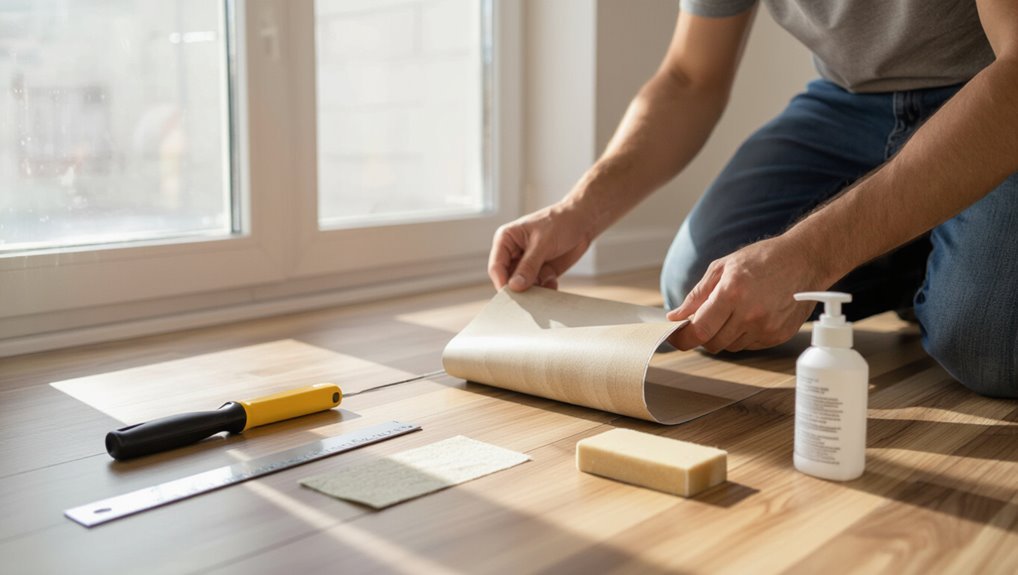
After matching color and texture with a repair kit, you’ll move on to patching larger damage in sheets, tiles, or planks.
Cut away loose or damaged vinyl, clean and dry the area, and trace a replacement piece from scrap.
Apply adhesive beneath the patch, press and roll to remove bubbles, wipe excess, and weight until cured.
Trim seams flush for a neat finish.
Seam welding for sheet vinyl (overview)
Although seam welding looks technical, you can tackle it with the right tools and steady hands: the process melts a thin line of vinyl and fuses the edges to create a durable, nearly invisible joint.
You’ll clean and align seams, run a heat gun and welding rod steadily, trim excess, and finish with a roller.
It’s ideal for long sheet joins when seams separate.
Full plank/tile replacement process
Start by evaluating the damage and gathering everything you’ll need: replacement plank or tile, adhesive or loose-lay seaming tape, a straightedge, utility knife, pry bar (if underlayment’s nailed), and a heavy roller.
Remove the damaged piece, clean the substrate, trim the new plank to fit, apply adhesive or tape, press firmly, and roll to remove air.
Allow cure time, then inspect seams and finish edges.
Tools, Materials, and Products Recommended
You’ll need the right adhesives and primers, plus fillers, patch kits, seam sealers, or welding tools depending on the repair type.
Gather moisture testers, sharp utility knives, rollers, and a heat gun to prep and install pieces accurately.
Don’t forget safety gear and cleanup supplies so you work safely and leave a clean job site.
Adhesives and primers what to choose
When choosing adhesives and primers for vinyl flooring, pick products rated for your vinyl type and subfloor—LVT/LVP, sheet vinyl, or luxury plank each need different formulations—and always match the adhesive to the traffic load and moisture conditions you expect. Use moisture-mitigating primer for concrete, pressure-sensitive adhesive for floating LVP, and full-spread for permanent installs.
| Product Type | Best Use |
|---|---|
| Moisture primer | Concrete |
| Pressure-sensitive | Floating LVP |
| Full-spread adhesive | Glue-down vinyl |
| Solvent-free primer | Sensitive areas |
Fillers, patch kits, seam sealers, and welding tools
While small scratches and gaps can be fixed with off-the-shelf fillers, repairing seams or larger voids in vinyl flooring often calls for specialized patch kits, seam sealers, or hot-welding tools that create durable, watertight joins.
Choose color-matched vinyl filler, solvent or water-based sealers for flexibility, and consider a plastic welding kit for permanent repairs.
Follow manufacturer instructions and test on scrap.
Moisture testers, utility knives, rollers, and heat guns
Before you cut or bond a single plank, confirm the subfloor’s moisture with a reliable tester. Then arm yourself with a sharp utility knife, a firm roller, and a controllable heat gun—each tool plays a specific role: the moisture tester prevents future failures, the knife makes clean cuts, the roller guarantees tight seams and adhesion, and the heat gun helps ease and set vinyl for repairs.
Use calibrated settings, replace dull blades, and roll firmly.
Safety gear and cleanup supplies
Now that you’ve checked moisture and gathered cutting and bonding tools, protect yourself and your work area with the right safety gear and cleanup supplies.
Wear nitrile gloves, safety glasses, and a dust mask. Use knee pads and proper footwear.
Keep rags, a shop vacuum, disposable towels, adhesive remover, and a small bucket of soapy water nearby. Dispose of waste per local rules.
Preventing Future Problems Best Practices and Maintenance
To prevent future problems, you should focus on proper subfloor prep and moisture control before you lay any vinyl.
Make sure the planks or sheets are acclimated, installed with correct expansion gaps and adhesive, and follow the manufacturer’s instructions.
Once installed, keep up routine cleaning and manage indoor humidity and temperature to extend the floor’s life.
Proper subfloor preparation and moisture control
Because vinyl only performs as well as the base beneath it, you’ll want to inspect and prepare the subfloor carefully and control moisture to prevent future problems.
Remove debris, level dips, repair cracks, and replace damaged plywood.
Test moisture with a meter and address high readings—seal concrete, improve drainage, add vapor barriers where needed.
Keep humidity stable to protect your floor long-term.
Correct installation tips (expansion gaps, acclimation, adhesive application)
Start by letting your vinyl acclimate in the room for at least 48 hours so it can expand or contract to local temperature and humidity.
Leave proper expansion gaps per manufacturer guidelines, trim edges precisely, and stagger seams for stability.
Use the recommended adhesive sparingly and evenly, press planks firmly, and roll the floor to guarantee full bond—avoiding trapped air or moisture that causes lifting.
Routine maintenance to extend vinyl life
Once you’ve got your vinyl properly installed, regular care will keep it looking new and prevent common problems like scratches, lifting, and discoloration.
Sweep or vacuum weekly, mop with a manufacturer-approved cleaner, and blot spills immediately.
Use felt pads under furniture, avoid rolling heavy appliances without protection, and trim pet nails.
Reapply finish or protective products as recommended.
Environmental controls: humidity and temperature management
Keeping your vinyl clean helps a lot, but controlling the room’s humidity and temperature will stop many problems before they start.
Keep indoor humidity between 35–55% and avoid rapid swings. Use dehumidifiers, humidifiers or HVAC to maintain steady conditions.
Prevent extreme heat or cold near windows and doors.
Stable climate reduces expansion, contraction, warping, and adhesive failure, prolonging flooring performance.
Common Mistakes to Avoid During Repair and Installation
Don’t grab the wrong adhesive or filler—using materials that aren’t rated for vinyl will cause failures fast.
Check the subfloor for moisture or damage before you start, and don’t rush acclimation or seam treatment.
And be careful with heat tools: overheating or improper use can warp or burn vinyl.
Using the wrong adhesive or filler
When you pick the wrong adhesive or filler, the results show up fast: seams can lift, patches can crumble, and stains can bleed through.
You should match adhesive type to vinyl—pressure-sensitive, vinyl-specific, or seam sealer—and use color-stable, flexible fillers.
Test adhesion in a hidden spot, follow cure times, and avoid solvent-based products that can soften vinyl or fail under foot traffic.
Ignoring subfloor moisture or damage
If you ignore subfloor moisture or structural damage, your new vinyl can buckle, bubble, or fail long before it’s paid off.
Always test for dampness with a moisture meter and inspect for rot, mold, or soft spots.
Repair or replace compromised decking, install a proper vapor barrier, and guarantee the surface is flat and dry before laying vinyl to prevent recurring problems.
Rushing acclimation or improper seam treatment
One common mistake is rushing acclimation or skimping on proper seam treatment, and doing so often dooms a vinyl floor before it’s even finished.
You should let planks or sheets sit in the installation room for the recommended time, follow manufacturer seam prep, use correct adhesive or weld methods, and tight-fit seams.
Skipping these steps causes gaps, lifting, and visible seams.
Overheating or improper use of heat tools
Skipping proper seam prep can lead straight into another common pitfall: overheating or misusing heat tools.
If you apply too much heat or stay too long, vinyl can warp, shrink, or scorch. Use a temperature-controlled heat gun, keep it moving, and test on scrap.
Follow manufacturer temperature guidelines and work gradually to avoid permanent damage and weak seams.
Cost, Time, and When to Hire a Pro
You’ll want to weigh typical DIY costs versus professional repair or replacement before you start.
Expect quick fixes like patching or seam repair to take an hour or two, while full replacement can take a day or more.
Call a flooring contractor if the damage is extensive, the subfloor’s compromised, or you don’t have the time or tools to do it right.
Typical costs for DIY repairs vs professional repair/replacement
Repairing vinyl yourself often costs far less than hiring a pro, but the price gap depends on the job: expect basic patching or seam repairs to run $10–$100 in materials and a few hours of your time, while professional repairs typically start around $150 and can climb to $500+ for larger or complex fixes; full replacement usually ranges from $2 to $8 per square foot for materials plus $1–$4 per square foot for installation.
| Option | DIY cost | Pro cost |
|---|---|---|
| Patch/seam | $10–$100 | $150–$500+ |
| Small replacement | $2–$8/ft² materials | $1–$4/ft² install |
| Complex job | Minimal tools | Higher labor & materials |
Time estimates by repair type
After weighing costs for DIY versus pro work, it helps to know how long each repair usually takes so you can plan the job and decide whether to tackle it yourself.
Small patch: 30–60 minutes.
Replacing a plank/tile: 1–3 hours.
Re-gluing lifted seams: 1–2 hours plus drying.
Full room replacement: 4–10 hours.
Prep and curing can extend timelines.
Signs you should call a flooring contractor
When damage goes beyond a quick patch or the job will take more time and skill than you can spare, call a flooring contractor—especially if costs, warranties, or structural issues are involved.
Hire a pro when large areas bubble, seams separate, subfloor rot appears, or manufacturer warranties require certified installers.
Also call if you lack tools, time, or confidence to guarantee a durable, code-compliant repair.
Quick Repair Guides (Cheat-Sheets)
You’ll get three focused cheat-sheets to guide fast fixes: a peeled-edge step checklist, a small-bubble step checklist, and a cracked plank/tile step checklist.
Each checklist gives the tools, materials, and precise steps to follow. Use them to decide what you can do quickly and when to call a pro.
Quick fix for peeled edges step checklist
Use this checklist to quickly reattach peeled vinyl edges and stop trips or water damage before it gets worse.
You’ll need glue, a roller, clamps, a clean rag, and patience.
- Clean beneath the lifted edge
- Apply vinyl adhesive sparingly
- Press and align edge firmly
- Smooth with roller to remove air
- Weight or clamp until set
Quick fix for small bubbles step checklist
If you’ve already handled peeled edges, small bubbles are the next common nuisance to nip in the bud.
You’ll need to work quickly to avoid bigger lifts. Follow this checklist:
- Locate and mark the bubble
- Heat gently with a hair dryer
- Puncture tiny hole with a pin
- Press out air and apply adhesive beneath
- Smooth and weight until set
Quick fix for cracked plank/tile step checklist
One quick crack can spread and ruin a whole plank, so act fast with this compact step checklist to repair a cracked vinyl plank or tile.
Do these steps precisely to save the plank and prevent moisture damage:
- Clean debris and dry area
- Inspect damage depth
- Apply vinyl repair filler or epoxy
- Smooth and level with putty knife
- Sand lightly and match finish
FAQ
Got questions about bubbling, adhesives, heat fixes, color matching, or whether the subfloor needs replacing?
You’ll get clear, practical answers on whether you can re-glue moisture-bubbled vinyl, how long adhesives need to cure, whether heat guns can hurt the material, how closely patches can match, and signs that the subfloor must be replaced.
Read on for straightforward guidance and quick decision tips.
Can you re-glue vinyl flooring that has already bubbled from moisture?
Can you re-glue vinyl flooring that’s bubbled from moisture? Yes, but only if the backing and adhesive are intact and the plank hasn’t warped or delaminated.
Dry the area thoroughly, peel back carefully, clean residual glue, apply a suitable vinyl adhesive, and press flat with weight.
If the core is compromised or mold’s present, replace the affected pieces instead of re-gluing.
How long do vinyl repair adhesives take to cure before foot traffic?
How long will repaired vinyl be ready for walking on?
Most vinyl repair adhesives set within 15–60 minutes but need longer to reach full cure.
Expect light foot traffic after 4–6 hours and normal use after 24 hours.
Temperature, humidity, and adhesive type affect times—epoxy and urethane often cure faster than solvent-based glues.
Always follow manufacturer cure instructions for best results.
Will heat gun fixes damage vinyl further?
If you use a heat gun carefully, you can soften and reshape vinyl without making the damage worse, but improper technique will worsen bubbles, scorch the surface, or melt backing layers.
Work at low heat, keep the nozzle moving, and test on a scrap.
Use a roller to flatten softened areas and avoid overheating seams.
Stop if you smell burning.
Is it possible to match color/texture when patching old vinyl?
After heating and reshaping vinyl to repair a bubble or tear, you’ll probably want the repaired area to blend in visually.
You can often match texture and color reasonably by using scrap from a hidden area, careful trimming, and adhesive underlay. Fading, wear, and printed patterns may limit perfection.
Blend seams with seam sealer and light sanding; expect some visible variation.
How do I know if the subfloor needs replacement?
Wondering whether the subfloor needs replacing? Check for soft spots, sagging, or bounce when you walk; persistent moisture, mold, or rot under the vinyl; large delaminated areas or extensive damage around seams and edges; and screws or nails that pull out easily.
If repairs are extensive, uneven, or the subfloor has structural issues, replace it to guarantee a stable, long-lasting vinyl installation.
Additional Resources and References
Check your flooring manufacturer’s guidance and warranty terms before you start any repairs so you don’t void coverage.
You’ll also want links to step-by-step video demos and product pages for the specific adhesives, patches, or tools you’ll use. Use those resources to confirm techniques and buy compatible materials.
Manufacturer guidance and warranty considerations
Because manufacturers set specific installation and maintenance rules, you should consult their guidance before starting repairs or replacements to avoid voiding your warranty.
Check your warranty terms and registration, follow approved repair methods, use recommended adhesives and parts, document damage and repairs, and contact customer support for pre-approval.
- Warranty terms
- Approved methods
- Recommended materials
- Photos and receipts
- Manufacturer contact
Links to step-by-step video demos and product pages
If you prefer visual guidance, use curated step-by-step video demos and product pages to walk you through common vinyl repairs and replacements.
They show tools, techniques, and product links so you can follow along, compare options, and buy supplies confidently.
Check tutorials for your vinyl type and watch installers’ tips before starting.
- Quick patching demos
- Full plank replacement
- Adhesive application guides
- Tool recommendations
- Product comparison pages