How to Attach a Wall to a Concrete Floor Securely and Safely
You’ll secure a wood-framed wall to concrete by anchoring the treated bottom plate with the right fasteners, controlling moisture, and checking alignment and loads. Lay a sill gasket under the plate, mark stud locations, drill correct-depth holes with a hammer drill, and install anchors (Tapcons for light loads, sleeve or wedge anchors for medium, epoxy or wedge for heavy). Tighten anchors, plumb the studs, seal the joint to prevent rot, and keep inspecting for corrosion and gaps to learn more.
How to Attach a Wall to a Concrete Floor Quick Answer
The safest, most common methods are concrete anchors or masonry screws for wood plates and epoxy-set bolts for heavy loads.
You can usually tackle a simple framed wall yourself if you have the right tools and the slab is level, but call a pro for structural walls, uneven floors, or when plumbing/electrical routing is involved.
Use a quick checklist—load, wall type, floor condition, tools on hand—to decide DIY vs. hiring help.
Direct summary of the safest, most common methods
If you’re fastening a wall to a concrete floor, the safest and most common options are anchor bolts through a bottom plate, concrete screws (like Tapcon), and adhesive-mounted construction anchors; each method gives strong, reliable connections when you follow manufacturer specs for hole size, depth, and spacing.
You should consider:
- Anchor bolts through plate
- Concrete screws (Tapcon)
- Adhesive anchors
- Epoxy-set threaded studs
When to call a pro vs. DIY decision checklist
Sometimes you’ll handle wall-to-concrete fastening yourself, but call a pro when the job involves structural walls, existing slab issues, unusual loads, buried utilities, or when you lack the right tools or confidence; use this quick checklist to decide whether to DIY or hire help.
- Structural/permitted work?
- Slab cracked, uneven, or water-damaged?
- Heavy loads or complex framing?
- No tools, experience, or time?
Basic Understanding What It Means to Attach a Wall to Concrete
When you attach a wall to concrete, you need to know what kind of wall you’re working with—stud wall, masonry, or framed interior partition—because each uses different fasteners and techniques.
Check the concrete too: slab-on-grade, basement slab, or an uneven surface will change anchor choice and prep.
Finally, decide if the wall is bearing or non-bearing, since load-bearing connections require stronger anchors and often mechanical or structural ties.
Types of walls (stud wall, masonry, framed interior partitions)
Walls come in a few common forms—wood or metal stud partitions, full masonry walls, and framed interior partitions—and each type attaches to concrete differently.
So you’ll pick fastening methods and materials based on the wall’s structure, load, and finish. For studs, you’ll anchor a sole plate with powder-actuated fasteners or anchors.
Masonry bonds directly with mortar or anchors. Framed interiors use lighter anchors and blocking for fixtures.
Concrete floor types and conditions that affect attachment (slab-on-grade, basement slab, uneven surfaces)
Because concrete comes in different forms and conditions, how you attach a wall depends heavily on the slab type and surface quality.
You’ll assess moisture, levelness, and edge conditions, then choose anchor type and prep.
Consider:
- Slab-on-grade — shallow, watch moisture.
- Basement slab — colder, possible vapor barrier.
- Uneven surfaces — grind or shim.
- Cracked or spalled — repair first.
Load considerations: bearing vs. non-bearing walls
If a wall will carry roof or floor loads, you’ll treat its attachment to concrete very differently than you’d for a non-bearing partition.
Bearing walls need continuous, strong anchors and careful alignment with footings or load-bearing pads, while non-bearing walls can rely on lighter anchors and simpler shear restraints.
You’ll size anchors, verify concrete capacity, and provide proper transfer paths for loads; consult structural plans.
Tools, Materials, and Safety Preparations
Before you start fastening, gather essential tools like a hammer drill, masonry bits, and torque-ready drivers, and choose the right fasteners—sleeve or wedge anchors, Tapcon or concrete screws, or epoxy anchors—based on load and concrete condition.
Select construction materials such as a treated bottom plate, sill sealer, and flashing, and prepare safety gear and site setup with PPE, dust control, and utility locating.
Finally, assess the floor for cracks and moisture using a moisture meter or calcium chloride test so you can pick appropriate anchors and spacing.
Essential tools
You’ll need a compact set of reliable tools and safety gear to fasten a wall to concrete—treat this list as the job’s foundation:
- Hammer drill with masonry bits and depth stop.
- Tape measure, chalk line, and carpenter’s square.
- Level, pry bar, and adjustable wrench.
- Safety: eye protection, hearing protection, dust mask, and work gloves.
Fasteners and anchors explained (sleeve anchors, wedge anchors, Tapcon screws, concrete screws, epoxy anchors)
Anchors matter: choosing the right fastener—sleeve, wedge, Tapcon/concrete screw, or epoxy—determines how securely your wall will stay put and what tools and safety steps you’ll need. Pick sleeve/wedge for heavy loads, Tapcon for light framing, epoxy for max holding. Use correct drill bits, torque, and PPE.
| Anchor type | Best use |
|---|---|
| Sleeve/wedge | Heavy loads |
| Tapcon/epoxy | Light to max hold |
Materials for wall construction (treated bottom plates, sill sealer, flashing)
Materials matter: you’ll want a treated bottom plate to resist moisture and rot, a sill sealer to block air and vapor at the concrete-to-wood joint, and flashing where water can track toward the wall.
Use preservative-treated lumber rated for ground contact, closed-cell foam or rubber sill sealer, and corrosion-resistant flashing and fasteners.
Seal overlaps and laps continuous flashing for reliable moisture control.
Safety gear and site prep (PPE, dust control, locating utilities)
Before you touch a tool, make a site safety plan and gear up: wear eye protection, a respirator or dust mask, hearing protection, gloves, and sturdy boots, and make sure clothing fits to avoid snags.
Control dust with barriers and a shop vac; call utility services before drilling.
Follow this checklist:
- PPE ready
- Dust containment
- Ventilation
- Utilities located
Assessing floor condition and moisture testing (calcium chloride, moisture meter)
With your safety gear on and utilities marked, next check the slab itself for cracks, unevenness, and moisture that can ruin framing or cause mold.
Probe cracks, measure flatness with a straightedge, and run a moisture meter across the surface.
For higher certainty, perform a 72-hour calcium chloride test.
Record results, address high moisture, and postpone framing until the slab meets manufacturer and code limits.
Step-by-Step Method: Attaching a Wood-Framed (Stud) Wall to a Concrete Floor
Now you’ll walk through the basic steps to fasten a wood-framed wall to concrete, starting with laying out and marking the wall location on the slab.
Prepare a pressure-treated bottom plate with sill sealer, then drill holes and install anchors at the correct spacing and depth for your chosen anchor type.
Finally, secure the plate, check for plumb and square, and raise and fasten the studs and top plate to the ceiling structure.
Step 1 Layout and marking the wall position
Start by establishing a clear reference line for the wall so you’ll know exactly where the bottom plate will sit on the concrete. Then:
- Measure and mark wall endpoints with a tape measure.
- Snap a chalk line along the floor reference.
- Transfer stud locations to the floor at 16″ or 24″ centers.
- Check squareness with a 3-4-5 triangle and adjust lines as needed.
Step 2 Preparing the bottom plate (pressure-treated wood, sill sealer)
Prepare the bottom plate by cutting pressure-treated lumber to length and laying down a sill sealer to keep moisture and air out of the wall cavity.
Place the plate on the sealer, align with your layout marks, check for straightness and level, and trim as needed for tight fit at corners and openings.
Nail or temporarily clamp plate to hold position before anchoring.
Step 3 Drilling and installing anchors (hole spacing, depth, anchor type selection)
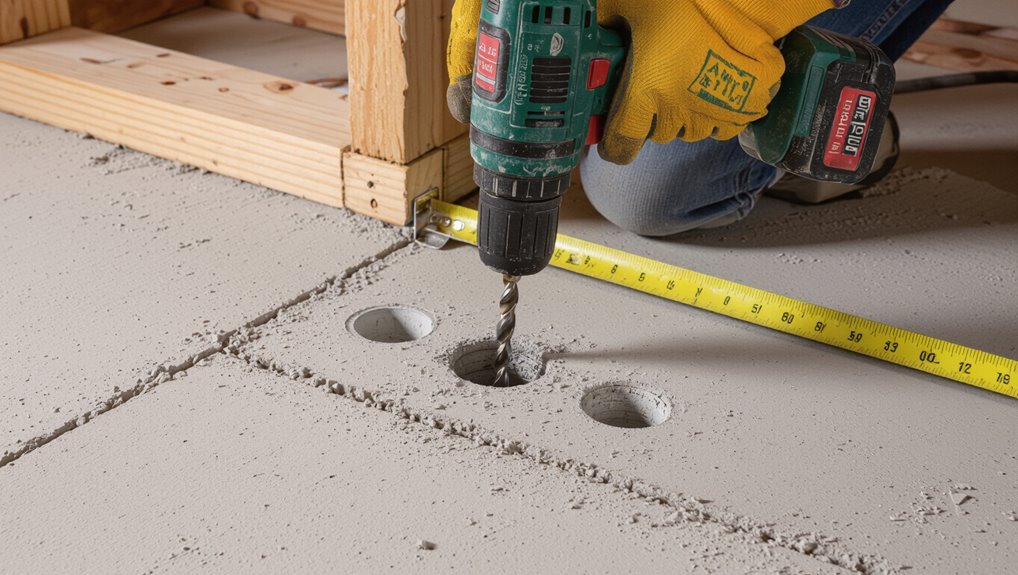
With the bottom plate positioned and temporarily secured, it’s time to mark and drill for anchors that will hold the wall to the slab.
Mark holes at studs or 16″–24″ centers, keeping 6″–12″ from ends.
Drill to anchor manufacturer depth with a hammer drill and masonry bit.
Choose sleeve, wedge, or epoxy anchors based on load and concrete condition; clean holes and install.
Step 4 Securing the plate and checking for plumb/square
Drive the anchors snug, then tighten their nuts or set the sleeve heads so the bottom plate sits firmly against the slab without lifting; that solid connection is what lets you accurately plumb and square the wall.
Use a long level and a plumb bob or laser, shim where necessary, and temporarily screw or clamp the plate to hold alignment.
Recheck diagonals for squareness.
Step 5 Raising and fastening studs and top plate to ceiling structure
Stand the studs into the bottom plate, spacing them at your layout marks (typically 16″ or 24″ on center).
Then lift the pre-cut top plate up to the ceiling structure and tack it temporarily so you can square the assembly.
Plumb each stud, drive fasteners through top plate into ceiling joists or blocking, use structural screws or nails per code, and reinforce corners and openings.
Step 6 Sealing and insulating the bottom plate area (moisture barrier, foam sealant)
Seal the gap between the bottom plate and concrete before you finish framing to stop ground moisture and drafts from getting inside.
After anchoring, lay a sill gasket or closed-cell foam strip under the plate. Fill remaining voids with minimal-expanding polyurethane foam, then trim flush once cured.
For extra protection, run a continuous bead of high-quality silicone or butyl caulk along the joint.
Alternative Methods for Different Wall Types
If you’re working with masonry or concrete block, you’ll use different anchors and bonding techniques than with wood studs.
For metal stud walls you’ll set track systems to the floor and select appropriate concrete fasteners or epoxy anchors.
And if you need a floating or non-penetrative wall, consider furring channels, isolation clips, or other decoupling methods that reduce vibration and thermal bridging.
Attaching masonry or block walls to concrete floor
When you’re attaching masonry or concrete-block walls to a concrete floor, you’ll choose methods that handle weight, lateral loads, and moisture differently than for framed walls.
Use continuous concrete footings, bond beams, and mortar-bed leveling.
Key steps: guarantee proper drainage and damp-proofing, install vertical reinforcement and dowels into the floor, grout cores fully, and verify alignment and bearing to prevent settlement or water intrusion.
Metal stud walls on concrete (track systems and fasteners)
Although metal-stud partitions are lighter than masonry, they still need a secure, level connection to concrete floors; start by laying out a continuous steel track anchored to the slab and select fasteners that match your substrate and load requirements.
Mark and drill per layout, insert powder-actuated pins, wedge anchors, or concrete screws as specified, set tracks true, then install studs, aligning and fastening at regular intervals for rigidity.
Floating walls and non-penetrative options (furring channels, isolation clips)
Because you might need to minimize vibration, sound transfer, or avoid drilling into a slab, floating wall systems let the partition sit independently of the concrete floor.
You can use furring channels or resilient isolation clips to decouple framing, then finish with drywall or panels.
Benefits include:
- Reduced vibration
- Improved sound isolation
- No slab penetrations
- Easier retrofit installation
Common Problems, Mistakes, and How to Avoid Them
When you’re fastening a wall to concrete, common mistakes like over- or underdrilling anchor holes or choosing the wrong anchor for the load or concrete condition can ruin the connection.
You’ll also need to watch for moisture and rot on wooden sole plates and check alignment and squareness before you set anything.
Below we’ll cover each problem, its consequences, and clear corrective actions you can take.
Overdrilling or underdrilling anchor holes
If you drill too deep or not deep enough, the anchor won’t seat properly and the wall’s hold can be compromised, so getting hole depth right is critical.
Measure anchor length, mark drill bit, and stop at the mark. Avoid forcing bigger holes; they reduce grip.
Clean debris from the hole before inserting anchors so they expand or bond as designed for full strength.
Using wrong anchor type for load or concrete condition
Although concrete looks uniform, different anchors handle loads and slab conditions very differently.
Choosing the wrong type will leave your wall unsafe or fail prematurely. You should match anchor type to load (shear, tension, vibration) and concrete condition (cracked, hollow, or low-strength).
Check manufacturer ratings, use chemical anchors for poor substrate, and consult specs so connections stay secure.
Ignoring moisture and rot risks for wooden plates
Because wood soaks up moisture from concrete and the air, you’ll quickly invite rot and mold if you ignore damp-proofing for sill plates.
Seal with a continuous sill gasket or asphalt felt, use pressure-treated lumber, and maintain ventilation.
Inspect periodically, replace any softened wood, and keep water away from the joint.
These steps protect structural integrity and prevent costly repairs.
Poor alignment and failure to check squareness
When you rush the layout or skip checking corners, your wall will end up out of plumb or skewed, making doors bind, trim gap, and drywall hard to finish.
You’ll misplace anchor lines, create inconsistent stud spacing, and transfer stress to fasteners.
Small angle errors multiply along runs, complicating electrical, plumbing, and finishes.
Measure, mark, and verify before fastening anything.
Solutions and corrective actions for each mistake
Now that you know how misalignment and unchecked corners cause problems, let’s fix them and other common mistakes with practical steps you can use on the job.
Use a chalk line, laser level, and corner squares to realign frames; shim and pack gaps before fastening; replace warped studs; reroute utilities before anchoring; retest squareness, then secure with appropriate anchors and corrosion-resistant fasteners.
Best Practices and Tips for Long-Term Performance
To guarantee a durable connection, follow proper anchor spacing, maintain edge distances, and design for even load distribution.
Protect fasteners from corrosion in damp areas and choose materials that resist rust to extend longevity.
Also plan thermal and acoustic isolation at the wall base and keep a simple inspection and maintenance checklist to catch issues early.
Anchor spacing, edge distances, and load distribution guidelines
Proper anchor spacing and edge distances keep your wall secure and prevent concrete cracking or pullout failures. You should space anchors per load, maintain minimum edge distance (usually 4–6× anchor diameter), stagger loads, and distribute shear and tension with continuous plates. Check manufacturer tables and structural drawings for specifics.
| Factor | Guideline |
|---|---|
| Spacing | Per load specs |
| Edge | 4–6× dia |
| Staggering | Use offsets |
| Plates | Continuous distribution |
Corrosion protection and fastener longevity in damp areas
While correct spacing and edge distances keep anchors from pulling out, the long-term performance of those fasteners in damp conditions depends on how you protect them from corrosion.
Use stainless steel or hot-dip galvanized anchors rated for wet environments, apply corrosion-resistant coatings or sealants at penetrations, guarantee proper drainage and vapor barriers, and inspect periodically to replace compromised fasteners promptly.
Thermal and acoustic isolation strategies at base of wall
When you bridge the gap between wall and concrete floor, thinking about thermal and acoustic isolation at the base prevents cold drafts, moisture-driven condensation, and sound flanking that can undermine comfort and longevity.
Use closed-cell foam gasket or compressible foam tape for thermal break and seal.
Add acoustic sealant and a resilient isolation strip between sole plate and slab.
Guarantee continuous, gap-free installation.
Inspection and maintenance checklist
After sealing and isolating the wall base, you should set up a simple inspection and maintenance checklist to keep those details performing over time.
Inspect anchors, sealant, and isolation strips every 6–12 months; look for cracks, corrosion, or gaps.
Tighten loose fasteners, replace degraded sealant, and clear debris.
Record findings, schedule repairs, and confirm drainage remains effective to prevent moisture damage.
Quick Comparison of Fastener Options
Now you’ll compare common fasteners so you can pick the right one for your job.
Concrete screws are quick and removable.
Wedge anchors give strong expansion hold.
Sleeve anchors work well for medium loads.
Epoxy anchors offer the highest strength for heavy or cracked concrete.
Consider load, installation speed, and whether you need future removability when choosing.
Concrete screw vs. wedge anchor vs. sleeve anchor vs. epoxy anchor
Choosing the right concrete fastener comes down to load, concrete condition, installation speed, and whether you’ll remove the anchor later—so let’s compare concrete screws, wedge anchors, sleeve anchors, and epoxy anchors to help you decide.
| Type | Best use |
|---|---|
| Concrete screw | Light loads, removable |
| Wedge anchor | Heavy loads, solid concrete |
| Sleeve anchor | Medium loads, varied conditions |
| Epoxy anchor | Highest load, cracked or hollow concrete |
Project Variations and Case Scenarios
When planning your wall, consider how the setting changes what fasteners and treatments you’ll use.
For a damp basement you’ll want moisture-resistant materials and a raised sill plate, while a garage partition needs extra anchoring and blocking for vehicle-impact loads.
For thin interior partitions on a slab, use lightweight top-and-bottom plates and shorter anchors to avoid cracking the concrete.
Basement renovation with high moisture recommended approach
If your basement has persistent moisture, you’ll need a different approach than a typical drywall job: prioritize moisture control and use materials and framing methods that tolerate damp conditions.
Install a vapor barrier, raise framing on treated sill plates or metal studs, use cement board or moisture-resistant panels, and guarantee proper drainage and ventilation.
Fasten walls to concrete with corrosion-resistant anchors.
Garage partition wall with vehicle loads reinforcement tips
Because garage partition walls may need to bear occasional vehicle impacts, fuel or tool storage, or racking for heavy parts, you’ll want to reinforce the connection to the concrete floor and the wall framing beyond standard interior practices.
Anchor bottom plates with heavy-duty wedge or epoxy-set bolts, use doubled studs or steel channels at impact zones, add continuous blocking, and tie tops into ceiling joists for load distribution.
Thin interior partition on slab lightweight attachment options
For light, non-load-bearing partitions on a slab you can skip heavy anchors and use simpler attachments that still resist everyday bumps and movement.
Use a metal or treated bottom plate fastened with Tapcon screws or powder-actuated nails into slab control joints; seal with foam or caulk.
Consider resilient clips for sound isolation and staggered studs to minimize vibration and moisture transfer.
Tools and Materials Shopping Checklist
Before you head to the store, make a concise list: for a typical 10 ft stud wall you’ll need 2×4 studs, top and bottom plates, concrete anchors or sleeve anchors, construction adhesive, screws/nails, shims, a sill gasket, and basic tools like a drill, hammer, level, and tape measure.
If this is a heavy‑duty or commercial job, swap to thicker studs or metal track, heavier anchors (epoxy or wedge anchors), industrial adhesive, and a rotary hammer and SDS bits.
Keep quantities and anchor strengths handy so you can shop confidently and avoid returns.
Exact items list for a typical 10 ft stud wall install
You’ll need a clear, complete shopping list before you start so you don’t stop mid-job; the items below cover tools, fasteners, framing lumber, wallboard, and basic safety gear for a typical 10 ft stud wall install.
- Tape measure, level, chalk line, framing square
- Circular saw, drill/impact, hammer, utility knife
- 2×4 lumber, top/bottom plates, 16d nails, concrete anchors, screws
- 1/2″ drywall, joint compound, drywall screws, safety glasses, gloves
Suggested replacement/upgrades for heavy-duty or commercial jobs
When you’re upgrading from a typical DIY setup to a heavy‑duty or commercial install, choose sturdier tools and higher‑grade materials that stand up to frequent use, higher loads, and stricter code requirements.
Swap standard anchors for stainless steel wedge or epoxy-set anchors, use galvanized or stainless studs and plates, opt for industrial polyurethane sealant, a hammer drill with SDS bits, and a torque‑rated impact driver.
FAQ
You’ll find answers here to common questions like whether you need pressure-treated bottom plates, how far apart anchors should go, and what anchor diameter and embedment depth typical stud walls demand.
We’ll also cover handling radiant heating in a slab and whether to install a moisture barrier between concrete and wood.
If you have a specific wall type or heating setup, mention it so we can give exact recommendations.
Can I use regular wood for the bottom plate or must it be pressure-treated?
Can you use regular lumber for the bottom plate, or do you need pressure-treated?
You should use pressure-treated or a moisture barrier where the plate contacts concrete to prevent rot and insect damage. Regular wood will degrade over time if it touches damp concrete.
If you’re building on a slab that stays dry and sealed, untreated lumber might be acceptable but treated is safer and code-preferred.
How far apart should anchors be spaced along the plate?
If you used pressure-treated lumber or a barrier at the plate, the next step is securing it to the slab with properly spaced anchors.
Space anchors typically 4 to 6 feet apart for nonbearing walls, closer—about 3 to 4 feet—where loads or seismic forces are higher.
Always follow local code and engineer recommendations; add anchors at corners and where blocking or openings occur.
What anchor depth and diameter are required for typical stud walls?
For most typical 2×4 or 2×6 stud walls, you’ll use anchors 3/8- to 1/2-inch in diameter set at least 3 to 4 inches into the concrete; larger or load-bearing walls often require 5/8-inch anchors driven 4 to 6 inches deep or as specified by the manufacturer and local code.
Match anchor type to load, follow spacing, and confirm embedment with manufacturer specs and local code.
How do I handle radiant heating embedded in a concrete slab?
How will you work around radiant tubing in a slab when anchoring a wall?
Locate tubing with a thermal camera, slab scan, or as-built plans before drilling.
Mark safe zones and use shorter fasteners or adhesive anchors to avoid penetration.
If tubing occupies the sill area, shift the plate, use a steel plate spacer, or consult the heating installer for safe rerouting or protective sleeves.
Is it necessary to create a moisture barrier between concrete and wood?
Before you fasten wood to a slab, think about moisture control—concrete holds and transmits moisture that can rot untreated wood and corrode fasteners.
Yes, install a vapor barrier or sill gasket under sole plates, use pressure-treated lumber or a moisture-resistant membrane, and apply corrosion-resistant anchors.
Test slab moisture first; skip barriers only if levels meet building-code limits and manufacturer specs.