What Is Vinyl Flooring Made Of and Why Does It Matter?
Vinyl flooring is made from layered PVC—backing, a core, a printed design film and a protective wear layer—plus additives like plasticizers, stabilizers and pigments that control softness, durability and color. You’ll pick sheet, tile or luxury plank with WPC or SPC cores depending on moisture, traffic and comfort needs. Composition dictates scratch resistance, water performance, indoor emissions and recyclability, so choosing the right build matters for lifespan and health. Keep going to learn specifics for rooms and budgets.
What Vinyl Flooring Is Quick Answer
Vinyl flooring is a synthetic floor covering made from PVC layers that you can buy as sheets, planks, or tiles.
It’s typically composed of a wear layer, printed design layer, core, and backing that give it durability and water resistance.
You’ll care about this if you’re a homeowner, builder, renovator, or designer choosing an affordable, low-maintenance floor.
Direct definition and one-sentence summary of composition
Though it looks like wood or tile, this flooring is a synthetic sheet or plank made primarily of polyvinyl chloride (PVC) with fillers, plasticizers, a printed design layer, and a wear-resistant topcoat—so you get durable, water-resistant flooring that mimics natural materials.
You’ll find what’s vinyl flooring made of summarized as layered PVC construction: backing, core, design film, and protective wear layer.
Who this matters to (homeowners, builders, renovators, designers)
If you’re choosing floors for a home, project, or client, vinyl matters because it blends affordability, durability, and style in ways that fit many needs.
You’ll appreciate low maintenance and moisture resistance for busy households. Builders value fast installation and cost control. Renovators like easy upgrades, and designers get versatile looks.
Vinyl helps you meet budgets, timelines, and aesthetic goals efficiently.
Basic Science What Vinyl Flooring Is Made Of
You’ll learn that PVC (polyvinyl chloride) is the core ingredient that gives vinyl its durability and flexibility.
Modern vinyl floors are built in layers—wear layer, design film, core and backing—each serving a specific function.
Manufacturers also add plasticizers, stabilizers, pigments, fiber reinforcements and various backings or underlayments to tune performance and comfort.
Core materials: PVC (polyvinyl chloride) explained
PVC, or polyvinyl chloride, forms the plastic backbone of most vinyl flooring and gives it the durability and flexibility you expect.
You’ll find PVC provides water resistance, chemical tolerance, and dimensional stability while remaining lightweight.
Manufacturers blend PVC with plasticizers, stabilizers, and fillers to tune softness, hardness, and cost.
Understanding PVC’s role helps you judge performance, lifespan, and environmental considerations when choosing flooring.
Layer breakdown of modern vinyl flooring
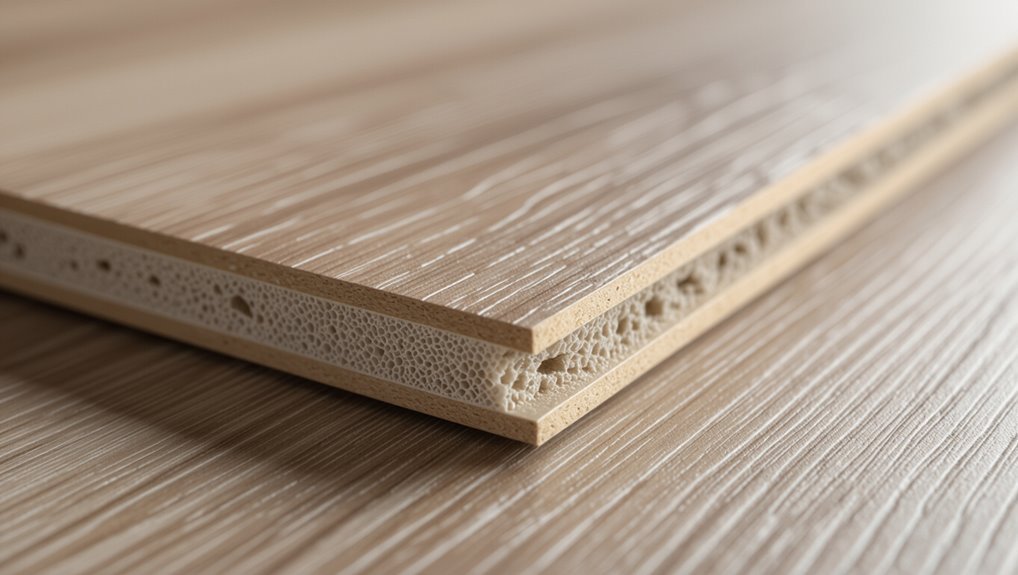
Knowing what PVC brings to the table makes it easier to see how vinyl flooring is built up from several distinct layers, each with a specific job.
You’ll find a wear layer for scratch and stain resistance, a printed design layer for appearance, a PVC core for stability and resilience, and often an attached backing for moisture control and added comfort underfoot.
Additives and fillers: plasticizers, stabilizers, pigments, and fiber reinforcements
While the rigid PVC core provides the structure, additives and fillers give vinyl flooring the practical traits you notice—flexibility, colorfastness, UV and heat resistance, and extra strength.
You’ll find plasticizers control softness, stabilizers prevent degradation, pigments deliver consistent color, and mineral or fiber reinforcements boost dimensional stability and impact resistance.
These components determine durability, feel, and long-term appearance.
Common backing and underlayment materials
Those additives and reinforcements shape the vinyl layer you walk on, but the backing and underlayment control how the floor performs beneath it.
You’ll find foam, felt, cork, fiberglass, and felt-backed PVC options. They affect cushioning, sound reduction, thermal insulation, moisture resistance, and dimensional stability.
Choose backing that matches installation type and subfloor conditions to guarantee comfort, longevity, and proper warranty coverage.
Types of Vinyl Flooring and How Composition Differs
Now you’ll look at how different vinyl products are built and why that matters for performance and cost.
You’ll see how sheet vinyl, assorted tile options, LVP cores, and grade differences change what you should choose for each space.
Use the quick list below to guide the comparison.
- Sheet vinyl: continuous flexible vinyl layers with a printed design and wear layer for residential or light commercial use.
- Vinyl tiles: includes VCT (waxed, homogeneous composition, needs maintenance) and luxury vinyl tile (layered construction with printed film and wear layer).
- Luxury vinyl plank (LVP) cores: WPC (wood-plastic composite with foam core) and SPC (rigid stone-plastic composite) each offer different stiffness and moisture resistance.
- Residential vs commercial-grade: commercial products use thicker, tougher wear layers and denser cores for higher traffic and longer life.
Sheet vinyl composition and typical construction
Sheet vinyl is a continuous, flexible flooring sheet made from layers of PVC and supporting materials that work together to deliver durability, comfort, and design.
You’ll find a wear layer (clear PVC or urethane) over a printed design layer, a flexible PVC backing and sometimes a foam or fiberglass core for stability.
Installation is usually rolled and glued or loose-laid.
Vinyl tiles (VCT and luxury vinyl tile) differences in materials
While both VCT (vinyl composition tile) and luxury vinyl tile (LVT) look like hard-surface flooring, they’re made quite differently:
VCT uses compressed vinyl and mineral fillers, creating a porous, waxed surface you maintain regularly.
LVT is multi-layered with a printed design layer and clear wear layer over a resilient PVC core, offering easier cleaning, more realistic patterns, and greater dimensional stability.
Luxury vinyl plank (LVP) core types (WPC, SPC) and their components
There are two common LVP core types you’ll see—WPC (wood-plastic composite) and SPC (stone-plastic composite)—and each builds on the same basic vinyl plank structure: a clear wear layer, a printed design layer, and a core that controls rigidity, water resistance, and underfoot feel. You’ll prefer WPC’s softer cushion or SPC’s firmer, ultra-stable core.
| Feel | Water | Strength |
|---|---|---|
| Cozy | Secure | Durable |
| Warm | Confident | Steady |
Residential vs. commercial-grade vinyl material and durability distinctions
Because your floor has to stand up to different traffic patterns and maintenance routines, manufacturers tweak vinyl formulations to meet residential versus commercial demands.
You’ll find residential vinyl uses softer, thinner wear layers and quieter cores for comfort, while commercial vinyl has thicker, denser wear layers, firmer cores, and enhanced PVC/urethane blends for abrasion, indentation, and chemical resistance—suited to heavier traffic and rigorous cleaning.
Why Composition Matters Performance and Practical Impacts
Your choice of vinyl composition directly affects how long the floor lasts, with thicker wear layers offering better scratch and abrasion resistance.
You’ll also notice differences in water performance, comfort, insulation, and sound depending on the core and backing, while the printing layer and colorfastness determine how well the floor keeps its appearance.
Finally, the material dictates installation options—some compositions suit glue-down, others click-lock or loose-lay systems—so pick one that matches your use and installation plan.
Durability and wear layer thickness correlation
When you pick a vinyl floor, the wear layer thickness and the product’s composition directly determine how long it’ll resist scratches, dents, and surface wear; thicker wear layers and harder polymer blends usually mean better performance in high-traffic areas. You should match wear layer to room use: thicker for entryways, thinner for closets.
| Feature | Recommendation |
|---|---|
| 6–8 mil | Low traffic |
| 12–20 mil | Moderate traffic |
| 20+ mil | Heavy traffic |
| Composition | Choose firmer PVC blends |
Water resistance and moisture performance by material
Although vinyl’s surface looks uniform, its composition and backing determine how well it handles water and moisture, so you should pick the right type for the room’s conditions.
Rigid cores (WPC/WPC) resist spills but can swell if seams leak; SPC offers superior dimensional stability.
Glue-down vinyl needs good subfloor preparation, while waterproof click-lock planks tolerate moisture best for kitchens and basements.
Comfort, insulation, and sound properties related to core/backing
Water resistance matters, but the same core and backing choices also shape how a floor feels, how warm it stays underfoot, and how much noise it absorbs.
Choose a cushioned vinyl or foam-backed LVT for a softer, warmer feel and improved sound dampening.
Rigid cores like SPC offer less give and transmit more impact noise, though underlayment can boost insulation and acoustic performance.
Appearance, printing layer quality, and colorfastness
Because the printed layer and surface composition determine what you actually see and how long it lasts, choosing vinyl with high-quality printing and UV-cured wear layers matters more than you might think.
You’ll get truer patterns, finer textures, and better resistance to fading, staining, and abrasion. Higher-resolution prints and robust coatings keep colors vibrant under sunlight and cleaning, reducing replacement frequency.
Installation methods affected by composition (glue-down, click-lock, loose lay)
Installation method depends largely on the vinyl’s composition: rigid core and thick backing favor click-lock, flexible vinyl sheets usually need glue-down, and heavier engineered planks suit loose-lay when they’ve enough weight and frictional backing.
You’ll choose based on subfloor, room use, and moisture. Proper selection reduces movement, gaps, and failures, and simplifies repairs or future replacement.
Health, Safety, and Environmental Considerations
When you choose vinyl flooring, pay attention to VOCs and other chemical emissions by checking for low‑emitting certifications and manufacturer test data.
Watch for legacy additives like phthalates, lead, and similar contaminants while noting that many modern formulations use safer alternatives.
Also consider fire resistance ratings and the product’s recyclability and lifecycle impacts so you can balance safety with environmental responsibility.
VOCs and chemical emissions sources and what to look for
Although vinyl offers durability and cost-effectiveness, it can also release volatile organic compounds (VOCs) and other chemicals that affect indoor air quality.
Phthalates, lead, and other contaminants historically used vs. modern formulations
Because older vinyl formulations often relied on phthalates, heavy metals like lead, and other additives to soften, stabilize, and color the material, you should know how modern manufacturers have changed ingredients to improve health and environmental profiles.
Today, many producers use phthalate-free plasticizers, stricter heavy-metal limits, recycled content, and third-party certifications, so you can choose safer, lower-emission products with documented ingredient transparency.
Fire resistance and flammability factors
If you’re choosing vinyl flooring, consider its fire performance since different formulations and surface treatments change how the material ignites, flames spread, and produces smoke and toxic gases.
You should check fire ratings, look for additives that improve resistance, and prefer products tested for smoke toxicity.
Install per code, maintain clearances, and avoid combustible subfloors or improper adhesives that can worsen fire behavior.
Recyclability and lifecycle impacts
Fire performance isn’t the only safety concern with vinyl flooring; you also need to weigh recyclability and overall lifecycle impacts.
You should consider materials, disposal, and embodied energy when choosing vinyl. Here are four practical factors to assess:
- Recyclability rates vary by product and region.
- PVC complicates circularity and recycling costs.
- Installation waste often goes to landfill.
- Life-cycle assessments reveal long-term emissions.
How to Choose Vinyl Flooring Based on Composition (Step-by-Step)
Start by identifying how you’ll use the room and how much foot traffic it will see.
Then prioritize water resistance and core type for moisture-prone areas, match the wear layer and warranty to expected wear, and check health certifications and environmental labels.
Finally, consider the installation method and whether your substrate is compatible before you buy.
Step 1 Identify room use and traffic level
Before picking a vinyl type, consider how you’ll use the room and how much foot traffic it gets, because that determines the durability and wear layer you should choose.
For high-traffic areas like hallways or kitchens, pick thicker wear layers and commercial-grade vinyl.
For bedrooms or low-traffic spaces, you can choose thinner, budget-friendly options that still offer comfort and aesthetic variety.
Step 2 Prioritize water resistance and core type for moisture-prone areas
When you’re dealing with moisture-prone rooms like bathrooms, basements, or laundry areas, prioritize vinyl types and core constructions that resist water intrusion and dimensional changes.
Choose waterproof options like SPC or WPC with tight locking systems, or fully waterproof luxury vinyl plank.
Make certain glued or loose-lay installations suit the subfloor and that seams and edges are properly sealed to prevent swelling and mold.
Step 3 Match wear layer and warranty to expected wear
Consider the wear layer and warranty as your main predictors of how long the floor will look and perform; pick thicker wear layers (20–30 mil or higher) for heavy traffic and commercial use, thinner for light residential rooms.
Match warranty terms to expected use—look for abrasion and stain coverage, prorated vs. full, and installation conditions so you’re protected where it matters most.
Step 4 Evaluate health certifications and environmental labels
As you compare vinyl options, check health certifications and environmental labels to see what they actually guarantee about indoor air quality, chemical content, and manufacturing practices.
Look for credible seals (FloorScore, GREENGUARD, Cradle to Cradle) and read scopes, limits, and testing dates.
Prioritize transparent manufacturers that publish VOC levels, phthalate disclosures, and end-of-life guidance so you can choose safer, lower-impact flooring.
Step 5 Consider installation method and substrate compatibility
Installation matters: choose a method that fits your subfloor and lifestyle, because how vinyl is attached affects performance, moisture resistance, and future repairs.
Decide between glue-down, loose-lay, click-lock, or full-spread adhesive based on moisture, traffic, and DIY skill.
Check substrate flatness and compatibility—concrete, plywood, and existing floors need specific prep—to prevent failures and simplify maintenance.
Common Mistakes When Selecting Vinyl Flooring
Don’t pick vinyl just because it’s the cheapest option — check the wear layer and core to make sure it’ll last.
You should also assess moisture and subfloor conditions, verify VOC levels and safety certifications, and avoid mixing incompatible installation methods or products.
Missing any of these can lead to premature failure, health concerns, or costly repairs.
Choosing solely on price without checking wear layer or core
Although a low sticker price can be tempting, you shouldn’t pick vinyl flooring based only on cost without checking the wear layer and core construction first.
Thin wear layers scratch and show wear quickly, and weak cores dent or warp under furniture.
Inspect wear-layer thickness, material (urethane or aluminum oxide), and core density so your inexpensive choice still performs and lasts where you plan to install it.
Ignoring moisture and subfloor conditions
If you skip checking moisture levels and the condition of your subfloor, even the best vinyl can fail quickly—cupping, adhesive breakdown, and mold are common outcomes.
You’ll want to test moisture, repair cracks, level surfaces, and install proper underlayment or vapor barriers. Ignoring these steps voids warranties and shortens lifespan, so address subfloor issues before laying vinyl to avoid costly repairs.
Overlooking VOCs and safety certifications
Addressing moisture and subfloor issues is only part of the job; you also need to take into account indoor air quality and safety.
Don’t ignore VOC emissions, certifications like FloorScore or GREENGUARD, or manufacturer test data. Low-VOC choices reduce odors and long-term health risks.
Verify labels, ask for documentation, and prefer products with independent third-party certification to protect occupants and meet building or resale requirements.
Mixing incompatible installation methods and products
When you combine different installation methods or mix products from different manufacturers, you risk installation failures, voided warranties, and expensive callbacks.
You should stick to manufacturer-recommended adhesives, underlayments, and installation systems. Mixing floating planks with glued connections, or using mismatched adhesives, alters performance and warranty coverage.
Ask suppliers for compatible components, get written approvals, and have installers follow specified methods to avoid costly fixes.
Maintenance and Longevity Tips Based on Material
How you clean and care for vinyl depends on the type—sheet, LVP, and VCT each need different routines and products.
Use preventive habits like entry mats, furniture pads, and humidity control to cut wear and avoid damage.
Know the signs for refinishing, spot repair, or full replacement based on the flooring’s composition and visible wear.
Cleaning routines by vinyl type (sheet, LVP, VCT)
Because each vinyl type wears and reacts differently, you’ll need tailored cleaning routines for sheet vinyl, LVP (luxury vinyl plank), and VCT to keep them looking good and lasting longer.
For sheet vinyl, mop with mild detergent and avoid abrasive scrubbers.
For LVP, sweep daily and use pH-neutral cleaner.
For VCT, strip and finish periodically and follow manufacturer’s neutral cleaner instructions.
Preventive habits to extend life (mats, furniture pads, humidity control)
If you want your vinyl to stay attractive and durable, adopt simple preventive habits: place absorbent mats at entries, use rugs in high-traffic zones, fit furniture with felt pads, and lift rather than drag heavy items.
Maintain indoor humidity around 30–50% to prevent warping or gaps.
Clean spills promptly and avoid harsh chemicals to preserve wear layers and seams.
When to refinish, repair, or replace based on composition
When you assess whether to refinish, repair, or replace your vinyl, consider the material beneath the wear layer: solid vinyl plank (SPC), flexible sheet, or luxury vinyl tile (LVT) each respond differently to damage and aging.
SPC handles sanding poorly; you’ll replace damaged planks.
Sheet vinyl is best patched or fully replaced if seams or backing fail.
LVT can be spot-repaired or swapped plank-by-plank.
Comparative Summary Best Vinyl Types for Common Scenarios
You’ll want different vinyl types for different rooms, so here’s a quick side-by-side to help you choose. Use the table below to match each scenario with the vinyl that balances moisture resistance, durability, and cost. Pick what fits your traffic and budget, and you’ll get the best performance.
| Scenario | Best Vinyl Type |
|---|---|
| Bathrooms and laundries | Waterproof luxury vinyl plank (LVP) |
| Kitchens and mudrooms | Rigid core vinyl (WPC/SPC) |
| High-traffic commercial spaces | Commercial-grade sheet vinyl |
| Budget-friendly residential updates | Vinyl tile or basic LVP |
Bathrooms and laundries
Moisture and heavy foot traffic make bathrooms and laundries tough on floors, so you’ll want vinyl that resists water, stands up to wear, and stays safe when wet.
Choose SPC or WPC luxury vinyl plank for dimensional stability and rigid support; opt for a high-density wear layer and textured finish for slip resistance.
Glue-down or fully waterproof click systems work best.
Kitchens and mudrooms
Since kitchens and mudrooms get heavy traffic, spills, and occasional grit from outdoors, pick vinyl that balances durability, water resistance, and easy cleaning.
Choose rigid core or high-quality luxury vinyl plank with a robust wear layer and embossed texture for slip resistance.
Look for scratch- and stain-resistant finishes, waterproof warranties, and simple maintenance—sweep often and mop with manufacturer-approved cleaners.
High-traffic commercial spaces
When a commercial space sees constant footfall and heavy equipment, pick vinyl that prioritizes extreme durability, easy maintenance, and long-term appearance retention.
Choose commercial-grade heterogeneous or solid vinyl with thick wear layers (20–28 mil+), factory-applied urethane finishes, and welded seams for hygiene.
Prioritize slip resistance, stain and chemical resistance, and easy replacement of damaged planks to minimize downtime and lifecycle costs.
Budget-friendly residential updates
If you’re updating on a budget, vinyl gives you the best mix of looks, durability, and low cost—so you can refresh kitchens, bathrooms, and living areas without breaking the bank.
Choose luxury vinyl plank for wood-like appeal and water resistance, sheet vinyl for seamless wet-room protection, and vinyl tile for DIY-friendly patterning.
Prioritize wear layer thickness and proper underlayment for lasting value.
FAQ
You’ll find answers to common concerns about safety, lifespan, installation over existing floors, SPC vs WPC cores, and recyclability.
If you’re worried about toxicity or how long a plank will last, I’ll give clear, practical answers.
I’ll also explain installation options, core differences, and whether vinyl can be recycled.
Is vinyl flooring toxic?
Though vinyl flooring’s durability and affordability make it popular, you might worry about chemicals released from some products.
Many modern vinyls meet low-VOC standards and phthalate-free formulations reduce risks, but older or cheap options can emit volatile compounds.
Choose certified low-VOC, phthalate-free, and Greenguard-rated products, guarantee proper ventilation during installation, and consult manufacturers’ safety data for peace of mind.
How long does vinyl flooring typically last?
Most vinyl flooring lasts between 10 and 25 years, depending on the type, installation quality, and how well you maintain it.
Luxury vinyl plank and tile often reach 20–25 years with proper care; cheaper sheet or low-density products wear out closer to 10–15 years.
Regular cleaning, protective pads, and avoiding sharp impacts extend lifespan and preserve appearance.
Can vinyl be installed over existing flooring?
Can you install vinyl over your existing floor? Yes—you often can, provided the surface is clean, level, dry, and firmly attached.
Remove loose tiles, fix gaps, and sand glossy finishes. Thin-set or adhesive requirements vary by vinyl type, so follow manufacturer guidelines.
Avoid installing over damp, cushioned, or badly damaged substrates to prevent failure and voided warranties.
What is the difference between SPC and WPC cores?
When you’re choosing between SPC and WPC vinyl, focus on their core makeup:
SPC (stone plastic composite) uses a rigid, mineral-filled core for extreme density and dimensional stability, while WPC (wood plastic composite) has a softer, foam-like core that provides more cushioning and warmth underfoot.
SPC is harder, better for high-traffic or heavy furniture; WPC offers quieter, more comfortable underfoot feel.
Is vinyl flooring recyclable?
Curious whether your old vinyl flooring can be recycled?
Many vinyl products, especially rigid LVT and SPC, are technically recyclable, but local facilities often won’t accept them due to mixed materials, adhesives, and contamination.
You can check with manufacturers’ take-back programs, specialized recyclers, or municipal drop-offs.
Reuse, donation, or repurposing are often more practical and environmentally beneficial alternatives.